The performance control of deep foundations is a decisive step for validating geotechnical calculation models and for ensuring the ultimate and service limit states of the structure. In Brazil, the guidelines of ABNT NBR 6122:2022 establish objective criteria for verifying the performance of piles and caissons through load tests. In the universe of static tests, technical discussion often converges to the comparison between two axial loading procedures: the conventional static load test at the pile head and the internal loading test at depth, known as the bidirectional test.
Although both procedures have the primary purpose of analyzing soil-structure interaction and the load-displacement response of the foundation element, the stress transfer mechanisms during the test execution are fundamentally distinct. While the top-down test pushes the pile from its head against an external reaction, the internal test uses an expansive hydrodynamic cell mounted in the reinforcement cage at depth, dividing the structural element into two segments that react mutually. This physical distinction requires specific analytical approaches so that the results obtained in the field can be compared and applied in foundation design.
Physical Mechanism of Top-Down Loading versus Internal Loading
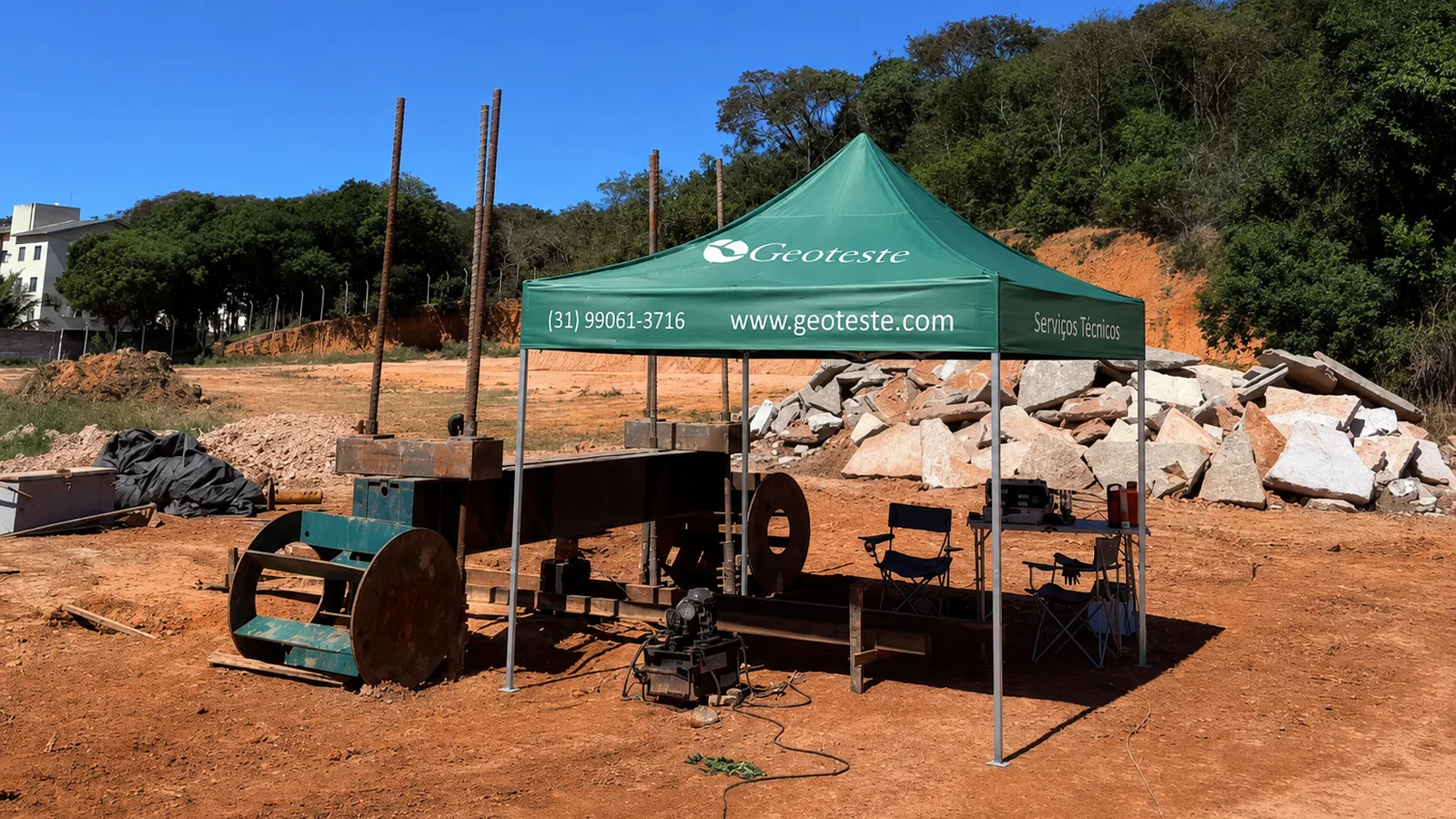
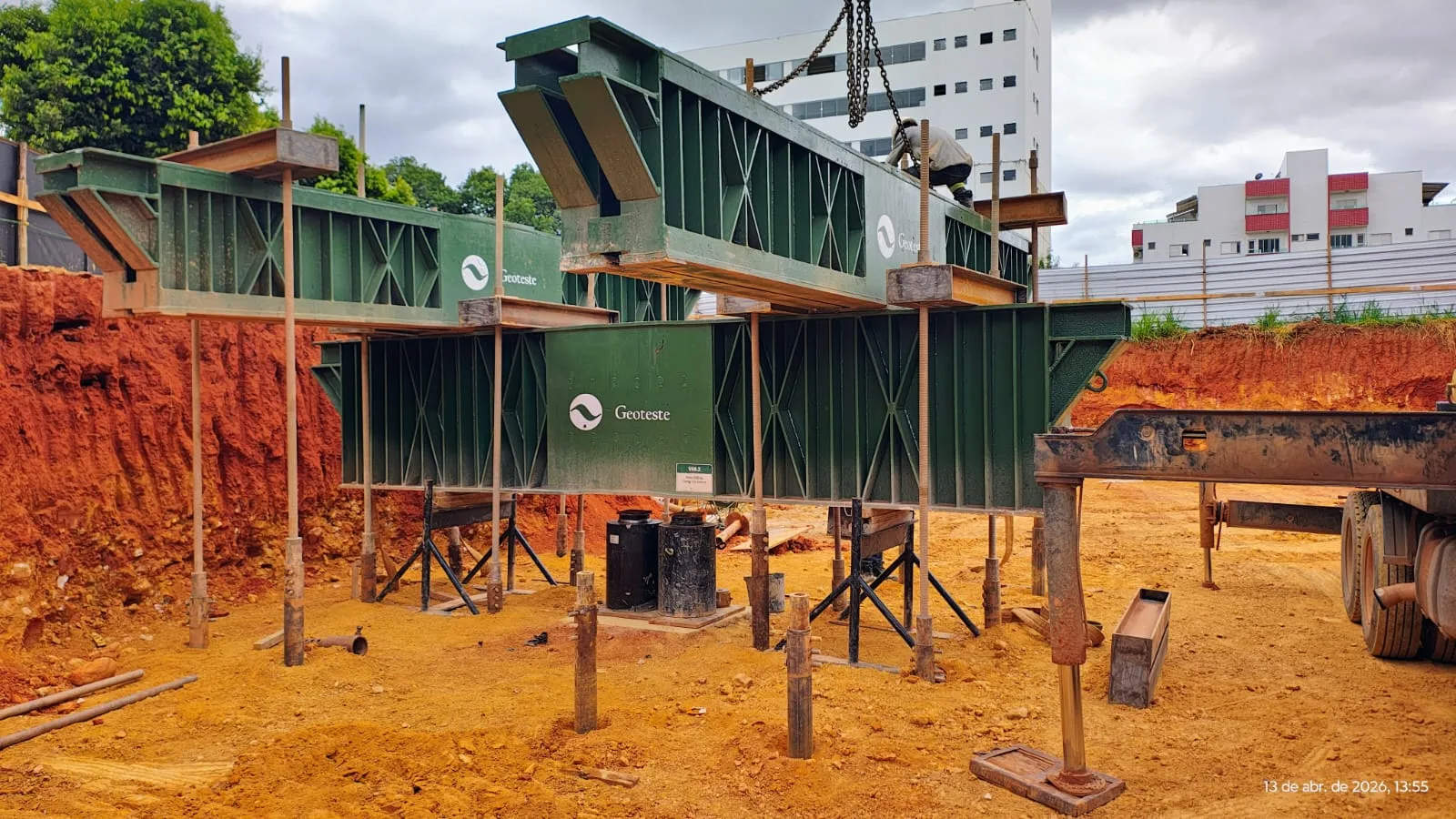
In the conventional static load test (PCE), governed in Brazil by ABNT NBR 16903:2020 and internationally by ASTM D1143/D1143M-26, the axial compression force is applied directly to the top section of the element by means of one or more hydraulic jacks. This hydraulic assembly rests against an external reaction system, consisting of metallic beams connected to anchor tie-downs in the ground, neighboring tension piles, or, in specific situations, a cargo platform with concrete blocks or metallic profiles.
Under this boundary condition, the load propagates from top to bottom along the pile shaft. As loading is increased, progressive elastic deformation of the concrete and steel occurs, generating relative displacements between the shaft and the surrounding soil mass. Lateral friction is mobilized upward against the downward movement of the pile. If the applied load is sufficient to transfer stresses to the lower end of the element, the pile toe undergoes settlement and mobilizes its base resistance. The displacement measured at the pile head reflects the sum of the elastic shortening of the entire shaft and the toe settlement.
In the bidirectional test, standardized internationally by ASTM D8169/D8169M-26, the loading is generated inside the pile body. One or more expansive hydrodynamic cells, such as the Osterberg cell or its national equivalent, are coupled to the reinforcement cage and cast at a previously determined depth in the test design. By injecting pressurized fluid into the cell, it opens vertically, pushing the upper segment of the pile upwards and the lower segment downwards.
In this arrangement, the upper segment acts as a reaction for the lower segment, and vice versa. For the pile section located above the expansive cell, lateral friction is mobilized in the downward direction, acting in shear as a tensioned pile, adding to the resistance the self-weight of the concrete in that section. For the section located below the cell, the force pushes the base against the soil or supporting rock, mobilizing the toe resistance and eventual lateral friction of the lower shaft, in the same direction as conventional compression. Therefore, the bidirectional test completely eliminates the need for external reaction beams, anchor tie-downs, or reaction piles at the surface.
Operational and Field Logistics Differences
The physical characteristics of each test directly impact the construction site, influencing mobilization costs, execution schedule, physical space requirements, and maximum achievable load capacity. The main operational contrasts observed between the conventional static load test and the bidirectional test are highlighted below:
- Physical space and interferences: The conventional PCE requires significant free area at the construction site for the assembly of large transition beams, in addition to the positioning of reaction piles at minimum distances that prevent mutual stress interference, as foreseen in ABNT NBR 16903:2020. The bidirectional test concentrates all operations within the alignment of the test pile, freeing up the construction area for equipment circulation.
- Maximum force capacity: In conventional high-tonnage load tests, above 1500 to 2000 tons-force, metallic reaction beams become gigantic elements, increasing transport costs and raising operational risk. The expansive hydrodynamic cell installed inside the pile can apply high loads without requiring a surface structure, reaching combined forces of tens of thousands of kilonewtons simply by increasing the number and size of the cells.
- Prior definition of the test element: The pile that will receive the bidirectional test needs to be selected before its drilling or concreting, since the cell must be coupled to the reinforcement cage during assembly with hydraulic and instrumentation tubing. In the conventional load test, although prior selection is technically advisable, any pile already executed can receive the bearing plate and be subjected to the test, provided there is feasibility for the reaction system to be installed.
- Preservation of the element after testing: The conventional top-down test in service conditions allows the tested pile to be subsequently integrated into the structure as a functional foundation element. In the bidirectional pile, the cell expansion creates a physical opening in its cross-section. To allow eventual reuse of the pile in the structural design, the cell chamber and surrounding voids must be rigorously filled by high-pressure cement grout injection after test completion, re-establishing concrete continuity.
Instrumentation and Measured Quantities
In both tests, instrumentation must follow rigorous criteria to ensure the reliability of the obtained data. In the conventional static load test, the displacement of the pile top is measured by four displacement transducers (dial gauges or LVDTs) fixed to independent reference beams (reference frames). The applied load is monitored by calibrated load cells associated with precision hydraulic gauges. Optionally, non-deformable steel bars supported at different elevations of the pile (tell-tales) or strain sensors using optical fiber and strain gauges can be installed to determine the shaft shortening and toe settlement.
In the bidirectional cell test, instrumentation is necessarily more complex, as measurements at the pile top provide only a fraction of the necessary information. The test requires the simultaneous recording of four fundamental quantities:
- Internal fluid pressure applied to the expansive cell, converted into axial opening force based on the hydraulic area of the pistons and calibration curves of the device.
- Upward displacement of the upper plate of the cell, measured by mechanical extensometers or transducers installed inside guide tubes fixed to the reinforcement cage.
- Downward displacement of the lower plate of the cell, also measured by reference rods that reach the bottom of the pile.
- Displacement of the pile top at the surface, monitored by transducers mounted on external reference beams, allowing the measurement of the global head movement and the elastic shortening of the upper section.
The analytical differential of the bidirectional test is that it physically separates the resistance of the upper section from the resistance of the lower section, recording independent load-displacement curves for each component during the test stages.
Construction of the Equivalent Load-Settlement Curve
The raw result of a bidirectional load test does not represent the response of a pile subjected to top-down loading. The cell simultaneously provides two distinct curves: the load versus uplift curve for the upper section and the load versus downward settlement curve for the lower section. To transform these data into the equivalent top-down load versus settlement curve, applicable to structural design according to ABNT NBR 6122:2022 limits, it is mandatory to perform an analytical interpretation based on the elasto-geotechnical behavior of the element.
The conversion requires kinematic compatibility of the two sections under the assumption that, in a real top-down loading, both move downwards together. When analyzing the upper section, which is loaded upwards in the bidirectional test, lateral friction is mobilized with self-weight relief, whereas in conventional loading, the pile's weight acts in favor of compression. Additionally, in a pile loaded at the head, the shaft undergoes progressive elastic shortening along its entire length, while in the bidirectional test, elastic downward compression affects only the lower part, and the upper part experiences tension.
The elaboration of the equivalent curve involves the adoption of theoretical and empirical hypotheses established in technical literature, depending on the stratigraphic profile and the stiffness of the structural element.
Silva and Osterberg Method
The classical method proposed by Silva and Osterberg is based on the simplifying hypothesis that the lateral friction mobilized in the upper section in the upward direction has analogous modulus and ultimate value to those that would be developed in the downward direction, with the exception of the correction due to the element's self-weight. For each adopted displacement value, the load mobilized by the upper section (corrected for self-weight) and the load of the lower section are summed. The total load at the top is associated with this common displacement, to which is added the additional elastic shortening that the shaft would experience if the entire load were transmitting from the pile head.
Massad's Analytical Approach
Studies developed at the University of São Paulo (USP), led by Professor Faiçal Massad, deepened the interpretation of the bidirectional test, demonstrating that the simplified sum of displacements can lead to distortions in the initial stiffness of the equivalent curve, especially in long piles or shafts in stratified soils. Massad's analytical methodology employs differential load transfer formulations, incorporating hyperbolic or elastoplastic functions to describe the mobilization of local lateral friction (t-z curves) and base response (q-z curve).
The model allows for a more precise decoupling of the effect of residual lateral friction, the compressibility of concrete under real compression stress gradients, and the influence of the water table level on effective stresses along the shaft. The application of Massad's method provides a more realistic reconstruction of pile flexibility, avoiding overestimates of foundation stiffness under working loads.
Contributions of Falconi, Maset, and Cruz in SEFE Debates
At the Seminars on Special Foundation Engineering (SEFE), researchers and designers like Falconi, Maset, and Cruz presented analytical and comparative field studies confronting conventional top-down load tests with bidirectional tests performed on identical piles in Brazilian projects. These studies highlighted essential aspects for the calibration of the equivalent curve:
- Positioning of the expansive cell: The installation elevation of the cell should coincide with the estimated force equilibrium point, where the friction capacity of the upper section equals the sum of friction and toe resistance of the lower section. If the cell is positioned too far above or below this neutral plane, one of the sections will reach geotechnical failure prematurely, limiting the maximum mobilization of the other segment and requiring the use of mathematical extrapolation methods (such as Van der Veen or Chin-Kondner) to construct the equivalent curve.
- Friction differences in sandy and clayey soils: Maset and Cruz's research showed that in soils with strong dependence on the effective vertical stress state (granular soils), upward mobilized lateral friction may differ subtly from that mobilized downward due to changes in the coefficient of earth pressure at rest and the mechanisms of dilation or compressibility at the concrete-soil interface.
- Modulus of elasticity of concrete: The precise determination of the elastic modulus of reinforced concrete over time is a critical factor in Falconi's formulation and Maset's studies. Small variations adopted for the elastic modulus significantly alter the corrected elastic shortening portion in the equivalent curve, potentially leading to perceptible deviations in the estimated final settlement for the design load.
Technical Comparative Table Between Methodologies
The following table summarizes the primary distinctions between the conventional static load test and the bidirectional test, organized by the most relevant practical and theoretical aspects:
| Evaluation Aspect | Conventional Load Test (PCE) | Bidirectional Load Test (PCB) |
|---|---|---|
| Main test standard | ABNT NBR 16903:2020 / ASTM D1143 | ASTM D8169/D8169M-26 |
| Force application location | Pile head at surface | Inside the shaft via expansive cell |
| Required reaction system | Metallic beams, tie-downs or cargo platform | Self-reaction between pile segments |
| Occupied area on site | Large area for system assembly | Restricted to the perimeter of the tested element |
| Directly measured quantities | Top load and total head settlement | Cell load, upper and lower displacement |
| Separation of friction and toe resistance | Depends on additional instrumentation along the shaft | Physically obtained from the cell position |
| Equivalent top load-settlement curve | Directly provided by test data | Constructed by analytical interpretation methods |
| Reuse as a working pile | Direct, provided the test is interrupted at the test load | Requires subsequent injection of cement grout into the cell chamber |
Criteria for Selecting the Load Test Method
The decision between performing a conventional or bidirectional load test should be guided by the design engineer and geotechnical consultant based on project conditions. The conventional top-down load test remains the direct reference method for proving the acceptance criteria provided in ABNT NBR 6122:2022, as it reflects exactly the physical condition to which the foundation will be subjected during the building's lifespan, being the ideal option for small to medium capacity piles and sites that can accommodate the reaction system.
On the other hand, the bidirectional test establishes decisive technical and financial advantages for large-diameter deep foundations (such as bored piles, barrettes, and caissons in bridges, viaducts, ports, and high-rise buildings), where test loads exceed the feasibility of conventional reaction beam assembly. Furthermore, when the objective of the investigation is to improve the design model through explicit decoupling between the ultimate lateral friction stress and the toe bearing capacity, the bidirectional test provides valuable geotechnical control data for the calibration of daring structural designs.
Technical Validation and Consulting in Foundation Testing with Geoteste
The correct characterization of pile behavior under static loading demands rigorous planning, unrestricted compliance with technical standards, and methodological expertise in interpreting field results. Geoteste operates in all stages of quality control and performance of deep foundations, conducting axial static compression and tension load tests according to the specifications of ABNT NBR 16903:2020 and the precepts of ABNT NBR 6122:2022, in addition to tests with instrumentation at depth, dynamic load tests according to ABNT NBR 13208, and bidirectional load tests.
Our technical team supports designers, foundations, and construction companies from the conception of the test plan, definition of instrumentation by extensometry and calibrated load cells, to the construction and analysis of equivalent load-settlement curves using established interpretation methods from Brazilian geotechnical literature. Contact Geoteste's specialists to structure your project's static testing program with technical precision and engineering safety.