The Static Load Test (SLT) is the most traditional and conclusive field test for determining the load versus displacement behavior of deep foundation elements. Regulated in Brazil by ABNT NBR 16903:2020, which replaced the former NBR 12131, and required for specific control and performance criteria by ABNT NBR 6122:2019 with Amendment 1:2022, the load test provides direct data on the response of the structural element and the soil mass under static axial or lateral loading.
Despite its high degree of theoretical reliability, the precision and legal and technical validity of the results do not depend exclusively on the progressive application of hydraulic force. In foundation engineering practice, most problems that invalidate the test or lead to erroneous interpretations occur even before the first pressure stage in the hydraulic jack. Geometric planning, preliminary characterization, and physical instrumentation determine the quality of the obtained record.
Below, five critical errors made in the preparatory phase are detailed, which can ruin a testing campaign, generate high costs of additional mobilization, and compromise the safety of the final structure.
1. Inadequate selection of the test pile
The choice of the element to be tested cannot be arbitrary or based solely on ease of access at the construction site. ABNT NBR 6122:2019 with Amendment 1:2022 establishes clear guidelines on the performance of foundations and the representativeness of the test elements in relation to the entire work.
The common error lies in choosing a pile with executive characteristics that deviate from the rest of the project, such as differences in toe elevation, variations in effective diameter, changes in concrete consumption and strength, or a curing time incompatible with the test date. Furthermore, the test pile must represent the predominant geological, geotechnical conditions or the most critical sectors of the terrain identified in the preliminary investigation.
When the test is performed on a pile executed outside the standard parameters of the work, the settlement and mobilized load capacity data cannot be extrapolated to other elements with technical certainty. Extrapolation without physical and executive support mischaracterizes the load test as a calibration instrument for the foundation design.
2. Insufficient geotechnical characterization around the test site
Performing a static load test without recent geological, geotechnical investigation adjacent to the tested element compromises the physical interpretation of the results. ABNT NBR 16903:2020 lists, among the mandatory preliminary requirements, the existence of a representative stratigraphic profile at the tested pile location, including the groundwater table position.
The lack of stratigraphic data generates the following interpretation problems:
- Inability to correlate end bearing resistance and side friction with the competent and deformable soil layers.
- Lack of knowledge of compressible layers beneath the pile toe elevation, which can mask long, term settlements not detectable within the conventional test duration.
- Difficulty in evaluating temporal phenomena, such as consolidation or eventual pore, pressure variations in saturated soil during setup and loading.
- Uncertainty in sizing the length of anchors or reaction piles for the auxiliary system.
Without detailed subsurface characterization, the load versus displacement curve becomes a purely numerical data, devoid of the fundamental mechanical context for validating the project's geotechnical assumptions.
3. Inadequate sizing and arrangement of the reaction system
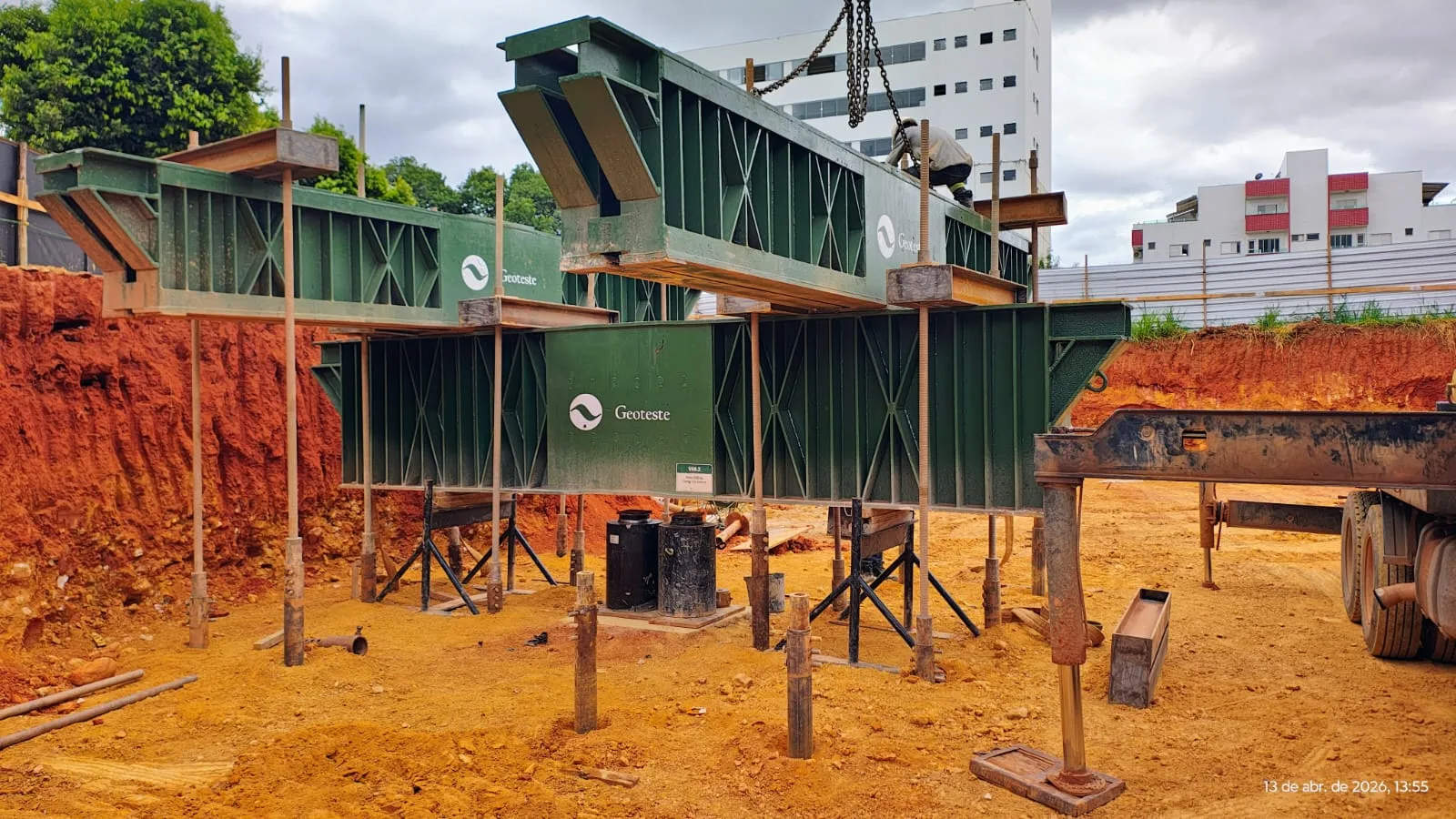
The reaction system is the structure responsible for absorbing the force applied by the hydraulic actuator on the test pile. This system can be composed of tension piles, ground anchors executed according to ABNT NBR 5629:2018, or caissons with self, weight (reaction by kentledge). Failures in the arrangement and stiffness of this system are frequent sources of errors in static load tests.
The main geometric mistake is disregarding the minimum distance between the tested pile and the reaction points. ABNT NBR 16903:2020 defines that the reaction supports or tension elements must be positioned at a sufficient clear distance to avoid inducing spurious stresses in the shaft or at the toe of the test pile. If the anchors or reaction piles are too close, the tension or compression stress bulb of the reaction directly interferes with the deformation zone of the test pile, artificially altering the mobilized side friction values and vertical displacements.
Another problem lies in the excessive flexibility of the reaction beams. If the metal assembly does not have an adequate moment of inertia to withstand the maximum predicted load with controlled deformation, continuous losses of hydraulic pressure, piston misalignment, and severe risks to the overall stability of the assembly on site occur.
4. Unstable reference system exposed to thermal disturbances
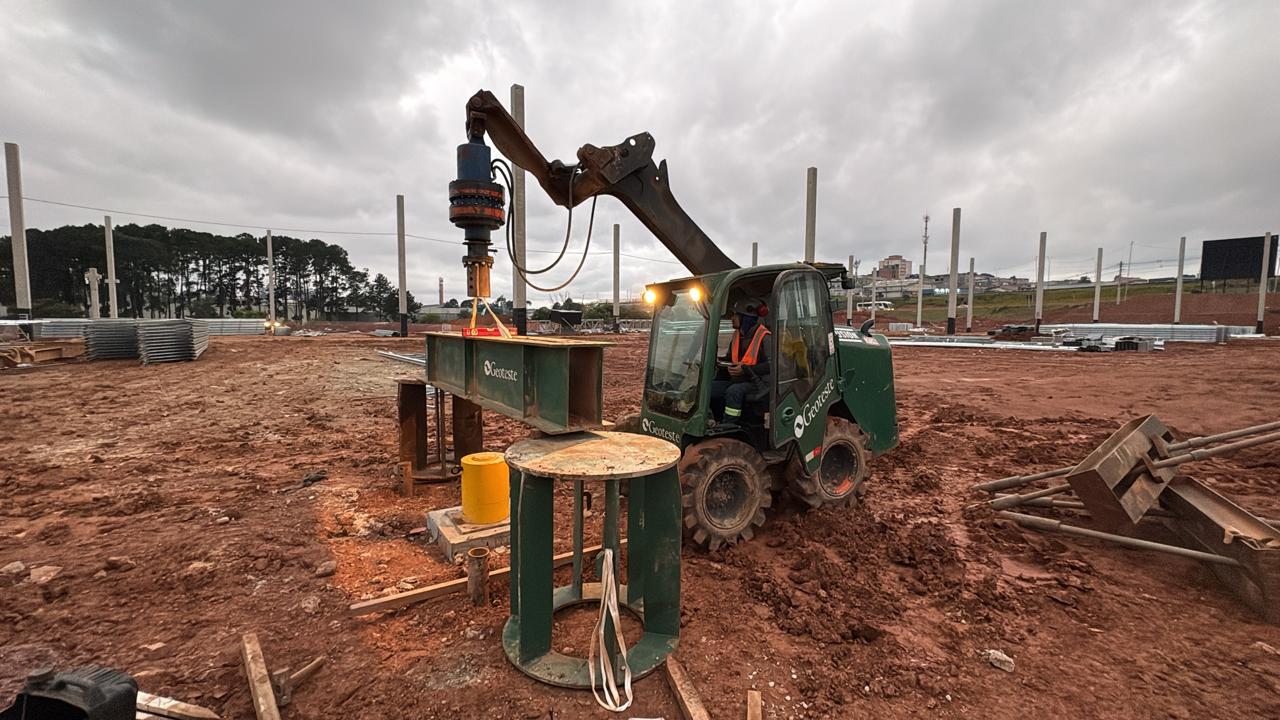
The precise measurement of pile head settlements depends on a reference line absolutely neutral to external movements. The reference beam, responsible for supporting the dial gauges or deflectometers, must remain unchanged throughout the test execution.
Inadequate setup of the reference system involves serious failures:
- Support of the reference beams within the influence radius of the reaction system or the test pile head, causing the reference to move along with the adjacent soil, falsifying settlement readings to values lower than actual.
- Insufficient beam extensions, disregarding the minimum normative clearance required by ABNT NBR 16903:2020 in relation to surrounding foundation elements and reactions.
- Lack of protection against weather conditions, such as direct solar incidence and ambient temperature variations. Thermal expansion of the metallic reference beams causes vertical arching that is read by deflectometers as pile deformations.
- Precarious fixing of support bases, allowing mechanical vibrations resulting from excessive wind, traffic of machinery on site, or movements of operating personnel.
5. Improper, misaligned, or uncalibrated instrumentation
The force and displacement measurement instrumentation is the heart of the load test. The use of equipment without updated calibration or mounted outside mechanical tolerances technically invalidates the campaign before the initial stage.
Regarding force, ABNT NBR 16903:2020 requires that the load application system be calibrated as a unit (hydraulic actuator, pump, hoses, and pressure gauge) or that a load cell calibrated in a laboratory accredited by the Brazilian Calibration Network (RBC) be used. The use of uncalibrated analog pressure gauges, with inadequate scales, or outdated calibration curves, introduces unacceptable errors in determining the loads for each stage.
In displacement monitoring, the positioning of deflectometers is vital. The standard requires the use of at least four instruments positioned on orthogonal axes, with a minimum resolution of 0.01 mm, to detect any tendency for rotation or differential settlement of the pile head. If the load applied by the hydraulic cylinder is not rigorously centered on the axial axis of the pile, eccentric loading occurs with spurious bending moment, causing asymmetric responses in the instruments and distorting the load versus displacement curve.
Pre, test control requirements according to ABNT NBR 16903:2020
To ensure that the test meets technical and normative requirements, the following items must be included in the assembly checklist before any pressure increment:
| Item checked | Normative technical criterion | Impact of non, compliance |
|---|---|---|
| Calibration certificates | Periodic RBC validity for load cell and pressure gauges | Uncertainty in the magnitude of applied forces and risk of legal invalidation |
| Reaction clearance | Clearance distance calculated according to pile geometry | Stress interference between reaction and tested element |
| Reference clearance | Minimum clear distance in relation to the pile and reaction supports | Displacement of the neutral reference and incorrect recording of settlements |
| Jack centralization | Perfect alignment between load center and pile axis | Application of bending moments and undesirable bending in the shaft |
| Orthogonal deflectometers | Minimum of four sensors for axial settlement control | Inability to assess head rotation and loss of reliability |
The importance of methodological rigor in foundation testing
The static load test does not allow for operational improvisation in the field. When mechanical assembly procedures, boundary distances, and the precision of reading systems are neglected, the financial investment and the project schedule suffer severe impacts. The technical report generated under improper conditions results in erroneous parameters for structural engineering, increasing the risks of unacceptable in, service performance or generating unnecessary overdesign due to lack of data reliability.
Correct compliance with ABNT NBR 16903:2020 and the control guidelines of ABNT NBR 6122:2019 with Amendment 1:2022 ensures that the test fulfills its main objective: to attest to load versus settlement behavior with scientific backing and proven metrological precision.
Specialized technical execution with Geoteste
Geoteste operates with full methodological rigor in the execution and interpretation of axial static compression and tension load tests (SLT), in addition to load tests with bidirectional expansive cells and dynamic tests regulated by ABNT NBR 13208:2007. Our engineering team analyzes the preliminary geotechnical characterization, designs the reaction system, and inspects every geometric and operational detail of the assembly on site, ensuring strict compliance with the requirements of ABNT NBR 16903:2020 and ABNT NBR 6122:2019 with Amendment 1:2022.
With electronic instrumentation calibrated by RBC, including digital deflectometers, high, precision load cells, and continuous data acquisition, we eliminate external disturbance sources even before the start of loading. To plan your campaign of load tests or field tests with full normative compliance and technical excellence, contact the specialists at Geoteste.