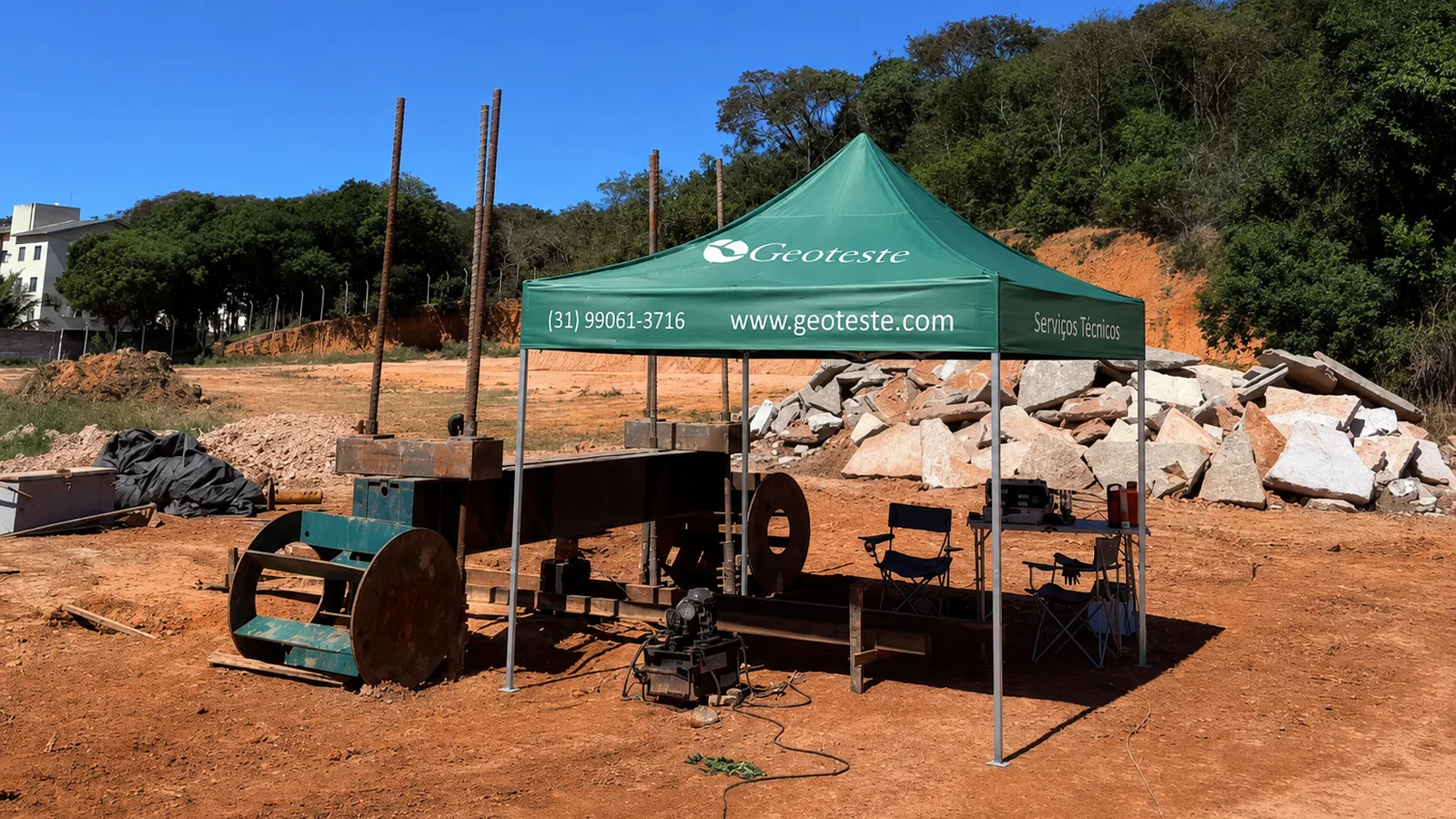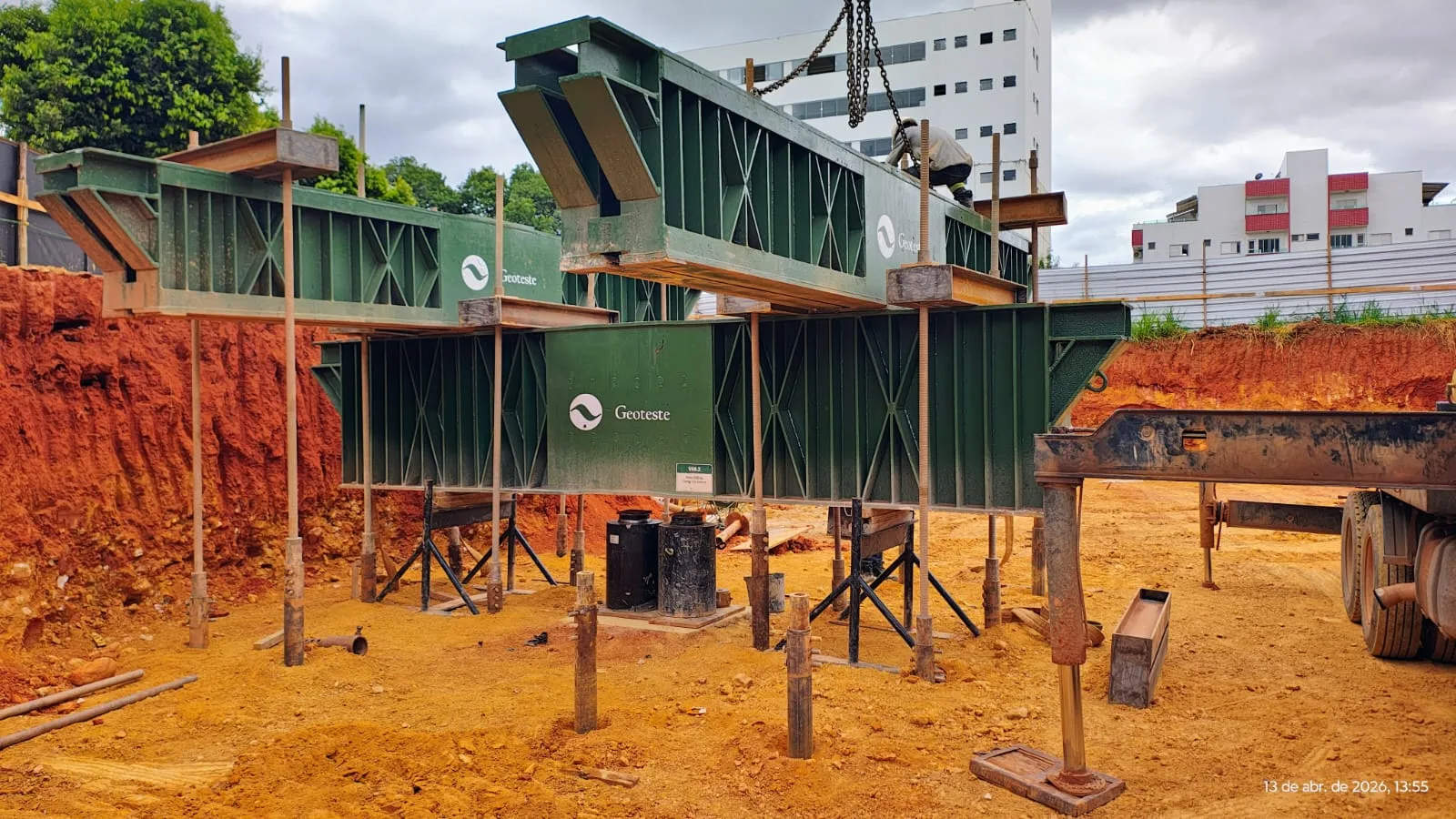
The investigation stage for bearing capacity and quality control is a determining pillar for the safety and economic viability of any civil engineering project.
In this context, geotechnical tests applied to foundations act as instruments to validate the performance of structural elements in situ.
More than a simple check, these tests allow for comparing the premises established during the design phase with the actual response of the foundation-soil system, ensuring strict compliance with project specifications.
These verifications provide precise parameters on the bearing capacity and deformational behavior of piles when subjected to service loads.
The interpretation of these data is fundamental to mitigate risks of excessive settlements or structural failures.
According to the nature of the solicitation and the objectives of the analysis, evaluation methods are divided into two main categories: static tests and dynamic tests.
Static tests determine the bearing capacity of foundations through the application of known loads in increasing manner and at equal time stages.
Simultaneously, the team records the corresponding displacements, which are monitored until the programmed maximum load is reached. Unloading is then performed.
Dynamic tests aim to verify the behavior of the interaction between the foundation element and the soil through the application of an impact force at the pile top, allowing for the evaluation of bearing capacity and pile integrity.
1- Static Tests
Static Load Test (SLT)
The Static Load Test (SLT) has consolidated itself as the most reliable method for determining the bearing capacity and stress-strain behavior of a foundation. Its central objective is to establish the correlation between the applied load and the vertical displacement (settlement) of the element, allowing for the construction of the load-settlement curve.The test is performed by applying known and increasing loads on the pile top. The force is generated by hydraulic jacks and absorbed by a reaction system which can be made through tie-downs in nearby elements, or by a helical reaction system.
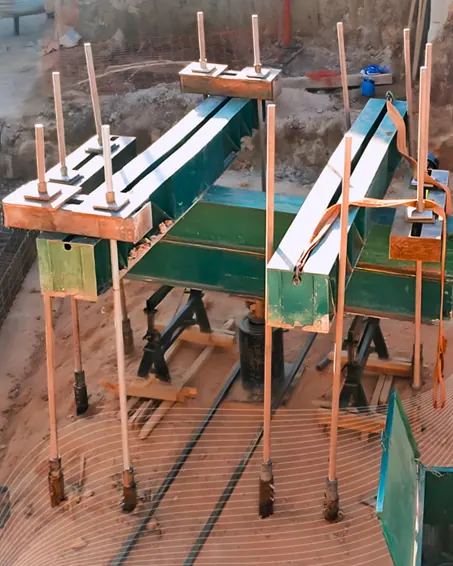
Figure 1, Execution of the SLT test
The team applies the load in stages, with time intervals defined by standard NBR 16903/2020.
The team monitors these intervals until the programmed maximum load is reached, which typically corresponds to twice the design working load, or until the characterization of geotechnical failure and loss of the element's skin friction.
Simultaneously, the team records the displacements (settlements). Then, the pile is unloaded.
The main product of the SLT is the load versus displacement graph, an analytical tool where the curve is constructed by plotting the stabilized points at the end of each stage.
The analysis of this curve plays a fundamental role, as it allows for determining the ultimate bearing capacity and predicting how the structure will behave under actual service loads.
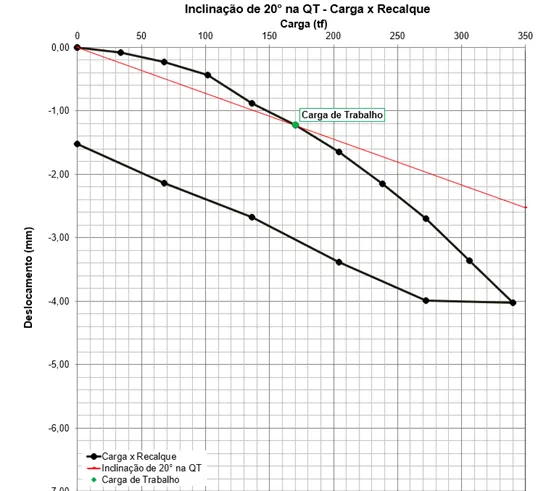
Figure 2, Load x Displacement Graph
This graph represents the response of the foundation and soil to loading. The descending curve serves as a parameter for visualizing and understanding the results, facilitating comparison between different results. The upper curve represents loading, and the lower curve, unloading.
Plate Load Test (Static Load Test on Plate)
The plate load test is conducted when there is an interest in defining the superficial bearing capacity of the soil, the coefficient of vertical subgrade reaction, and the estimation of settlements for shallow foundations.
In this methodology, a static load is applied to a rigid steel plate, usually with diameters of 30 cm, 45 cm, or 80 cm, or equivalent square shapes, positioned directly on the soil to be investigated.
Loading occurs through hydraulic jacks. To enable the application of force, a robust reaction structure is necessary, typically using the operational weight of heavy machinery, such as hydraulic excavators, backhoes, or loaded trucks, provided that the mass of this equipment significantly exceeds the maximum load to be achieved in the test, to prevent system uplift.
The main result consists of the graph showing the relationship between applied load and vertical displacement of the plate, expressed by means of the load versus displacement curve, analogous to the Static Load Test (SLT).
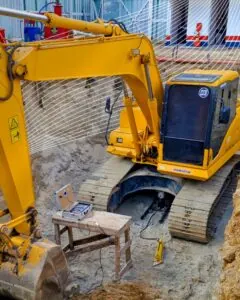
Figure 3, Execution of a Plate Load Test
2- Dynamic Tests
Pile Integrity Test (PIT), Low Strain
The PIT (Pile Integrity Test) is intended for verifying the structural integrity of piles and consists of a non-destructive test.
Being a quick, practical, and easy-to-perform method, the PIT allows for the evaluation of many piles in a short period, providing an advantage for verifying integrity when compared to more complex dynamic tests.
Figure 4, Execution of a PIT test
The test consists of applying a low-energy blow to the pile top, usually with the aid of a hand hammer.
An accelerometer is fixed to the pile head to record the propagation of the stress wave generated by the impact.
As the wave propagates along the shaft, reflections occur whenever there are variations in the pile's geometric or mechanical properties, such as changes in cross-section or material defects.
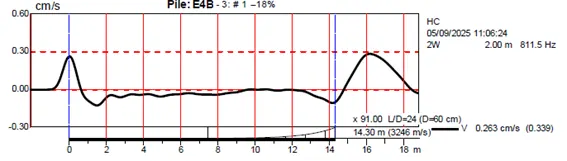
Figure 5, PIT test results
The test result is presented in the form of a velocity versus depth graph, whose interpretation allows for identifying possible anomalies.
Positive reflections indicate reductions in cross-section, and negative reflections are associated with increases in cross-section, which do not always represent structural problems.
Although the PIT does not directly provide the pile's bearing capacity, it is consolidated as a widely used tool for quality control and mass integrity verification.
Pile Driving Analyzer (PDA)
The PDA (Pile Driving Analyzer) is the dynamic test whose central objective is the evaluation of the pile's bearing capacity and integrity.
This procedure functions as a tool for verifying the structural element's performance, allowing for diagnosing whether the pile maintains its physical continuity and has the necessary resistance as per the design.
The PDA is performed by applying a cycle of successive blows to the pile head, generating an impact force that allows for measuring the interaction between the foundation element and the soil. These blows are stopped when block failure occurs or when twice the element's load value is reached.
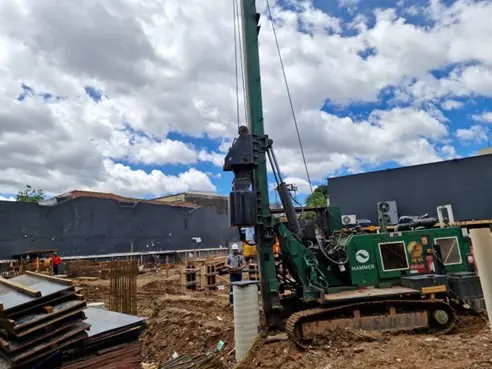
Figure 6, Execution of Dynamic Load Tests
During the test execution, strain gauges and accelerometers are fixed to the pile to record the force and velocity values associated with the propagation of stress waves.
From these records, information such as the total length and embedded length of the pile, penetration resistance during the test, compression force and displacement values, as well as dynamic material properties like modulus of elasticity, density, and wave propagation velocity, are obtained.
The data interpretation occurs based on Wave Analysis Theory, using the numerical method CAPWAP (Case Pile Wave Analysis Program).
This analysis allows for estimating the equivalent static bearing capacity of the pile, in addition to decomposing the total resistance into end-bearing and skin friction components.
Furthermore, wave analysis provides data for verifying the structural integrity of the pile along its length.
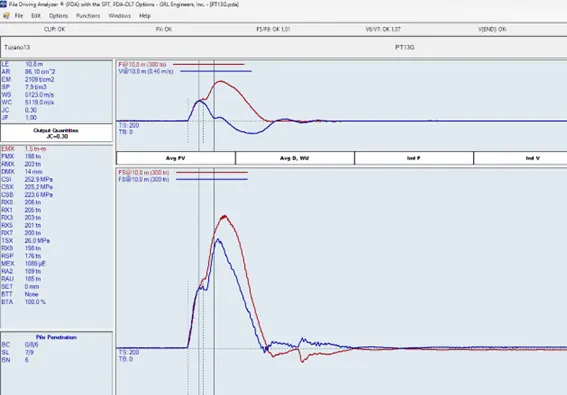
Figure 7, PDA test results
Geotechnical Tests
The geotechnical tests applied to foundations play a fundamental role in verifying structural performance and reducing risks associated with soil and pile behavior.
The application of static and dynamic tests makes it possible to evaluate the bearing capacity, structural integrity, and settlement behavior of foundation systems, providing technical subsidies for both project validation and execution quality control.
While static tests, such as the Static Load Test and the Plate Load Test, provide a direct representation of the load-displacement relationship, allowing for the analysis of the foundation's deformational behavior, dynamic tests, such as PIT and PDA, enable the verification of pile integrity and, in the case of PDA, also estimate bearing capacity.
Thus, the appropriate choice of methodology, combined with the correct interpretation of results, contributes decisively to ensuring the safety, performance, and durability of engineering works.
References:
Brazilian Association of Technical Standards (ABNT). ABNT NBR 6122:2019, Design and execution of foundations. Rio de Janeiro: ABNT. (Brazilian Standard).
Brazilian Association of Technical Standards (ABNT). ABNT NBR 13208:2007, Piles, Dynamic loading tests. Rio de Janeiro: ABNT. (Brazilian Standard).
Brazilian Association of Technical Standards (ABNT). ABNT NBR 6489:2019, Soil, Direct load test on foundation ground, Procedure. Rio de Janeiro: ABNT. (Brazilian Standard).
Brazilian Association of Technical Standards (ABNT). ABNT NBR 16903:2020, Soil, Static load test on deep foundation. Rio de Janeiro: ABNT. (Brazilian Standard).
CINTRA, J. C. A.; AOKI, N.; TSUCHIYA, T.; GIACHETI, H. L. Static and dynamic foundation tests. São Paulo: Oficina de Textos, 2013.