The Hammer GT20 impact system in PDA tests
The Hammer GT20 impact system is an innovative equipment developed by Geoteste for performing PDA tests, offering safety, productivity, and reliability in the evaluation of deep foundations.
The quality control of deep foundations, including the application of PDA tests with impact systems like the Hammer GT20, is an essential step for structural safety and project viability.
For medium and large-scale projects, especially those with high loads or heterogeneous soils, it is imperative to adopt reliable methods for verifying the performance of piles.
In this context, load tests play a prominent role.
Thus, these tests allow validating design assumptions and evaluating the actual behavior of foundations in situ.
Dynamic Load Test
Among the available methods, the Dynamic Load Test (PDA, Pile Driving Analyzer) stands out as a modern, efficient, and widely used solution, capable of providing relevant information about the bearing capacity, load transfer mechanisms to the soil, and structural integrity of piles.
The reliability of the PDA test, however, is directly associated with the quality of the impact system used, as well as the safety and repeatability of the execution procedure.
From this perspective, and aligned with technological innovation, Geoteste developed the Hammer GT20 Impact System.
The system constitutes an unprecedented solution in the national market, designed to elevate the levels of safety, productivity, and reliability in the execution of PDA tests.
Therefore, the Hammer GT20 represents a significant advance compared to traditional methods of impact application.
The equipment integrates established concepts of foundation engineering with a modern, automated, and highly safe design.
1. Dynamic Load Tests (PDA): Concepts and Objectives
The Dynamic Load Test is a standardized test in Brazil by ABNT NBR 13208:2007, Piles, Dynamic Load Test.
The test is widely used to evaluate the performance of deep foundations.
It applies to precast piles, steel piles, cast-in-place piles, and bored piles with different execution methods.
The principle of the test is based on the application of controlled impacts at the pile head, generating stress waves that propagate along the shaft to the tip. Thus, the analysis of the dynamic response of the pile, obtained through acceleration and strain sensors installed at specific sections of the shaft, allows the determination of fundamental parameters of the soil-pile system.
Objectives of the PDA test with Hammer GT20
Among the main objectives of the PDA test, the following stand out:
- Estimation of the mobilized ultimate bearing capacity of the pile,
- Evaluation of the resistance distribution along the shaft, distinguishing between side friction and tip resistance components,
- Verification of the effective pile length,
- Identification of possible structural anomalies, such as necking, cracks, or section variations,
- Determination of the safety factor concerning the working load adopted in the design.
For the execution of the test, a PDA equipment (computational unit), acceleration sensors (accelerometers), and strain sensors (strain gauges) are required, duly calibrated and installed on the pile shaft. The test applies impacts on a protection block positioned at the pile head, responsible for uniformly distributing the stresses and preserving the structural integrity of the tested element.
Therefore, the blows must present progressively increasing energy levels, with the test normally conducted until at least twice the pile's working load is reached or until the impact block ruptures. The processing of the recorded signals occurs later through specific software, based on wave propagation theory, which enables the interpretation of the results.
2-Conventional Impact Systems for PDA Tests
Historically, the execution of PDA tests uses different impact systems, selected based on equipment availability, site conditions, and pile characteristics. Among the most common methods, the following stand out:
- Hydraulic hammers coupled to cranes,
- Steel towers with free-fall hammers,
- Pile driving equipment adapted for impact application.
Although functional, these systems present significant limitations, especially regarding operational safety, assembly logistics, productivity, and data reliability.
The need for lifting heavy loads and working at height significantly increases operational risks.
The dependence on cranes or knuckle boom cranes increases the complexity of equipment mobilization and demobilization.
These factors contribute to increased costs associated with test execution.
Furthermore, the variability in impact energy application and difficulties in aligning the hammer with the pile axis can compromise the quality of the obtained data, requiring greater rigor in execution control.
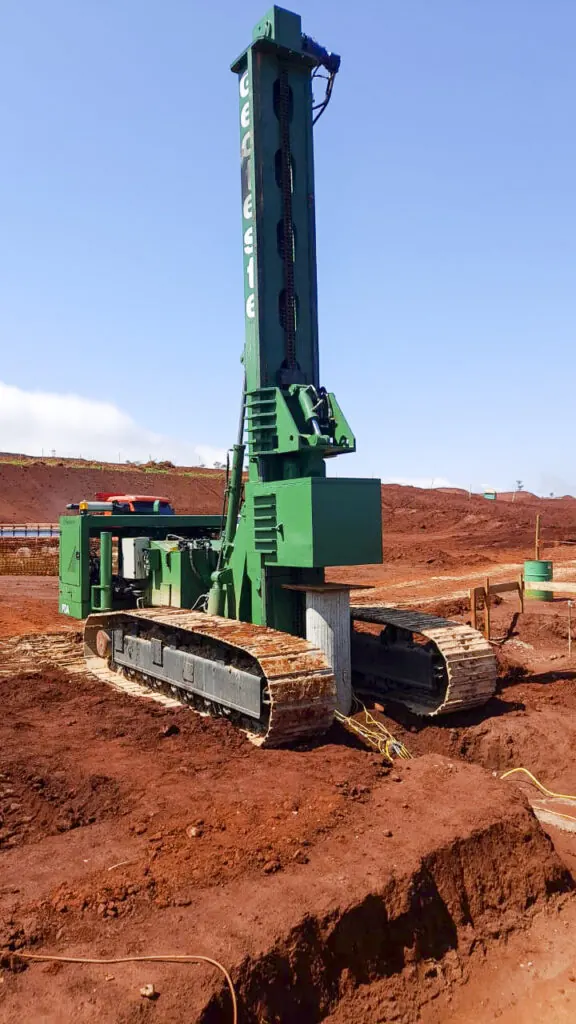
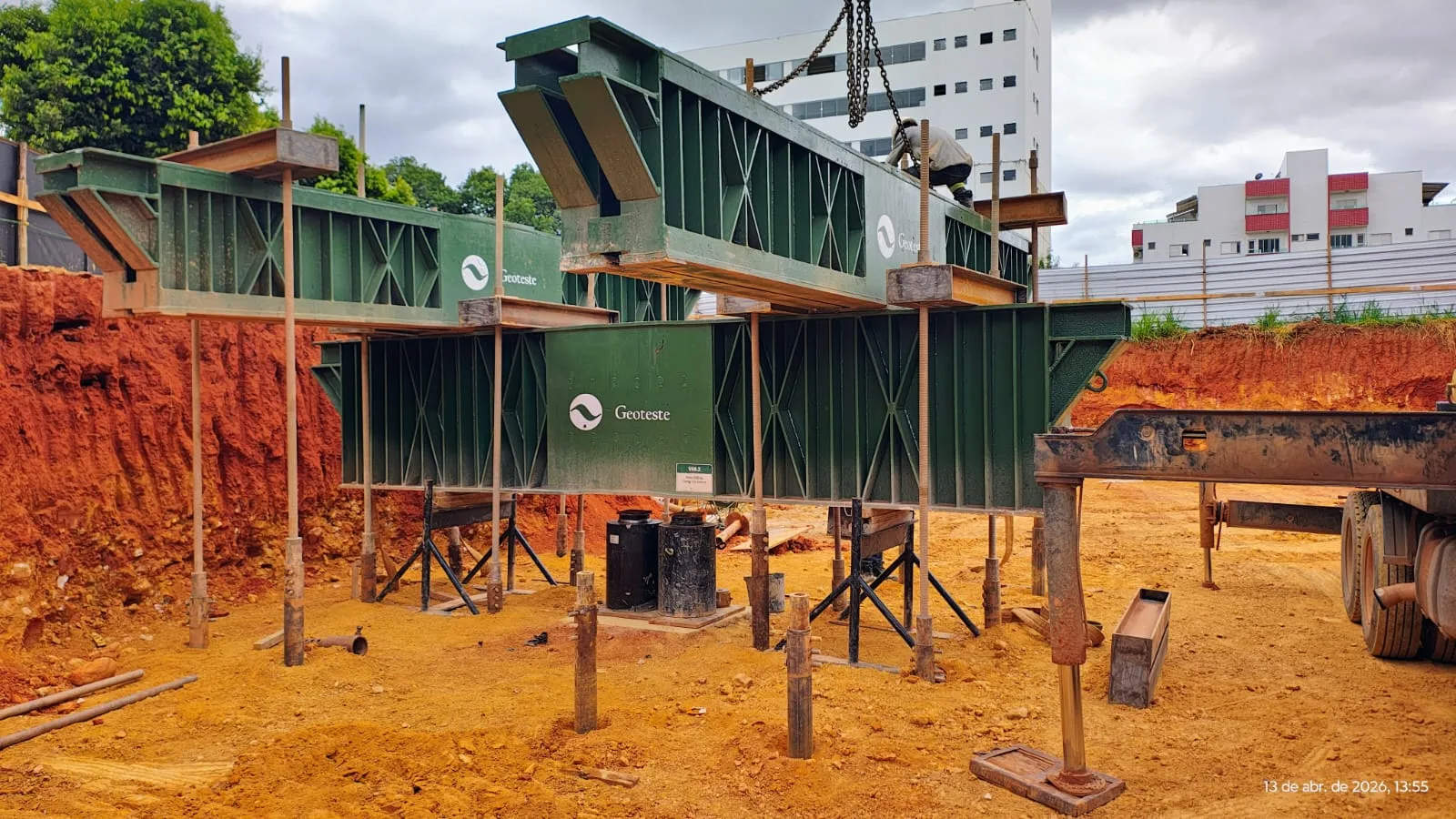
Figure 1 - Geoteste's Hammer performing PDA test on a pile
Design of the Hammer GT20
In the PDA test execution process, impact systems must simultaneously meet operational safety, cost, and productivity requirements.
These requirements vary depending on different site conditions.
Among the traditionally used methods, hydraulic hammers, towers with free-fall hammers, and pile driving equipment stand out.
Each of these systems has its own characteristics and specific applications.
The choice of system depends on the specificities of each project.
However, the continuous need for innovation in the foundation sector has driven the development of more efficient, productive, and safer solutions.
In this context, the Hammer GT20 was developed.
The Hammer GT20 uses the structure of a Mini Continuous Flight Auger machine and replaces the auger with a directed hammer system.
This system ensures alignment with the pile axis and precise impact control during test execution.
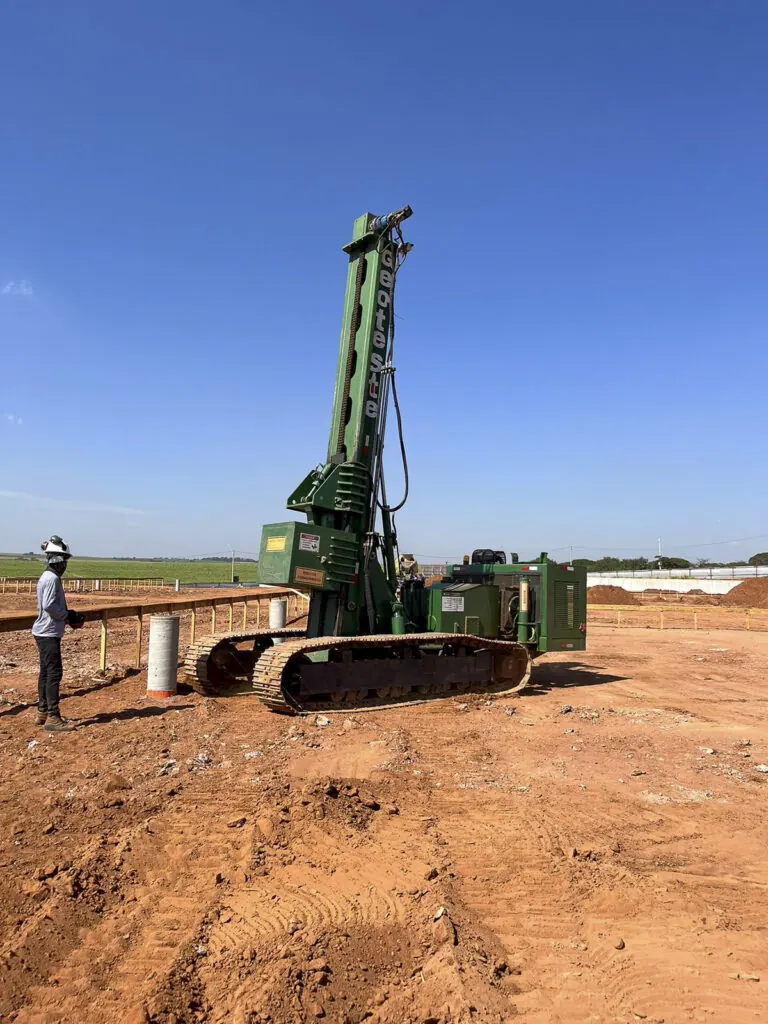
Figure 2, Hammer GT20, Geoteste
Structure and operating mode of the Hammer GT20
The Hammer GT20 is configured as an automated track-mounted impact system, equipped with its own engine, tower, cables, and integrated hammer. Its design, based on continuous flight auger equipment, allows a clear understanding of its structure and associated operational benefits.
In the execution of monitored continuous flight auger piles, the process begins after equipment mobilization.
The procedure involves positioning the auger, plumbing the tower, drilling the soil, removing excavated material, and concreting the shaft.
The system monitors all stages in real-time, ensuring high quality control and high productivity.
Execution of the PDA test
The execution of the PDA test with the Hammer GT20 follows a rationalized and safe methodology.
After equipment mobilization on site, the system autonomously moves to the location of the tested pile.
Subsequently, the system positions the tower, ensuring proper alignment with the foundation element's axis.
The equipment itself raises the hammer to the previously defined height, according to the desired impact energy. The system applies blows successively and in a controlled manner, while sensors installed on the pile record dynamic acceleration and strain signals.
Throughout the process, the operator remains away from the impact zone and controls the equipment via radio control.
The system interrupts the test when twice the pile's working load is reached or when the impact block ruptures.
Subsequently, the collected data is processed in the computational environment, enabling the interpretation of the foundation's geotechnical and structural parameters.
The system applies successive and controlled blows, while the sensors record dynamic acceleration and strain signals.
The system interrupts the test when twice the pile's working load is reached or in case of impact block rupture.
Subsequently, the collected data is processed in the computational environment, resulting in the interpretation and presentation of the foundation's performance parameters.
Advantages of the Hammer GT20
Given the above, the main advantages of the Hammer GT20 system, developed by Geoteste, are highlighted:
- Elimination of the risk of falls: unlike conventional systems, the Hammer GT20 eliminates the need for working at height. The system performs all operations at ground level, significantly increasing team safety.
- Eliminates lifting operations: The equipment eliminates lifting operations, as it was designed to eliminate the need for lifting the hammer and its components, reducing operational risks, simplifying logistics, and decreasing test preparation time.
- Eliminates the need for a Rigging Plan: due to the absence of suspended loads, there is no need for a Rigging Plan, resulting in time savings and cost reduction.
- High productivity: the Hammer GT20 allows performing up to 20 PDA tests per day. In comparison, traditional systems perform, on average, 5 to 8 daily tests, due to additional setup, lifting, and repositioning steps.
- High safety system: the automation of the process, the absence of working at height, the elimination of lifting, and remote operation make the Hammer GT20 an extremely safe system, in accordance with the requirements of ABNT NBR 13208:2007, Piles, Dynamic Load Test.
- Eliminates cranes or knuckle boom trucks: the equipment does not depend on cranes or knuckle boom trucks for assembly or operation, reducing logistical costs and facilitating work on sites with space restrictions.
- Radio control operation: The operation is fully controlled by radio, keeping the operator away from the impact zone, increasing the level of safety and ensuring reliability in data acquisition.
- Self-supporting system: the Hammer GT20 is fully self-supporting, combining the structure, tower, hammer, and control systems in a single piece of equipment, in addition to having its own mobility for movement and positioning at the test points.
Hammer GT20 with the tower positioned horizontally
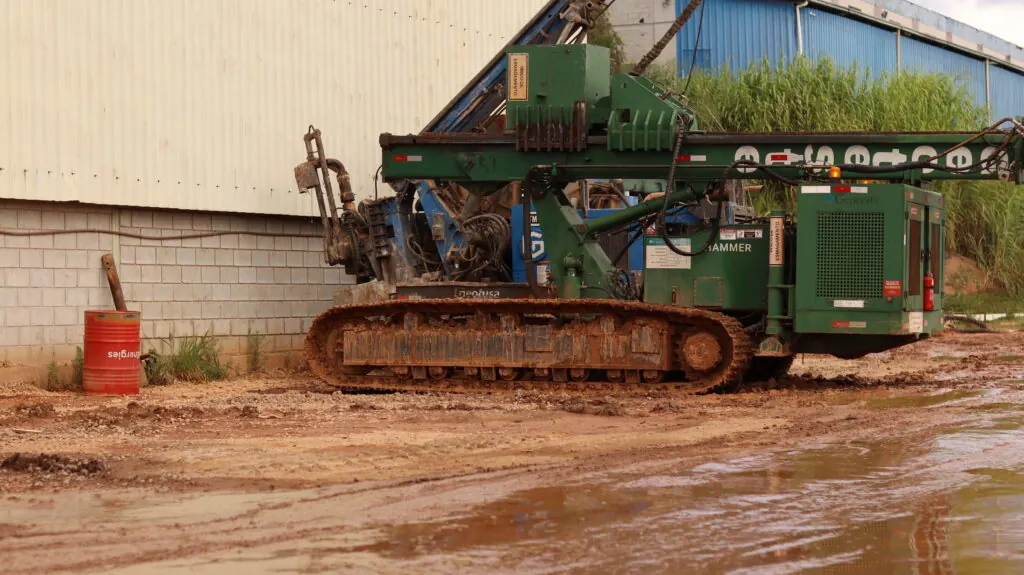
Figure 3, Hammer GT20 with the tower positioned horizontally
Proprietary patent
Geoteste internally developed the entire Hammer GT20 system, constituting a patented solution with high technological potential. This initiative reflects the company's commitment to continuous innovation, technical excellence, and value generation for its clients.
By investing in the development of its own technologies, Geoteste consolidates its position as a reference in the geotechnical testing sector, contributing to the evolution of quality control practices in deep foundations.
The Hammer GT20 Impact System represents a milestone in the execution of PDA tests in Brazil, combining safety, productivity, reliability, and innovation in a single piece of equipment. Its modern and self-supporting design eliminates the limitations of traditional methods, providing significant gains in operational efficiency and risk reduction.
Thus, the Hammer GT20 establishes itself as a technological solution of excellence, aligned with the current demands of foundation engineering and the highest standards of quality and safety required by the market.
Applicability of the Hammer GT20
The versatility of the Hammer GT20 impact system significantly expands the field of application of PDA tests.
The system becomes suitable for different types of projects and various geotechnical contexts.
Being a self-supporting, track-mounted equipment with high mobility, the system allows application in urban projects with space and access restrictions.
It can also be used in large-scale projects, such as industrial, infrastructure, and energy works.
In urban environments with limited areas for cranes and auxiliary equipment, the Hammer GT20 offers a significant operational advantage.
In operational terms, the system eliminates the use of knuckle boom trucks or cranes for lifting hammers and structures.
The autonomous movement capability allows rapid repositioning between piles.
This characteristic reduces interference on site and minimizes impacts on project logistics.
From a geotechnical perspective, the system performs efficiently in soils of different natures.
It applies to sandy, silty-clayey deposits, and more complex profiles, with intercalated layers and materials of higher resistance.
Precise control of impact energy allows adapting the test to the soil characteristics and pile type.
This adaptation ensures adequate mobilization of resistances without compromising the structural integrity of the tested element.
This operational flexibility reinforces the multifunctional nature of the system.
Thus, the equipment positions itself as a robust and efficient solution for foundation quality control in projects of different sizes and complexities.
Conclusion
In view of the above, the Hammer GT20 is consolidated as a high-performance technological solution for the execution of PDA tests, combining operational safety, high productivity, and technical reliability. Its innovative design contributes to the optimization of quality control processes in deep foundations, meeting normative requirements and the current demands of the geotechnical engineering sector. Furthermore, its application favors the reduction of risks, deadlines, and operational costs, strengthening technical decision-making by designers and builders, with direct gains in the overall quality of projects.