How to choose the pile to be subjected to SPT: technical and normative criteria
Learn how to choose a pile for a load test using NBR 6122 and NBR 16903 criteria. Check the guidelines for a representative and safe selection.

Por Maria T. Mota
Engenheira Civil Geotécnica
CREA/CONFEA 1417059923
The importance of correctly selecting the pile to be tested
The static load test, known by the acronym PCE (Prova de Carga Estática in Portuguese), is a comprehensive method for evaluating the load versus displacement behavior of foundation piles, as it simulates the real load over time that tends to occur in the element until the completion of the project. However, in most situations, it is not feasible to test all piles, and therefore, the choice of piles to be tested becomes so important. An inadequate choice can generate biased data, overestimating the actual geotechnical capacity of the ground or imposing unnecessary costs with unfounded structural reinforcements.
Understanding how to choose a pile for a load test requires a careful analysis that integrates local geology, the project's load map, the execution method employed, data from technological control during installation, and the requirements established by current Brazilian technical standards, especially ABNT NBR 6122 and ABNT NBR 16903.
Preliminary design pile versus construction pile
The first step in defining the pile to be tested consists of identifying the contractual and executive purpose of the load test within the project schedule. Piles subjected to static testing are divided into two main categories with distinct purposes.
Preliminary phase test pile
The preliminary phase test pile is executed before or at the beginning of large-scale production, often outside the projection of the definitive blocks. Its purpose is to confirm calculation hypotheses, validate the predicted length, calibrate geotechnical parameters, and verify the feasibility of the adopted drilling or driving method. In these cases, the test is usually taken to geotechnical rupture or to high loads in multiples of the working load to determine the actual ultimate capacity.
Control or construction performance pile
The construction pile is an integral element of the final structure of the building or infrastructure. Its objective is to prove in-service performance and the safety margin foreseen in the design. For these piles, the loading reaches values defined by the standard or by the designer, generally up to twice the allowable design load, with care not to structurally damage the piece if it is to be incorporated into the pile caps.
Geotechnical criteria for selection
The subsoil is rarely homogeneous along the implantation area of a structure. Variations in layer thickness, fluctuating water levels, and changes in the compaction or consistency of resistant horizons require an integrated reading of investigation profiles.
Stratigraphic representativeness: the chosen pile must be located in a sector of the ground whose stratigraphic profile represents most of the elements executed in the work.
Sectors with unfavorable geotechnical profile: when the objective is to evaluate global safety from a conservative perspective, elements located in areas where percussion drilling or cone penetration tests indicated lower lateral or tip resistance are selected.
Presence of geological transitions: in terrains with abrupt contact between residual soil and rock, or with the presence of boulders, the choice should fall on areas where the embedment depth may raise geotechnical doubts.
Executive and technological control criteria
During the execution stage, rigorous recording of drilling or driving parameters provides fundamental subsidies to indicate which piles should be selected for the load test.
Driven piles
For pre-cast concrete, metallic, or tubular piles, the driving records must be fully analyzed. Selection criteria include:
Driving resistance (nega) and elastic rebound behavior close to the theoretical limits calculated for the embedment depth.
Piles that presented a stopping depth discrepant from neighboring elements in the same block or structural module.
Occurrence of relaxation phenomena or temporal increase in resistance after prolonged rest.
Excavated piles, continuous flight auger, and cast-in-place piles
In the case of piles drilled and cast in the ground, digital monitoring and concreting control parameters guide the choice:
Concrete consumption and overconsumption profile compatible with the work average, avoiding elements with atypical bulges that mask the standard lateral response.
Piles where there was excessive time between the end of drilling and the beginning of concreting, to evaluate the impact of alteration of the bore wall or bottom sedimentation.
Concrete injection pressure and drilling torque registered by the onboard computer in continuous flight auger piles, selecting those that represent the operational average.
Integration with previous integrity and dynamic tests
The definition of the pile for the SPT can be refined by cross-referencing with data obtained from previous non-destructive tests. The use of low strain integrity tests, known as PIT, allows verifying the physical continuity of the shaft and discarding elements with section anomalies or concreting failures before mobilizing the reaction system.
Similarly, the prior performance of dynamic load tests on a sample of piles can map sectors with lower elastic response or mobilization of resistance, indicating the exact point where the static load test will provide the greatest technical return for validating the design model.
Logistical requirements and reaction system arrangement
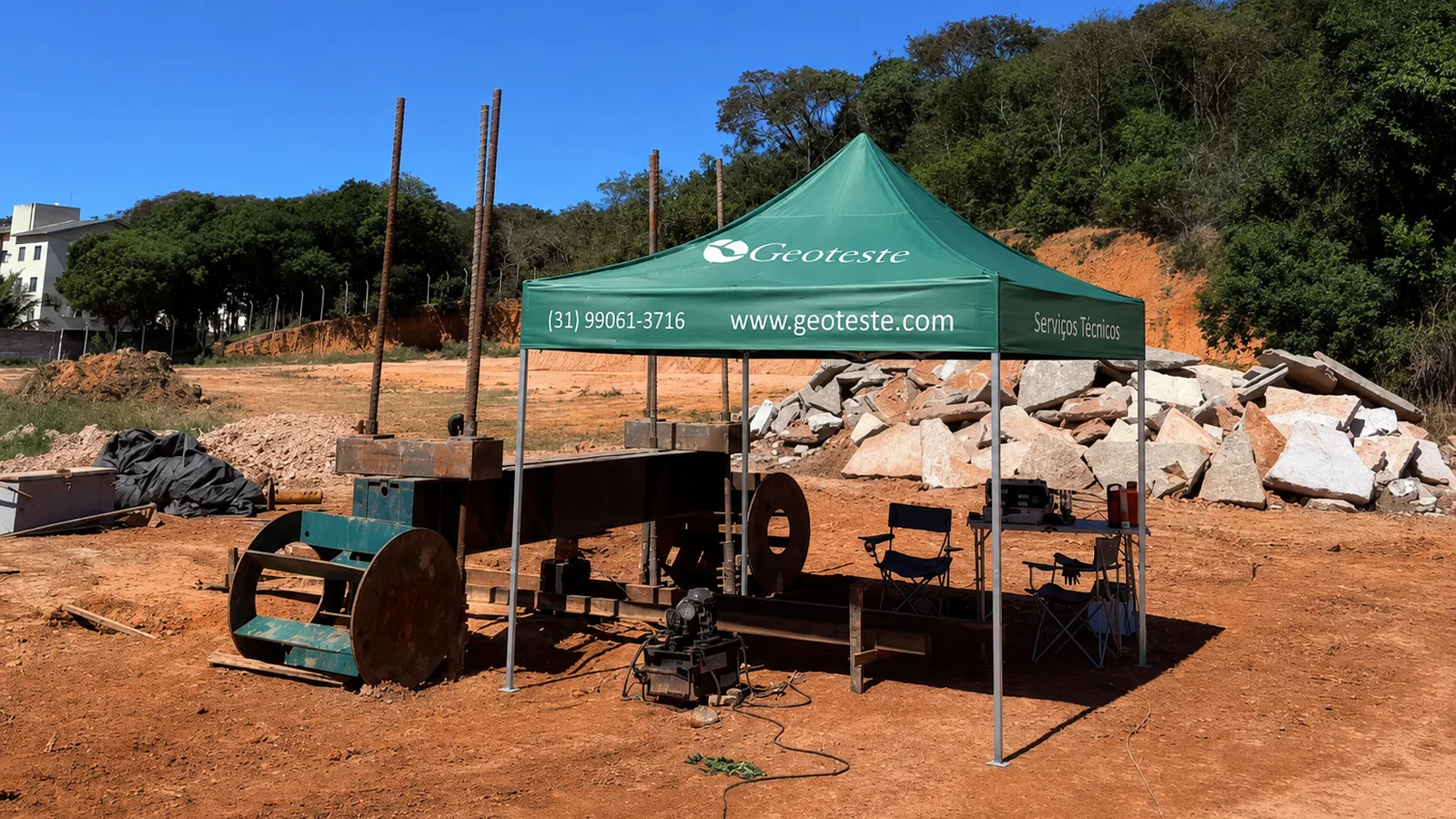
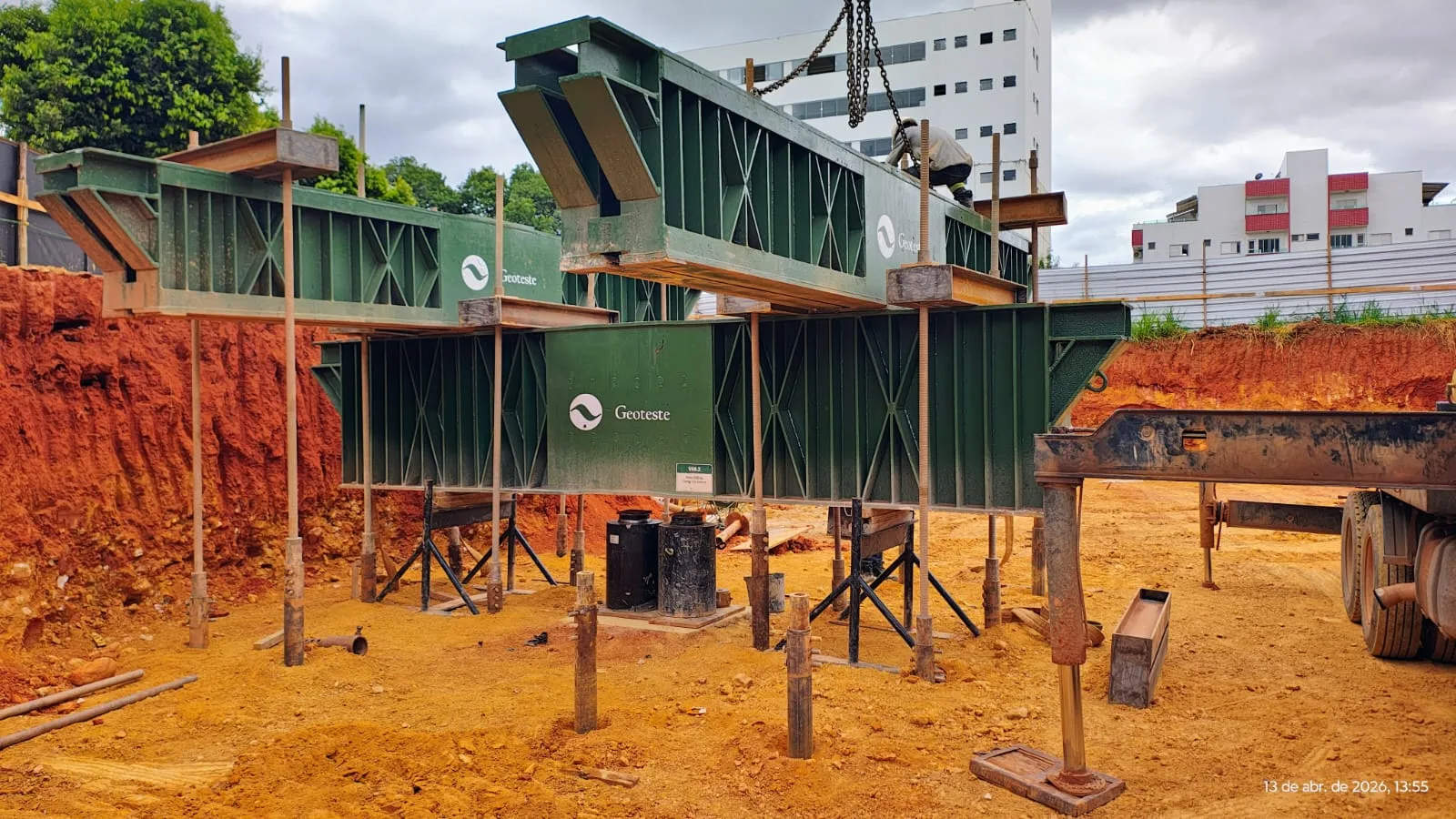
The feasibility of performing the static test requires adequate operational conditions. ABNT NBR 16903 establishes minimum distances between the tested element and the reaction elements, whether they are anchors anchored in the ground, neighboring piles, or loading beam supports.
Type of reaction system | Minimum recommended clear distance | Critical attention factor |
|---|---|---|
Neighboring tension piles | At least 3 times the pile diameter or 1.5 meters | Avoid interference of the tension bulb in the friction zone of the tested pile |
Anchored reaction tie-rods | Free section until below the tip or safe distance | Ensure that the anchorage does not transfer stress to the pile tip |
Loading frame with weights | Supports spread out to avoid inducing superficial settlement | Check stability of the ground mass under the loading frame support pads |
Thus, the choice of pile needs to consider whether the immediate surroundings have free space for the assembly of main and secondary beams, free from interference from already concreted blocks, retaining walls, or buried networks.
Normative requirements of ABNT NBR 6122 and ABNT NBR 16903
ABNT NBR 6122 defines the criteria for the minimum quantity of static load tests based on the total number of piles, the type of element, and the load class of the work. The standard specifies that the tests must be performed on piles representative of the different geotechnical conditions of the ground and the types of foundations adopted.
ABNT NBR 16903, in turn, regulates the executive method of axial compression, tension, or transverse load testing in deep foundations. It defines the procedures for instrumentation, application of load stages, criteria for stabilization of settlements per stage, and measurement of deformations, ensuring that the test provides reliable load versus displacement curves.
Decision-making matrix for pile selection
To systematize the selection process, design engineers and inspection teams can adopt a sequential analysis matrix:
Identification of homogeneous geotechnical zones of the work through the interpretation of drilling reports.
Separation of piles by diameter family, predicted length, and working stress level.
Screening of daily drilling or driving records to select elements executed without serious non-conformities.
Verification of shaft integrity through low strain testing.
Analysis of the geometric feasibility of installing the reaction beam and positioning anchor points according to NBR 16903.
Formal approval of the choice jointly between the structural designer, the geotechnical consultant, and the person responsible for technological control.
Geoteste's technical expertise in deep foundation control
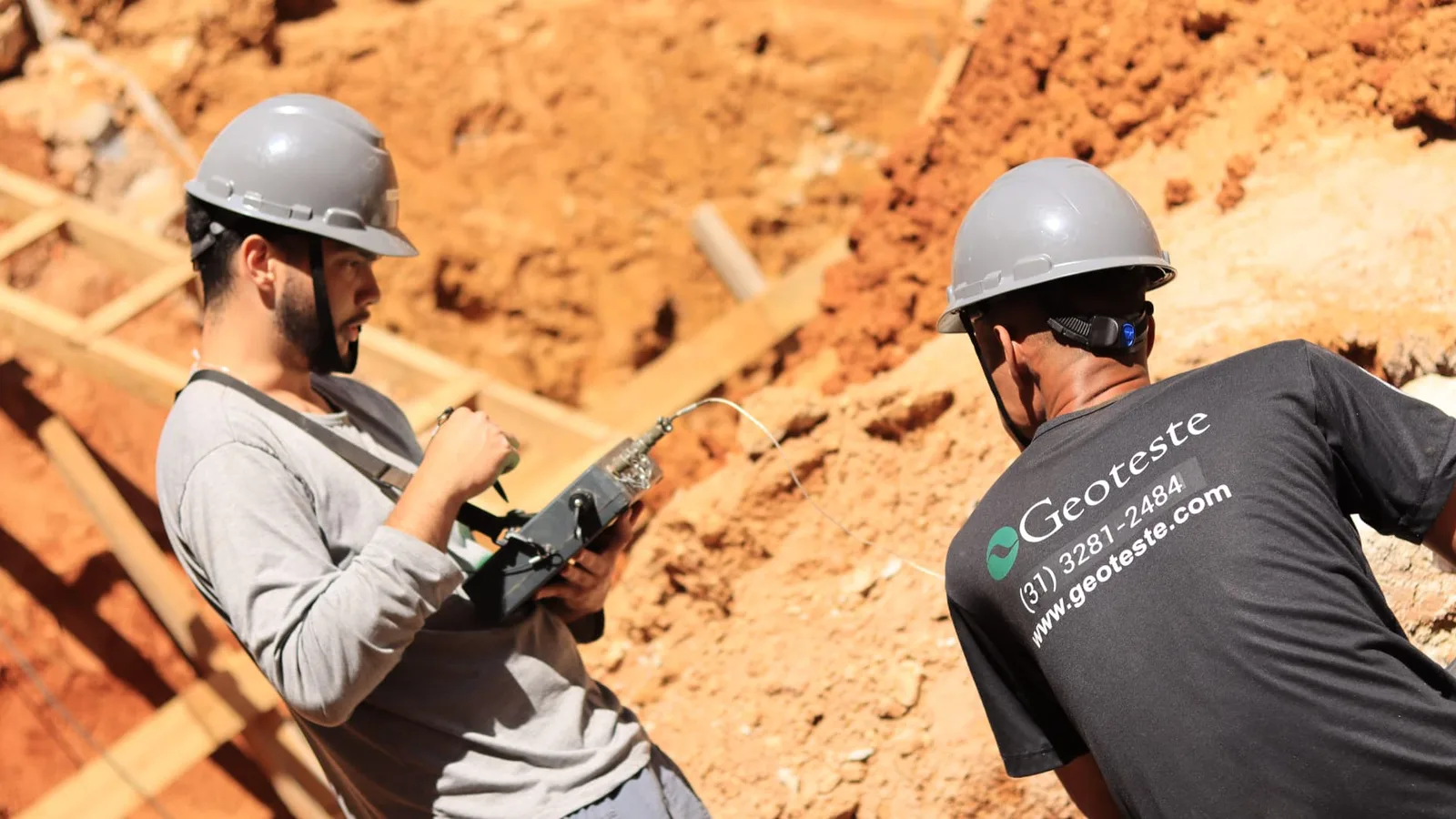
The correct definition of the pile and rigor in test execution are essential steps for the reliability of foundations. Geoteste operates in all stages of technological control of deep foundations, performing static load tests in full compliance with ABNT NBR 16903, in addition to dynamic load tests according to ABNT NBR 13208 and low strain integrity tests.
Our technical team supports designers, contractors, and project managers in evaluating executive parameters, logistical planning of reaction systems, and detailed interpretation of load versus settlement performance curves under the guidelines of ABNT NBR 6122. Contact the Geoteste engineering team to plan the testing campaign for your project.