The Role of Static Load Test and the Limitations of Top Measurement
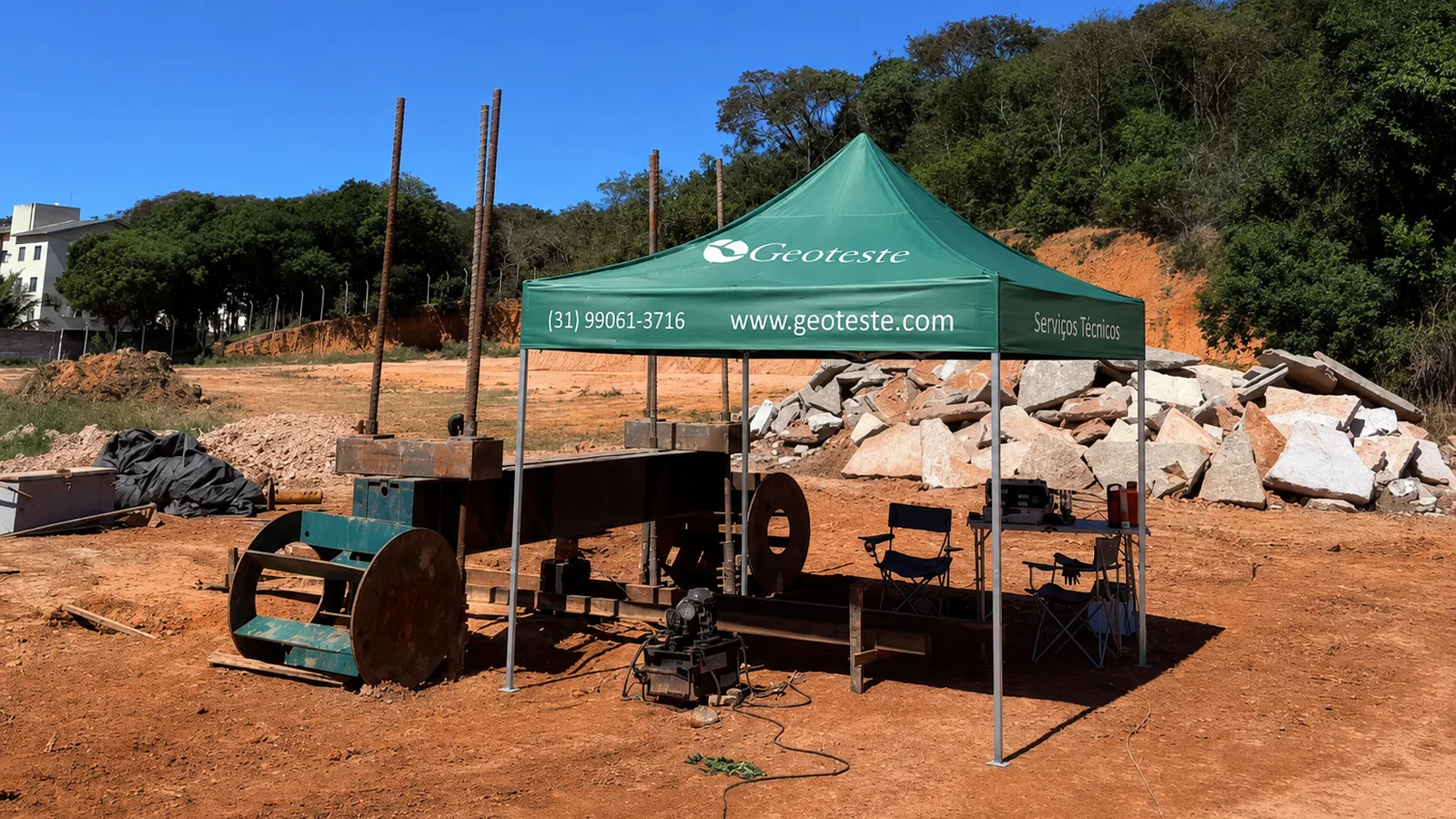
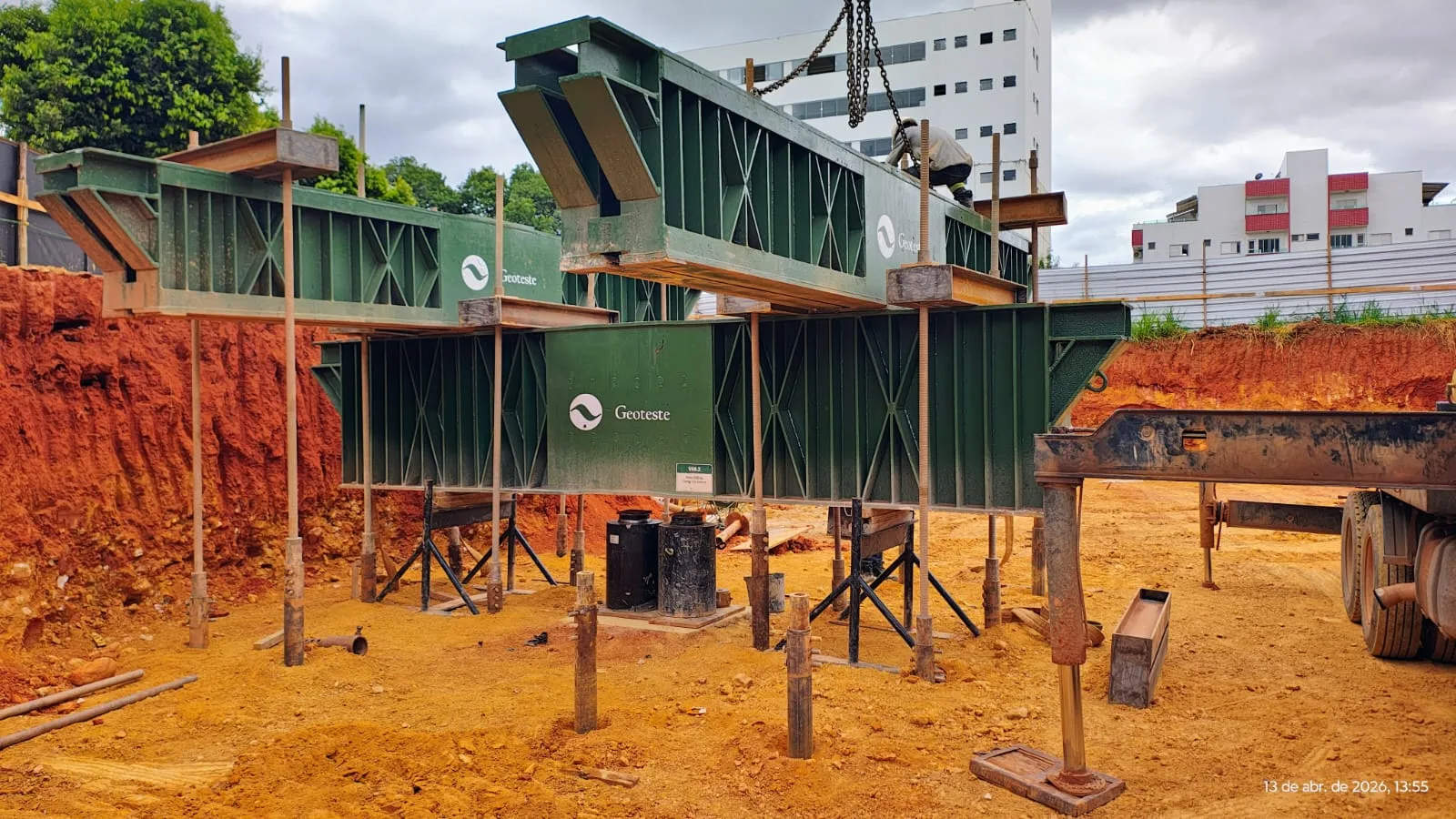
The static load test (SLT) constitutes the most traditional and established method for determining the behavior of deep foundation elements subjected to axial loads. Regulated in Brazil by standard ABNT NBR 16903:2020, the conventional static load test records fundamental quantities applied at the pile head: the axial force imposed by calibrated hydraulic jacks and the resulting vertical displacement at the top, measured by electronic transducers or mechanical deflectometers referenced to unyielding support beams.
From these primary records, engineers plot the well-known load-settlement curve. This global relationship provides immediate parameters regarding the system's stiffness, the stabilization of displacements under loading increments, and the apparent bearing capacity of the pile. However, this traditional approach treats the pile as a structural and geotechnical black box. The displacement measured at the top simultaneously synthesizes two distinct physical phenomena: the elastic deformation of the pile shaft itself along its length and the displacements of the interface with the soil mass resulting from the mobilization of side friction and toe resistance.
When instrumentation is limited to the top, the designer lacks empirical data to discern how much load was effectively absorbed by side friction along the traversed strata and what portion reached the pile toe. This absence of spatial discrimination prevents the verification of theoretical load transfer models adopted in the design phase, making more rational and economical interventions in foundation geometry impossible.
What is Instrumented SLT and What Quantities are Investigated
Instrumented SLT consists of performing a static load test on a pile equipped internally or externally with sensors distributed along its depth. This technique transcends simple global stability verification, transforming the structural element into a laboratory for investigating soil-structure interaction.
In an instrumented pile, the central objective is to measure variations in specific longitudinal strain or relative displacements at pre-determined horizontal sections along the shaft. From the specific strain and prior knowledge of the axial stiffness of the cross-section, the remaining axial force at each instrumented depth is calculated for each loading stage applied at the top.
The differentiation of axial load between two subsequent instrumentation levels allows calculation of the unit side friction developed in that specific soil section. Thus, in addition to the classic top load-settlement curve, the instrumented test generates continuous load transfer diagrams with depth and curves of side friction mobilization per geological stratum, as well as the curve of toe resistance mobilization.
Load Transfer Mechanisms Along the Shaft and Toe
The geotechnical behavior of an axially loaded pile is governed by the gradual transfer of shear stresses to the surrounding soil as the pile deforms. This transfer does not occur linearly or homogeneously, depending intrinsically on the relative stiffness between the pile and the soil mass, the stratigraphy of the ground, and the magnitude of relative displacement at the soil-pile interface.
In classical deep foundation literature, soil-pile interaction is frequently modeled using transfer curves known as t-z curves for side friction and q-w curves for base resistance. Side friction is typically mobilized under very small relative displacements, often between two and five millimeters, varying according to the pile diameter and the characteristics of the adjacent soil. In contrast, the pile toe requires significantly greater vertical displacements to mobilize significant fractions of its resistance capacity, reaching values between five and ten percent of the base diameter in granular soils or stiff clays.
In long or large-diameter piles tested conventionally, a load-settlement curve with apparently linear behavior at the top can mislead the engineer into assuming that the element works primarily by toe resistance or that it has an ample safety factor along the entire shaft. In reality, stiffer upper layers may be under total shear plastification while the pile base has not even begun to be effectively loaded. Only instrumented SLT rigorously identifies the progression of friction mobilization and the onset of stress transfer to the toe contact.
Conventional SLT versus Instrumented SLT: Technical Comparison
The choice between the conventional methodology and instrumented SLT reflects the difference between simple compliance homologation and precision engineering aimed at geotechnical optimization and risk control.
| Evaluation Parameter | Conventional SLT | Instrumented SLT |
|---|---|---|
| Quantities measured directly | Load at top and settlement at top | Load at top, settlement at top, specific strains or internal displacements at fixed depths |
| Side friction per stratum | Not measurable, dependent on theoretical back-analyses | Measured directly by the variation of axial force between instrumented sections |
| Toe resistance | Estimated indirectly or inferred by hypotheses | Determined directly by the sensor positioned in the section immediately above the toe |
| Elastic shortening of the pile | Calculated by theoretical equations with presumed stiffness | Integrated from deformations measured directly along the element |
| t-z and q-w mobilization curves | Non-existent from direct test data | Constructed directly for each geotechnical section traversed |
| Utility for design calibration | Reasonable for verifying global maximum and allowable load | High for refinement of soil parameters and geometric optimization of length |
Technologies and Sensors Used in Pile Instrumentation
The instrumentation of deep foundation elements for instrumented SLT requires robust, reliable sensors compatible with the aggressive conditions of the construction site, concreting, and the pile installation process.
Rod extensometers or telltales
Mechanical rod extensometers, commonly called telltales, consist of rigid metal rods enclosed by guide tubes without adhesion to the concrete. These rods are fixed at the lower end at specific depths of the shaft or at the pile base, while the upper end reaches the free surface at the top. By measuring the relative movement of the upper tip of the rod in relation to the pile top during loading, the displacement of the fixed point is obtained and, consequently, the average elastic shortening of the monitored segment.
Electrical resistance and vibrating wire strain gauges
Strain gauges are designed to measure micro-deformation of concrete or reinforcement. Vibrating wire sensors are widely recommended for geotechnical works due to their long-term reading stability, low susceptibility to electromagnetic noise caused by large machinery, and reliability in signal recording. These instruments are fixed to the longitudinal reinforcement or encapsulated in pieces known as concrete sister cells, installed aligned with the flow of compressive stresses.
Continuous and Distributed Fiber Optics
More recently, distributed fiber optic monitoring has been successfully applied to continuously measure deformations along the entire length of the element. This technology allows detection of singular points of stiffness variation, eventual constrictions, or overconsumption of concrete along the shaft, offering continuous spatial resolution that complements conventional point sensors.
Challenges in Determining the Concrete Elastic Modulus
The transformation of specific deformations recorded by internal sensors into axial force values strictly depends on the tangent or secant elastic modulus of the composite concrete and steel shaft. This variable represents one of the most critical steps in the interpretation of instrumented SLT.
Cast-in-place concrete is subject to variations in humidity, curing temperature, compaction homogeneity, and dispersion of mechanical characteristics along its depth. Adopting a purely theoretical elastic modulus can induce distortions in the calculated load transfer diagrams. For this reason, systematic instrumentation of a pile section near the top, where the applied axial load is exactly known and side friction is zero or negligible, acts as a local calibration of the actual deformability modulus of the cross-section.
Normative Requirements: ABNT NBR 16903:2020 and ABNT NBR 6122:2022
The execution of the static load test method for deep foundation elements strictly follows the precepts of ABNT NBR 16903:2020. This standard specifies reaction arrangements by tie-downs, reaction piles, or heavy kentledge, precision classes for load cells and pressure gauges, loading increment rates, and temporal criteria for settlement stabilization in slow or rapid tests.
ABNT NBR 6122:2022, the standard that establishes guidelines for foundation design and execution, emphasizes performance control and structural and geotechnical verification of piles. The use of instrumented load tests plays a relevant role by providing subsidies to justify adequate global safety factors, recalibrate unit friction formulations obtained by previous field soundings, and ensure that foundations operate strictly within serviceability and ultimate limit states.
Engineering Decisions Guided by Instrumentation Data
The execution of an instrumented SLT in the early phases of large-scale projects enables substantial savings and systematic reduction of operational risks. Among the engineering decisions based on the results of this test, the following stand out:
- Optimization of pile construction length based on the identification of sections with early mobilization of geotechnical resistance,
- Reduction of concrete and steel consumption in subsequent foundation elements through refinement of mobilizable unit side friction rates,
- Precise identification of friction loss in collapsible, compressible soils or those subject to negative skin friction,
- Validation of the actual contribution of the pile toe in resistant horizons such as soft rock, very stiff clays, or compact silts,
- Unequivocal separation between elastic structural deformation and permanent geotechnical displacement, enabling refined settlement analyses for highly sensitive masonry or concrete structures.
Specialized Solutions in Instrumented SLT with Geoteste
The instrumentation of deep foundations demands analytical rigor in sensor selection, excellence in instrument fixing to reinforcement, and technical mastery in converting field readings into useful structural and geotechnical parameters for decision-making. Geoteste operates comprehensively in instrumented static load tests, in strict compliance with the guidelines of ABNT NBR 16903:2020 and in alignment with the performance control criteria of ABNT NBR 6122:2022.
Our geotechnical engineering team has advanced technology in vibrating wire sensors, automated continuous acquisition systems, and consolidated methodologies for calibrating the composite modulus of the pile section. Whether in the preliminary design phase for optimizing the pile layout or in verifying behavior in infrastructure works and large-scale buildings, Geoteste delivers in-depth analytical reports with load transfer curves and settlements per stratum. Contact our technical specialists and elevate the reliability and economy of your project's foundations.