Load testing and cost reduction: how measuring real performance reduces foundation cost
How static load testing reduces foundation cost by lowering the safety factor allowed by NBR 6122, with criteria, limits, and when it is worthwhile.

Por Diogo Bechler
Engenheiro Civil Geotécnico
CREA/CONFEA 1416378065
Why load testing reduces foundation cost
The foundation usually accounts for a significant portion of the structure's cost, and it is almost always designed based on prediction, not measurement. Semi-empirical methods of bearing capacity, informed by SPT borings, carry a known dispersion, and this dispersion is compensated by a margin. Margin costs concrete, steel, piles, and time.
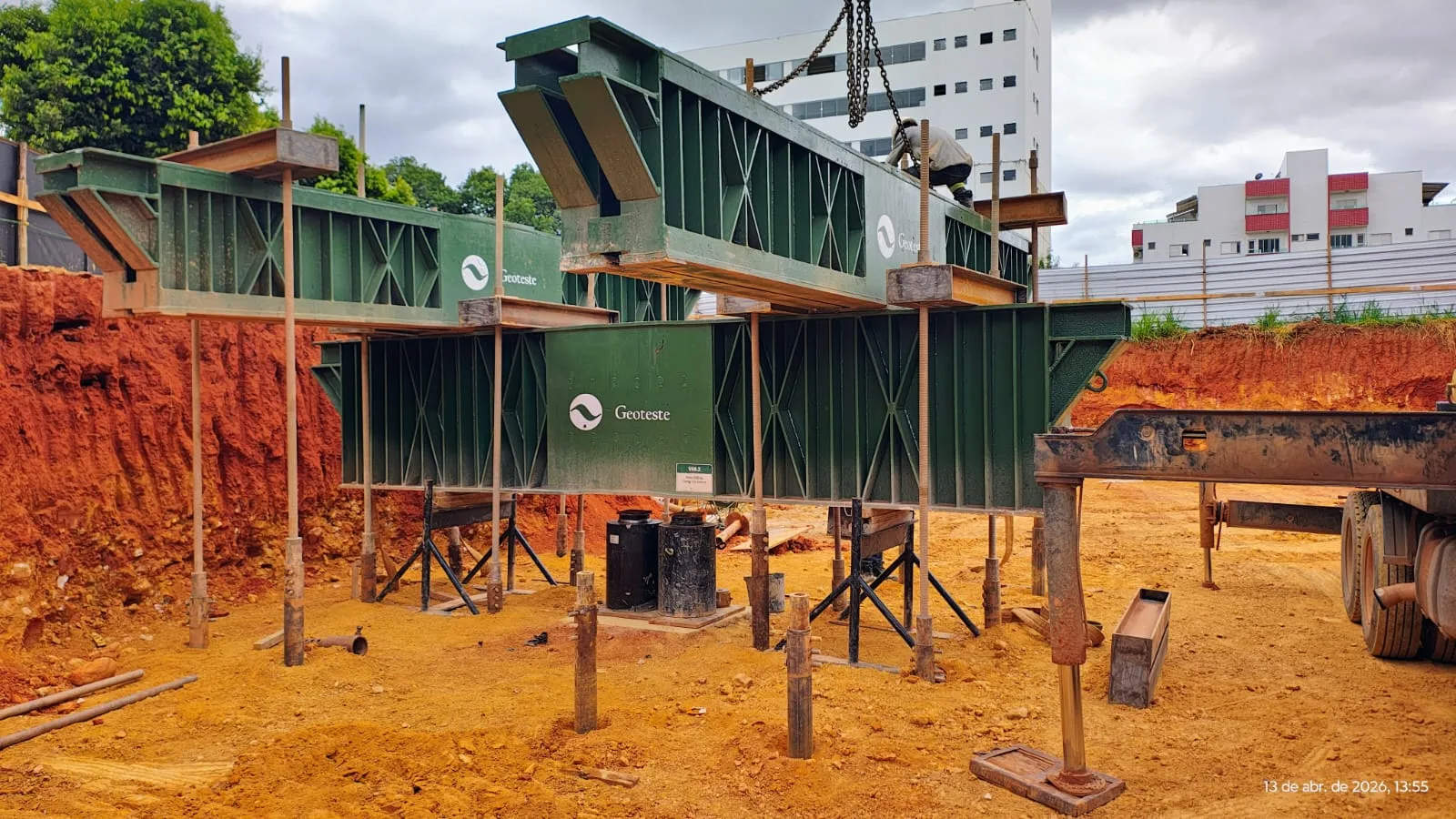
Static load testing replaces part of this margin with measured data. By loading a real element, constructed with the same execution process, in the same geotechnical profile of the project, the designer stops estimating the behavior of the soil-pile system and starts to know it. The economic gain does not come from reducing safety; it comes from reducing uncertainty.
The normative mechanism: safety factor and load testing
ABNT NBR 6122:2019, with Amendment 1:2022, is the standard for the design and execution of foundations. The static load testing method for deep foundations is established by ABNT NBR 16903:2020, which replaced the old NBR 12131. For dynamic loading, the reference is ABNT NBR 13208:2007. ABNT NBR 6489, on the other hand, deals with direct load testing on foundation soil, applicable to shallow foundations and plate load tests, and not to piles.
The central point for economy lies in how NBR 6122 treats the global safety factor. When foundation resistance is estimated only by semi-empirical methods, the design uses a global safety factor of 2.0. When load tests are performed in the quantity, timing, and conditions specified by the standard, with tests conducted in the initial phase of the project and loaded sufficiently to characterize the resistance, the standard allows for the adoption of a smaller global safety factor, of 1.6.
The correct interpretation of this provision is important. The standard does not authorize reducing the safety factor simply because a test exists on the site. The reduction depends on the number of load tests in relation to the total number of piles, the timing of execution, and the representativeness of the tested elements compared to the piling. This assessment is made by the foundation designer.
What margin reduction means in design
With a smaller global safety factor on the same resistance, the allowable load per element increases. In design practice, this gain is converted in three ways, isolated or combined:
- Reduction in the number of piles, maintaining geometry and length.
- Reduction in the length of piles, maintaining quantity and diameter.
- Reduction in diameter or change in element type, with direct reflection on concrete and steel consumption and pile caps.
There is also a second-order effect often forgotten: fewer piles mean fewer pile caps, less pile cap reinforcement, less excavation, less equipment movement, and fewer foundation days on the project's critical path.
Comparison between the two approaches
| Criterion | Design without load testing | Design with load testing |
|---|---|---|
| Basis of adopted resistance | Semi-empirical methods from SPT or CPT | Measured behavior of a real element from the project |
| Global safety factor | 2.0 | Can be reduced to 1.6 under NBR 6122 conditions |
| Treatment of uncertainty | Absorbed by design margin | Reduced by direct measurement |
| Material consumption | Dimensioned for the conservative hypothesis | Dimensioned for verified performance |
| Risk of executive surprise | Detected late, often in the structure | Detected in the foundation phase, when correction is inexpensive |
| Direct cost of control | None | Mobilization, reaction system, and testing |
When economy outweighs the cost of testing
Load testing is not advantageous in every scenario. The math works out easily when there is scale or significant uncertainty:
- Large piling projects. The cost of the test is fixed, and the gain multiplies by hundreds or thousands of elements.
- Geotechnical profiles with unpredictable behavior, such as heterogeneous residual soils, collapsible layers, or the presence of boulders.
- Sensitive execution processes, such as continuous flight auger (CFA) piles and excavated piles under stabilizing fluid, where theoretical prediction poorly captures the effect of execution.
- Projects with critical deadlines, where removing days from the foundation's critical path is worth more than the material saved itself.
In small projects, with a few dozen piles and a well-known profile, mobilization can exceed the savings. In these cases, dynamic testing (PDA) usually offers a better ratio between information obtained and cost, and can be combined with a reference static test.
Load testing performed at the right phase
The most expensive mistake made with load testing is performing it late. A test performed when the piling is already completed serves for verification, but no longer serves to optimize anything: the material has already been bought and installed.
Design load testing, performed on a test pile before or at the beginning of the execution of the definitive foundation, is what generates economy of scale. It calibrates the prediction method for that profile and that execution process, and the result propagates to the entire piling. It is also the only configuration compatible with the adoption of a reduced safety factor in the design phase.
What the test delivers beyond economy
Reducing cost is a consequence, not the objective of technological control. Load testing provides the actual load-settlement curve, allows evaluation of settlement under service load, separates the contribution of shaft and toe when the test is instrumented, and reveals execution problems before the structure is built. For this level of detail, see instrumented static load testing, which measures load transfer layer by layer.
How Geoteste supports the optimization of your project
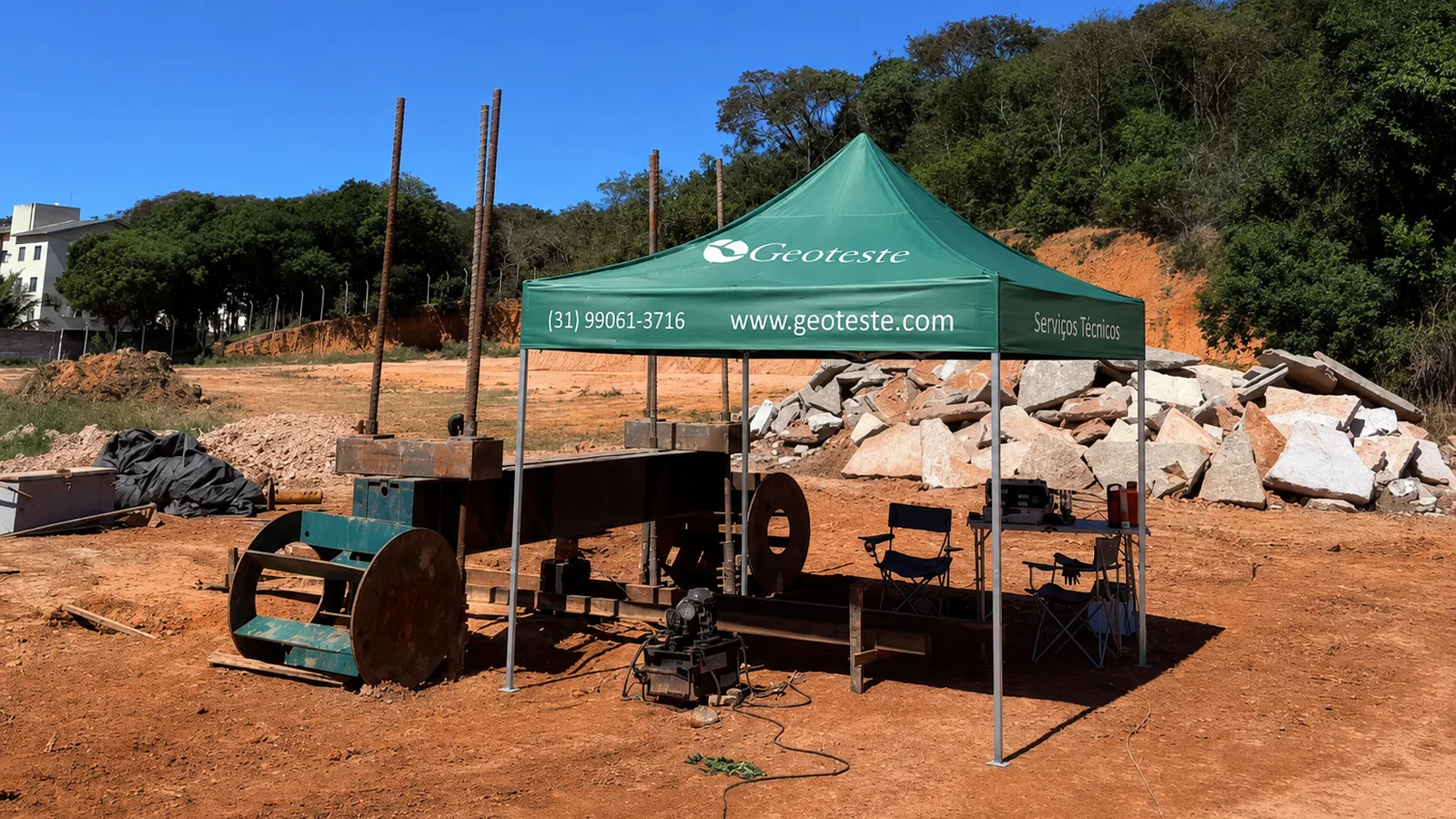
Geoteste performs static load tests according to ABNT NBR 16903:2020, dynamic load tests according to ABNT NBR 13208, bidirectional tests, plate load tests, and integrity tests, always within the requirements of ABNT NBR 6122. We act from the planning of the testing program to the interpretation of results, providing the designer with the technical support necessary to review hypotheses with confidence. Learn about static load testing or use our testing dimensioner to estimate the plan for your project.
Technical references
- ABNT NBR 6122:2019, with Amendment 1:2022. Design and execution of foundations. Rio de Janeiro: ABNT.
- ABNT NBR 16903:2020. Soil: static load testing in deep foundations. Rio de Janeiro: ABNT.
- ABNT NBR 13208:2007. Piles: dynamic load testing. Rio de Janeiro: ABNT.
- ABNT NBR 6489:2019. Soil: direct load testing on foundation soil. Rio de Janeiro: ABNT.