How many blows are necessary in a PDA test?
Discover how to define the number of blows in PDA. Understand the technical criteria for data acquisition and consult Geoteste specialists.

Por Rodrigo Gontijo
Engenheiro Civil Geotécnico
CREA/CONFEA 1416959840
Introduction to Dynamic Loading Test
The High Strain Dynamic Loading Test (DLT), internationally known as PDA (Pile Driving Analyzer) by its English acronym, constitutes a fundamental method for the evaluation of deep foundations. During the execution of this test, the foundation element receives the impact of a hammer, generating stress and velocity waves along the shaft. The correct conduct of the procedure requires a clear understanding that the quantity of blows applied does not follow a fixed and predetermined number, but depends directly on the objectives of the instrumentation and the conditions observed in the field.
For foundation engineers and designers, understanding the dynamics of data acquisition prevents misinterpretations and ensures that the transferred energy is sufficient to mobilize the desired resistance. The practice requires rigorous technical criteria, based on applicable standards and continuous observation of the pile's behavior under impact.
Reference technical standards
The execution of the dynamic test and the interpretation of its results must follow consolidated normative guidelines. In the national context, ABNT NBR 6122 establishes the general requirements for the design and execution of foundations, serving as a basis for quality control. Specifically for the test method, ABNT NBR 13208, which deals with dynamic loading tests on piles, applies.
In the international scope, the main reference is the ASTM D4945 standard, which standardizes the procedures for high-strain dynamic testing of deep foundations. Furthermore, the ISO 22477 family of standards, specifically the part applicable to dynamic tests, provides complementary guidance widely accepted by global geotechnical engineering.
Why the number of blows is not a fixed number
One of the most common errors in field practice is stipulating a rigid value, such as an exact number of impacts for all piles on a construction site. The number of blows in PDA varies depending on several operational and geotechnical factors. Among the main reasons preventing the adoption of a universal number of blows, the following stand out:
variability in the efficiency of the piling system or the hammer used;
particular conditions of soil resistance and stiffness along the pile shaft and at the toe;
need to verify the reproducibility of the signals obtained by the sensors;
adjustments in the hammer drop height to ensure sufficient energy without damaging the pile material;
occurrence of temporal phenomena, such as pile setup or relaxation, which require retesting at different times.
Criteria for field data acquisition
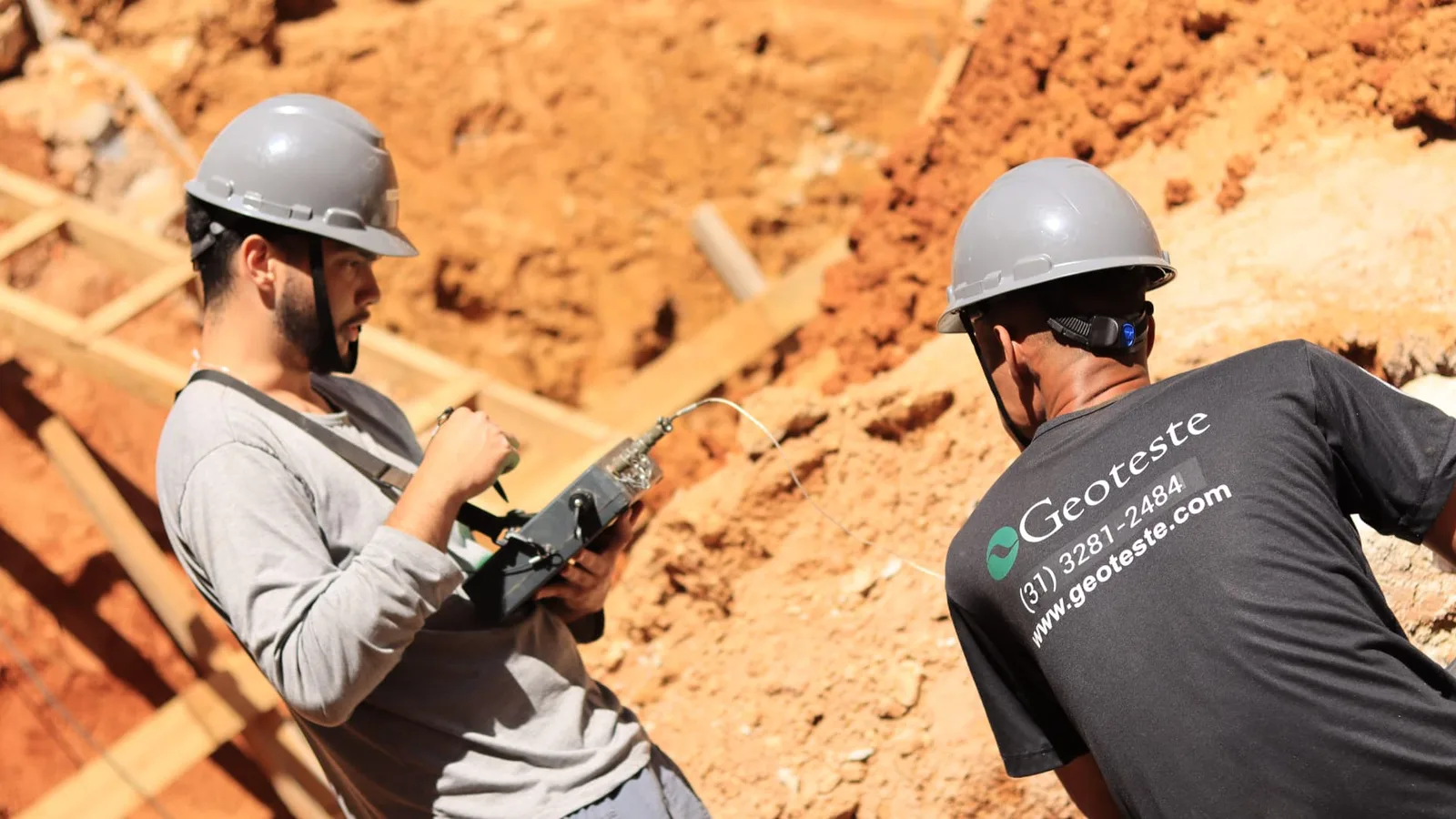
Data acquisition during the PDA test involves the continuous recording of force and velocity through accelerometers and strain transducers installed at the pile head. For the collection to be considered representative, the operator and the geotechnical engineer must observe specific criteria during the application of impacts.
The process usually begins with lower energy blows to check the integrity of the instrumentation and the coupling of the sensors. Subsequently, the energy is gradually increased until it reaches the necessary level to mobilize the intended geotechnical resistance. The following table summarizes the main stages monitored during acquisition.
Test Stage | Main Objective | Parameter Evaluated |
|---|---|---|
Initial verification | Check connections and sensor operation | Force and velocity signals |
Low-energy blows | Validate impact alignment | Deformation symmetry |
High-energy blows | Mobilize lateral and toe resistance | Maximum energy transfer |
Consecutive series | Ensure data consistency | Signal reproducibility |
What is measured, calculated, and estimated in PDA
To correctly interpret the results, it is essential to distinguish between directly obtained data and those derived by analytical processing. The equipment does not directly measure the static bearing capacity of the pile. The technical distinction is based on the following concepts:
measured: the force and velocity directly recorded by the electronic transducers at the pile head;
calculated: the maximum energy transfer, dynamic displacement, and maximum compression and tension stresses along the shaft;
estimated: the mobilized static resistance, obtained through wave analysis methods such as CASE or Signal Matching.
Limitations of the dynamic method
Although the PDA test is a powerful tool for the technological control of foundations, it has inherent limitations that must be considered by designers. The test evaluates the dynamic response under the specific hammer impact and does not replace a static load test when required by standards or contractual specifications for long-term calibration.
Furthermore, a single tested element does not automatically represent the behavior of the entire foundation of the structure. Extrapolations to adjacent piles require careful analysis of local geotechnical conditions and the execution process employed.
Foundation evaluation with Geoteste
The correct interpretation of the number of blows and the signals collected in a PDA test requires technical rigor, calibrated instrumentation, and a deep understanding of soil mechanics and wave propagation in elastic media. Geoteste has a technical team of engineers who, combined, have over 238 years of experience in geotechnical engineering and advanced technological control in deep foundations. Contact us and discover the best solution for your project.