What to do when a pile does not reach the expected load in the Static Load Test (SLT)?
The SLT does not reach expected load on the construction site? See the step-by-step investigation, technical re-evaluation, and engineering solutions according to NBR 6122.

Por Rodrigo Gontijo
Engenheiro Civil Geotécnico
CREA/CONFEA 1416959840
Introduction to failure or excessive displacement in the Static Load Test
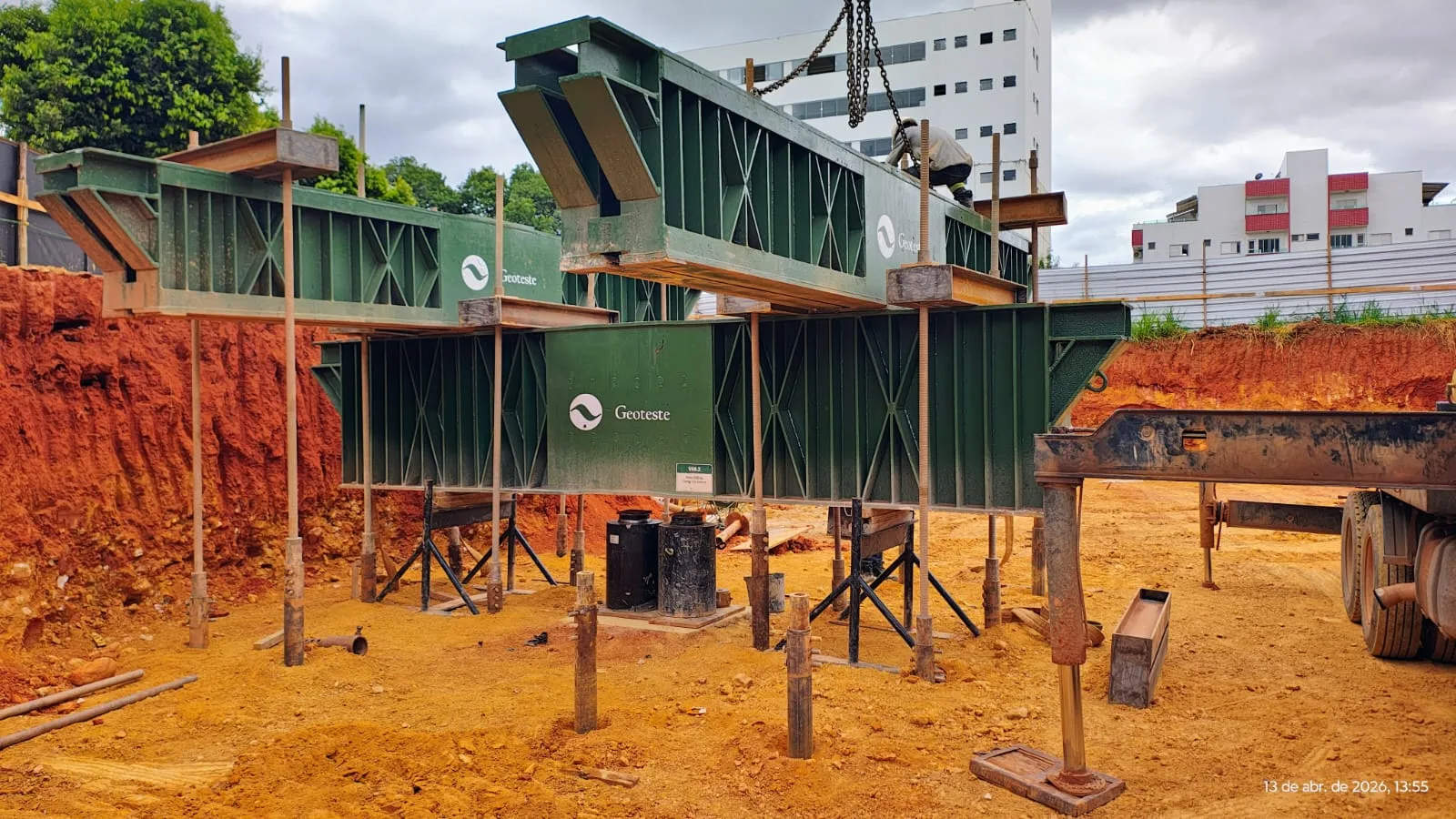
The Static Load Test (SLT), governed in Brazil by NBR 16903 and NBR 6122:2022, is the most conclusive method for determining the load-bearing capacity of a foundation element. It is the reference test where actual loads are applied incrementally to the pile by means of a hydraulic jack against a reaction system.
However, during the execution of the test, the foundation engineer (or the site inspector) may encounter a critical scenario: the SLT does not reach the expected load defined in the design. This situation occurs when the load-displacement curve shows excessive displacements before reaching the maximum predicted load (usually twice the allowable design load) or when there is a clear failure of the geotechnical element.
The confirmation of unsatisfactory performance requires a careful investigative approach before making drastic decisions, such as generalized reinforcement of the pile cap or discarding the constructed element. Below, we present the technical protocol to help diagnose the causes and guide decision-making.
Possible causes when the SLT does not reach the expected load
When a pile is provisionally classified as a rejected pile during the load test, the root cause may be linked to geotechnical, construction, or even failures in the test procedure itself.
1. Divergence in the geotechnical profile
Exploratory boreholes (SPT or CPTu) with excessive spacing or incorrect interpretation of the stratigraphic profile can lead to overestimated estimates of side friction or end-bearing resistance. The presence of interbedded soft layers, variation in the water table level, or isolated boulders not detected in the prior mapping are common causes of loss of load-bearing capacity.
2. Non-conformities in the element execution
Execution problems directly impact the behavior of the element. Depending on the pile type, the following stand out:
Excavated piles/caissons: Presence of degraded bentonite slurry/polymer at the bottom of the bore, collapse of the walls before concreting, or inadequate bottom cleaning.
Continuous flight auger (CFA) piles: Inadequate auger extraction speed, negative concrete pressure, or shaft fracturing.
Precast or metallic piles: Shaft damage during driving, excessive verticality deviation, or premature refusal in a false layer.
3. Temporal and rheological effects of the soil
In soft clayey soils, the relaxation time after installation is crucial. If the test is performed prematurely without waiting for the dissipation of pore pressures generated during driving or drilling, the measured resistance will be lower than the long-term resistance. Conversely, some soils experience relaxation over time.
4. Test system and instrumentation anomalies
Before declaring the failure of the geotechnical element, the load application and measurement system must be audited. Leaks in the hydraulic jack, manometer or load cell recalibration, displacement of the reference beam due to insolation or vibration, and unstable anchors can simulate fictitious displacements in the load-displacement curve.
Investigation protocol after unsatisfactory result
The finding that the SLT does not reach the expected load triggers a formal geotechnical and structural investigation process. The responsible engineer must follow the steps listed below:
Step 1: Test Audit and Equipment Calibration
Verify the calibration certificate of the jack-manometer/load cell assembly (which must be within the 12-month validity period) and inspect the readings of the dial gauges (deflectometers) or LVDT sensors. Ensure that the reference beam has not moved due to movement of the anchors or reaction.
Step 2: Structural Integrity Assessment (PIT)
Perform a Low Strain Pile Integrity Test (PIT) on the tested pile and adjacent piles. The PIT helps verify the executed length, detect shaft constrictions (necking), soil inclusions, or structural cracks resulting from driving stress or segregated concrete.
Step 3: Execution of Complementary Boreholes
Perform a Standard Penetration Test (SPT) or piezocone test (CPTu) as close as possible to the tested pile. The objective is to confirm if the pile toe embedment depths reached the resistant soil layer foreseen by the designer.
Step 4: Application of Dynamic Test (PDA)
The Dynamic Load Test (PDA, governed by NBR 13208) can be applied to the same element or to representative elements of the same group. The PDA provides the distribution of side friction and end-bearing resistance through the CAPWAP method, accurately identifying where the soil failed to mobilize the predicted resistance.
NBR 6122:2022 Criteria and Engineering Decision-Making
The NBR 6122:2022 standard (Design and Execution of Foundations) establishes the procedures for interpreting SLT results and determining the allowable load or the global/partial safety factor of the element.
When the load test does not reach the stipulated test load (twice the design load), the designer must recalculate the actual load-bearing capacity by extrapolating the load-displacement curve using established methods (such as Van der Veen, Chin, or Mazurkiewicz), provided that the curve has mobilized sufficient displacements to ensure the safety of the extrapolation.
Engineering Solution Options
Redefinition of the Element's Allowable Load: If the test shows that the pile supports a load lower than that designed with the safety factor required by NBR 6122, the element's allowable load can be lowered. This requires redesigning the pile cap and, eventually, including additional piles.
Execution of Reinforcement Piles: If the pile is considered rejected and cannot absorb a significant portion of the load, new piles (e.g., root piles or micropiles) are inserted into the foundation design to absorb the remaining forces.
Consolidation Injections (Post-grouting): In excavated piles or caissons whose deficiency is exclusively in end-bearing resistance, the application of high-pressure cement grout injection at the base can restore the intended geotechnical capacity.
Increase in Length for Future Piles: If the diagnosis indicates a divergence in the general geotechnical profile of the site, the embedment depth of all remaining piles in that sector must be deepened based on the new boreholes.
Conclusion
When the Static Load Test (SLT) indicates that the pile has not reached the expected load, we should not view the event as a concerning scenario, but as an opportunity to calibrate the project and the geotechnical model of the work. Structured technical investigation avoids unnecessary rework and ensures that the adopted solutions guarantee the stability and safety of the building according to the requirements of NBR 6122:2022.
To ensure precise diagnoses in field tests and customized contingency plans, rely on the technical expertise of the Geoteste team. Our team of engineers is expert in performing Static Load Tests (SLT) and is prepared to assist clients when adverse situations such as those discussed in this technical article occur. Contact us and ensure high-performance technological control for your project.