Introduction to quality control in deep foundations
The performance of a structure directly depends on the integrity and bearing capacity of its foundation elements. During the design and execution stages, uncertainties inherent to soil stratigraphic variability, construction methods, and material properties require rigorous verification procedures. In the context of deep foundations, quality control aims to certify whether the behavior of driven or cast-in-place elements meets the criteria established in ABNT NBR 6122:2022.
Among the established techniques for evaluating pile performance, the static load test (PCE) and dynamic load test (PDA) stand out. The choice between PCE x PDA often raises questions among engineering teams, construction managers, and designers. Instead of a technical dispute over superiority, it is about selecting the appropriate tool for the control objectives, considering factors such as execution deadlines, operational costs, physical space on the job site, and the level of statistical representativeness required by the project.
Definition and principles of the Static Load Test
The static load test constitutes the direct method for determining the load versus displacement behavior of a foundation element. In Brazil, the procedure for piles and caissons is governed by ABNT NBR 16903:2020, which replaced the former NBR 12131. The test consists of the progressive application of static forces to the pile top, measuring the resulting settlements using precision instruments, such as dial gauges or electronic linear transducers coupled to undeformable reference beams.
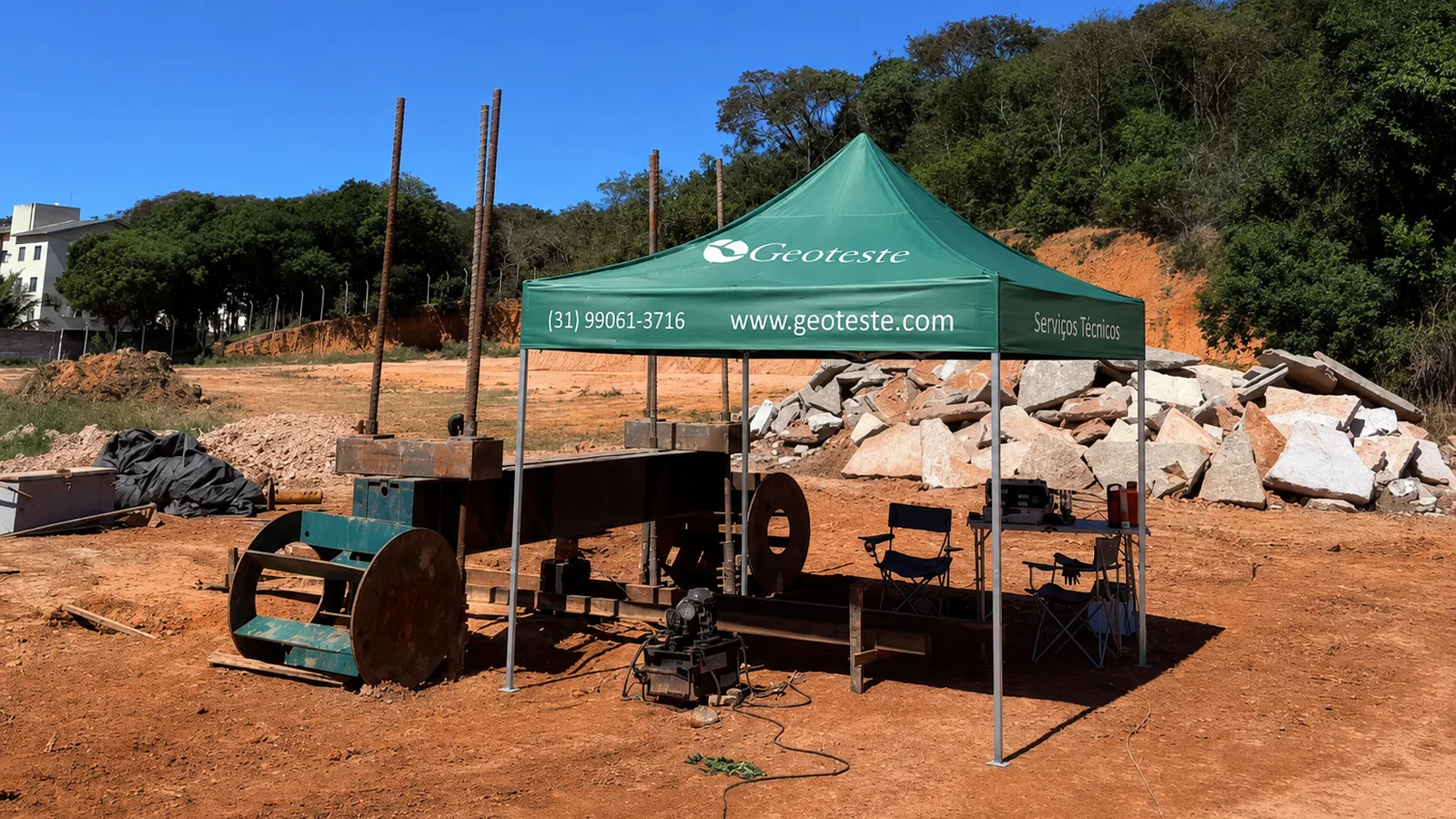
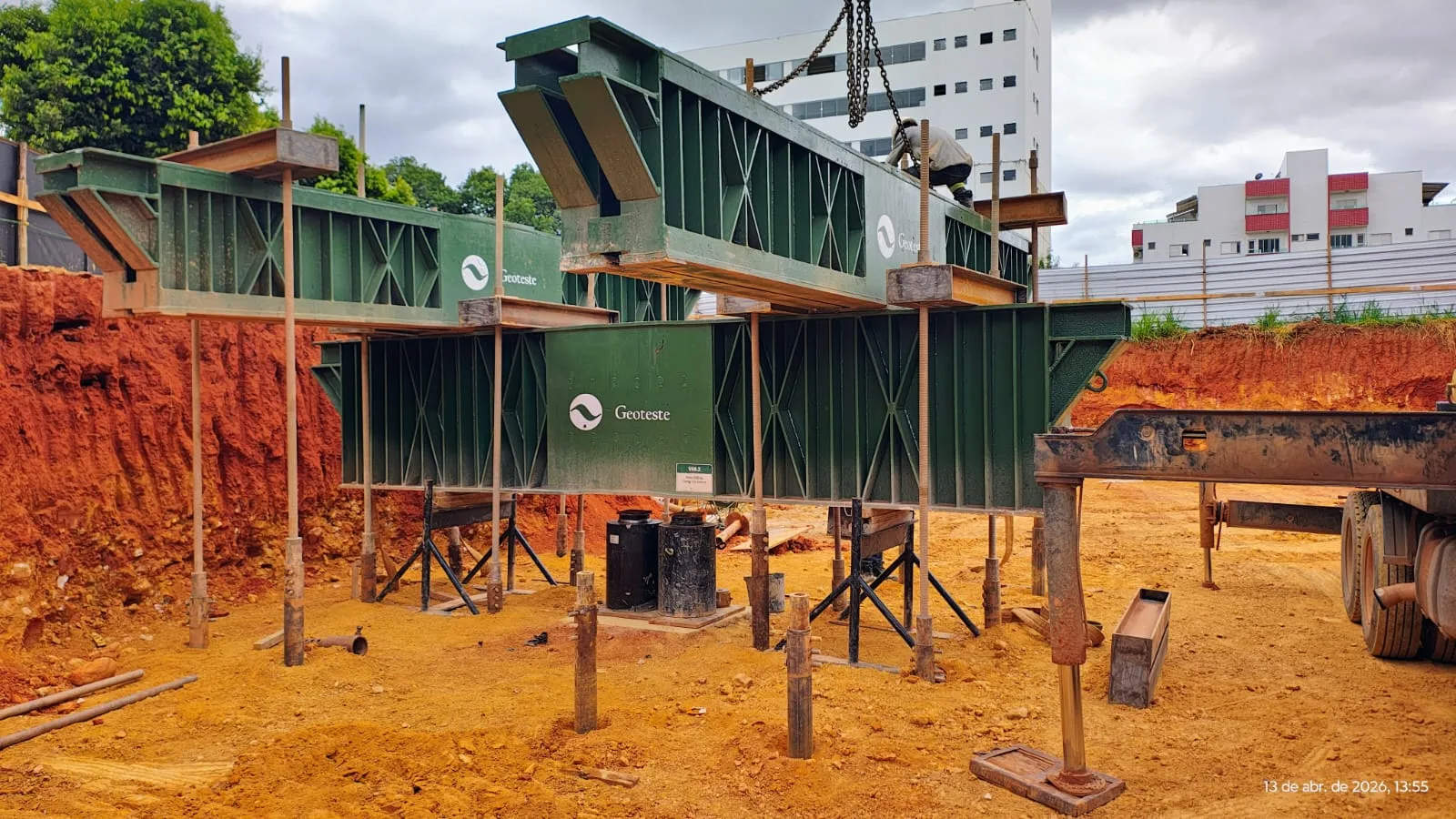
Loading can be performed slowly, quickly, or cyclically, applying successive load increments by means of a hydraulic cylinder activated by a pump. Since the test depends on the application of real forces at the pile top, the assembly of a compatible reaction system is mandatory. This system generally consists of reaction piles anchored to the ground, reaction boxes filled with ballast, or steel beams connected to adjacent reaction piles working in tension.
Technical advantages of the static load test
- Direct measurement of the load versus settlement curve under sustained static loading.
- Possibility of determining behavior at different levels of settlement stabilization.
- Direct evaluation of the elastic and residual settlement portions after complete unloading.
- Feasibility of in-depth instrumentation for segregation of side friction and toe resistance.
Limitations of the static load test
- Requirement for heavy and time-consuming assembly for the reaction system on the construction site.
- Interference with executive logistics and physical space restrictions in confined sites.
- High unit operational cost compared to rapid methods.
- Reduced sampling of the total pile lot due to the execution time of each test.
Definition and fundamentals of the Dynamic Load Test
The dynamic load test, widely known by the acronym PDA resulting from the equipment Pile Driving Analyzer, is based on the theory of one-dimensional wave propagation in rods. The method is nationally standardized by ABNT NBR 13208 and has international support in references such as ASTM D4945. The test is based on the application of a high-energy impact to the top of the element, typically provided by the driving hammer itself or by a free-falling weight system coupled to a crane.
Instrumentation involves fixing pairs of strain gauges and accelerometers installed on the lateral faces of the pile, positioned below the top. During the blow, the sensors record the specific strain and acceleration signals over time. From these primary data, the acquisition system calculates the force and velocity curves of the wave that travels through the shaft and reflects at impedance variations and at the pile toe. The total static resistance is not a quantity directly measured by the PDA, but rather an estimate derived from the processing of the measured data, subsequently complemented by numerical curve-fitting analyses, such as the CAPWAP curve-fitting procedure.
Technical advantages of dynamic loading
- High execution speed, allowing multiple elements to be tested per field day.
- Dispenses with the assembly of conventional reaction systems with large tie-downs or ballast.
- Evaluation of the structural integrity of the shaft along the entire tested length.
- Measurement of maximum compression and tension stresses applied during impact.
- Evaluation of the driving system efficiency and actual energy transfer from the hammer.
Limitations of dynamic loading
- The static bearing capacity is estimated via computational model and not directly measured at rest.
- Requirement for a blow with sufficient energy to mobilize soil resistance, at the risk of underestimating the pile capacity if the permanent settlement per blow is insufficient.
- Influence of transient dynamic effects and pore pressure dissipation at the moment of impact.
- Need for heavy hammers for testing large-diameter cast-in-place piles.
Structured comparison between PCE and PDA
For an objective analysis of the operational and geotechnical characteristics of each test, the following table summarizes the main variables that guide decision-making on the construction site.
| Analysis Aspect | Static Load Test (NBR 16903) | Dynamic Load Test - PDA (NBR 13208) |
|---|---|---|
| Main objective | Load versus settlement curve under static load | Dynamic mobilization, integrity, and static load estimation |
| Measured quantity | Applied static load and stabilized settlement | Force and velocity of wave propagation in the shaft |
| Ultimate load estimation | Conventional failure criteria or extrapolation methods | Numerical analysis of signal fitting (numerical soil model) |
| Reaction system | Requires a reaction frame, reaction tie-downs, or tensioned piles | Dispenses with anchored reaction system (uses falling mass) |
| Typical productivity | Generally one element every few days | Several elements in a single workday |
| Statistical representativeness | Low number of piles tested per project | A higher percentage of the foundation lot can be evaluated |
| Shaft integrity | Does not evaluate continuity along the length | Detects structural damage and section variations in the element |
Normative criteria and ABNT NBR 6122:2022
The regulatory standard for foundation design and execution in Brazil, ABNT NBR 6122:2022, establishes clear criteria for performing performance tests in civil engineering works. The normative text does not treat the tests as mutually exclusive, but rather as procedures with specific functions within the foundation quality assurance plan.
Regarding the minimum number of tests, NBR 6122:2022 defines rules based on the total number of piles in the project, the type of element used, and the foundation loading level. Historically, the standard admits an equivalence relationship in which dynamic tests can partially replace static load tests in certain numerical proportions, provided there are cross-calibration elements. This criterion allows projects with a high number of elements to increase control coverage through dynamic tests without losing the direct static reference.
The calibration of the dynamic model through a static load test on the same site and under the same subsoil conditions represents the best practice in geotechnical engineering. The result of the static load test serves to verify the soil damping parameters and the models adopted in the numerical analysis of the dynamic test, providing greater consistency for the predictions made for the other elements of the project.
Determining factors for test selection
To determine the most appropriate test for a given project, the technical responsible must analyze a set of technical, geological, and constructive conditions.
Pile type and construction method
Precast concrete piles, steel sections, and driven pipe piles are naturally favorable for the application of dynamic testing, as the driving equipment is already mobilized on site. In these elements, the PDA can even be performed during driving to monitor structural stresses, or during redriving after a certain period to evaluate soil resistance gain.
However, for large-diameter excavated piles, continuous flight auger piles, or root piles, performing the dynamic test requires the mobilization of an independent free-falling mass system with guides and a triggering mechanism. In these scenarios, setting up a reaction system for the static load test, or using embedded bidirectional cells, may present competitive operational viability compared to the dynamic impact of large masses.
Temporal phenomena of setup and relaxation
The resistance of a pile is not static over time after its installation. In cohesive soils and silts, the driving process generates excess pore pressure in the vicinity of the pile shaft. The dissipation of these pressures, associated with soil reconsolidation, leads to a gain in resistance over time, a phenomenon called setup. Conversely, certain saturated gravelly soils, shales, or weathered rocks may experience stress relief or degradation with a reduction in capacity, a process known as relaxation.
Both the static load test and the dynamic test must respect the normative waiting time between installation and testing, ensuring that the soil has re-established its stress equilibrium state. The dynamic test offers the technical advantage of being able to be performed at the end of the initial driving and repeated weeks later on the same pile, allowing for direct quantification of the rate of geotechnical resistance gain or loss.
Logistics, space, and schedule
In dense urban areas, basements of existing buildings, or steep slopes, the installation of a large reaction frame for static load testing may be unfeasible due to ground overload and the unavailability of space for truck and crane circulation. The dynamic test presents less spatial interference with the overall logistics of the project.
When the critical path of the executive schedule does not accommodate the assembly, execution, and disassembly of reaction systems for multiple elements, the recommended strategy is to perform a reference static load test and cover the remaining foundation fronts with expanded sampling dynamic tests.
Geoteste's specialized performance in foundation control
The correct choice between performing static load tests and dynamic tests must always reflect the subsoil's geotechnical parameters, project specifications, and current normative guidelines. Neither procedure fully replaces the utility of the other in all foundation engineering scenarios. The balanced combination of both tests offers the best relationship between safety, statistical control, and operational efficiency for the project.
Geoteste operates in the quality control of deep foundations in accordance with ABNT NBR 16903:2020, ABNT NBR 13208, and ABNT NBR 6122:2022. Our team performs axial and lateral static load tests with electronic instrumentation systems, as well as PDA dynamic load tests with advanced numerical modeling via CAPWAP, covering from the preliminary design phase and parameter calibration to the final quality control of the undertaking. Contact our geotechnical engineers to evaluate your project's demands and define the most suitable testing plan.