The common doubt about the equivalence between PDA and PCE
In the routine of deep foundation control and validation, designers and construction supervisors frequently face the comparison between dynamic load testing and static load testing. When both methods are performed on the same project, or even on the same foundation element, the classic question arises: should the numerical values of bearing capacity obtained be strictly equal?
The objective technical answer is no. Although both procedures aim to verify the performance of the foundation element under axial loads, they are based on distinct physical principles, use different measured quantities, mobilize the soil at incomparable time scales, and require their own analytical models for interpretation. Understanding these discrepancies prevents misinterpretations of reports and guides structured decision-making for geotechnical design.
What each method effectively measures in the field
One of the fundamental points established by good diagnostic engineering rigor is the distinction between what is measured by instruments, what is calculated mathematically, and what is estimated via theoretical models.
Static load test and the load versus displacement response
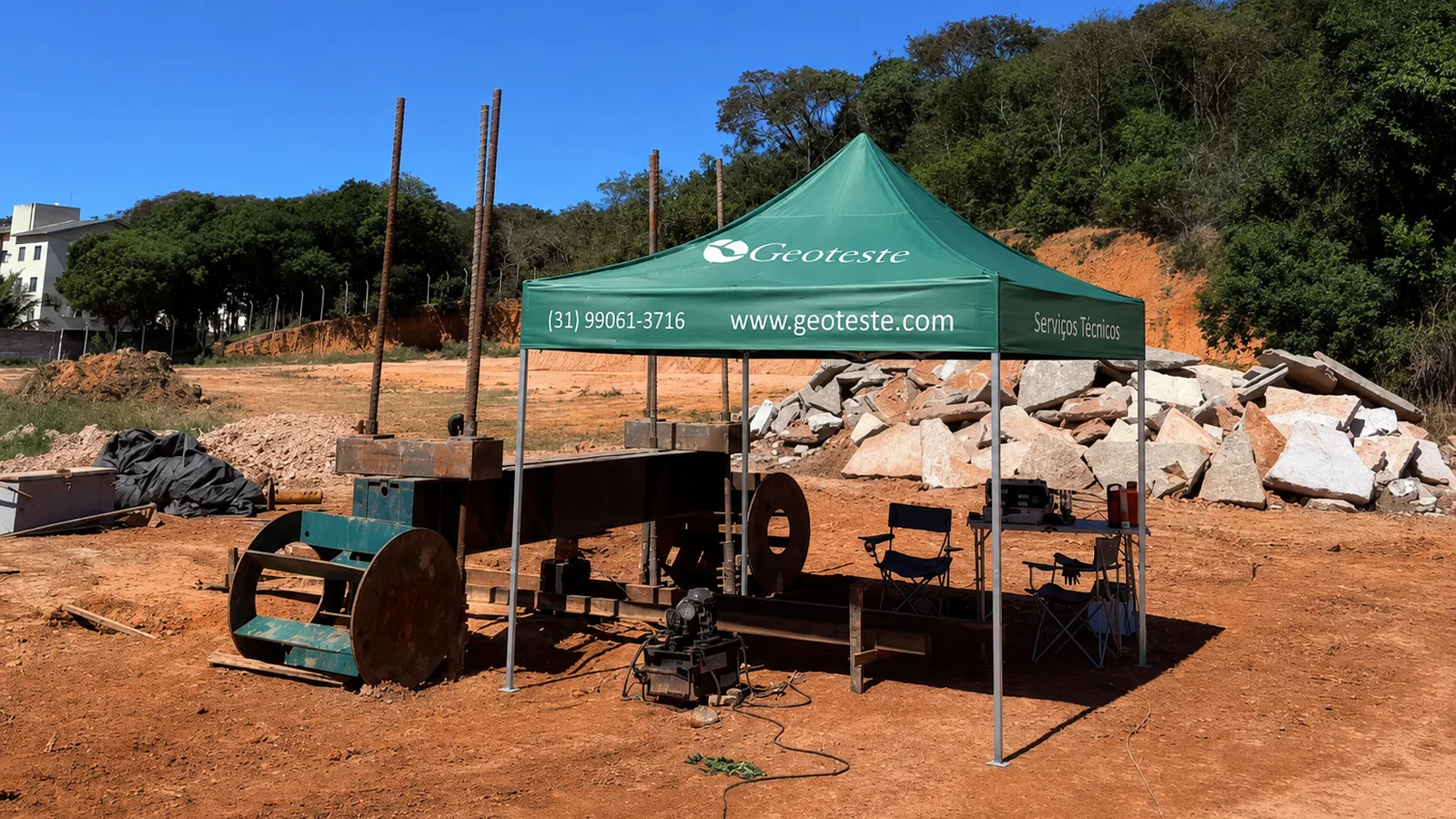
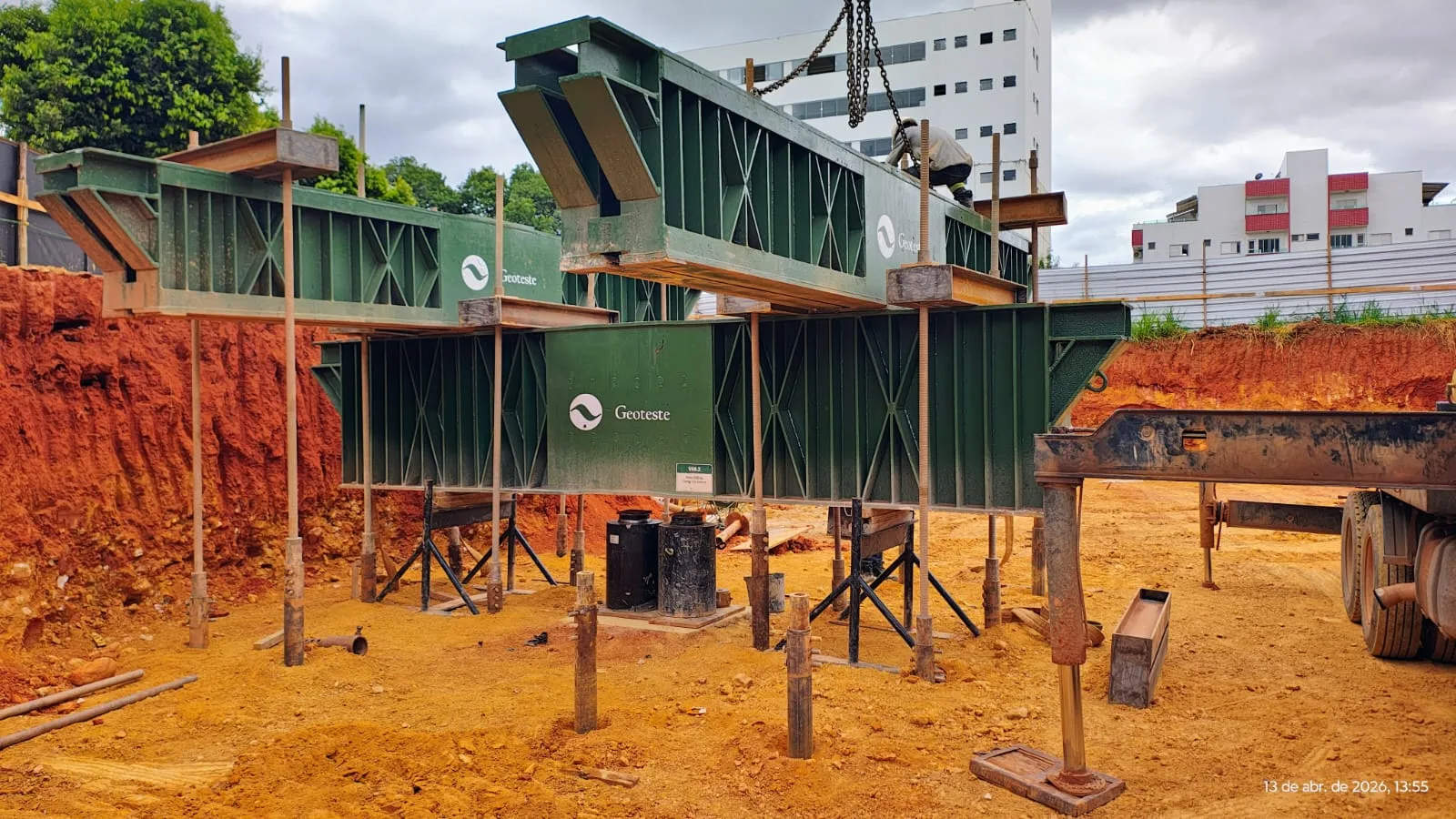
The static load test on deep foundations in Brazil is governed by ABNT NBR 16903:2020, which replaced the old NBR 12131. The method consists of applying static or quasi-static axial forces to the top of the structural element using duly calibrated hydraulic jacks, reacting against an anchored structure or kentledge box.
In this test, the directly measured quantities are the force applied at the top, measured by load cells or calibrated pressure gauges, and the corresponding vertical displacement, monitored by electronic transducers or dial gauges along controlled time increments. The primary result is a load versus displacement curve obtained under a quasi-static equilibrium regime, allowing direct observation of initial stiffness, residual settlement, and the approach of eventual physical or conventional failure limit states.
Dynamic load test and stress wave propagation
The dynamic load test, popularly known as PDA testing due to the pioneering Pile Driving Analyzer equipment, follows the prescriptions of ABNT NBR 13208:2007 and international references such as ASTM D4945. It is not a direct static measurement.
The procedure is based on the impact of a percussion system, such as a pile driver hammer or a free-falling hammer, on the pile top. This impact introduces a compressive stress wave that travels down the shaft to the toe and returns reflected by impedance variations and the resistance offered by the surrounding soil. Sensors attached to the shaft strictly measure two temporal quantities over a few milliseconds: the specific strain of the pile material and the acceleration caused by the blow.
From these measured quantities, the axial force and the particle propagation velocity are calculated. Subsequently, using the one-dimensional wave equation and methods such as the Case Method or numerical signal matching analyses, known as CAPWAP analyses, the total mobilized resistance is estimated, and the static component is separated from the dynamic component due to the soil mass's damping.
Physical and geotechnical factors that cause differences in results
Several phenomena prevent the result obtained in a dynamic test from mathematically coinciding with the level reached in a static load test, even when both are conducted with maximum technical rigor.
Strain rate effect and viscous damping
The loading rate imposed during the dynamic test is several orders of magnitude higher than that observed in a static load test. In PDA, the application of maximum energy occurs on the millisecond scale, generating high relative displacement velocities between the pile and the soil. Under these conditions, the soil develops a viscous dynamic resistance that does not exist in slow, quasi-static loading.
To estimate the equivalent static resistance from dynamic impact, analysis models subtract a portion associated with soil damping. The accuracy of this separation depends on the representativeness of the adopted parameters, such as the Case damping factor or Smith damping coefficients in numerical matching. Small discrepancies in these parameters generate deviations between the calculated static resistance and what would be measured in a slow test.
Applied energy and degree of resistance mobilization
For a static or dynamic load test to register the ultimate bearing capacity of a pile, the applied load must be sufficient to fully mobilize both the lateral friction along the shaft and the toe resistance. Generally, lateral friction requires displacements of a few millimeters for its complete mobilization, while toe resistance may require displacements greater than 5% or 10% of the pile diameter.
In a dynamic test, the hammer energy may not be sufficient to displace the pile in order to mobilize the total toe resistance. In this scenario, the PDA test does not provide the pile's actual ultimate capacity, but rather the resistance mobilized by that specific blow. In a static load test conducted with an adequate reaction system, the jacks can apply higher loads until geotechnical exhaustion or the pre-fixed design limit, leading to an unbalanced comparison if the PDA energy was limited.
The time factor: pore pressure dissipation, setup, and relaxation
The chronological interval between pile installation and testing is one of the most frequent sources of divergence in results. In saturated clayey soils, pile driving or drilling generates excess neutral pore pressure, temporarily reducing the effective stress of the soil.
Over days or weeks, the dissipation of these neutral pressures and the readjustment of stresses at the soil-foundation interface cause a gain in bearing capacity over time, a phenomenon called pile setup. A dynamic test performed at the end of driving will record significantly less resistance than a static load test performed thirty days later on the same element. Similarly, in certain dense silts or shales, the inverse effect of relaxation may occur, characterized by a gradual loss of resistance after installation.
Comparison between test methods
To clarify the role of each procedure in geotechnical risk management, the table below summarizes the operational and physical points that distinguish the static load test from the dynamic load test.
| Technical Aspect | Static Load Test (PCE) | Dynamic Load Test (PDA) |
|---|---|---|
| National Technical Standard | ABNT NBR 16903:2020 | ABNT NBR 13208:2007 |
| Nature of loading | Quasi-static force in maintained increments | Short-duration percussion impact |
| Measured quantities | Force at top and vertical displacement | Specific strain and temporal acceleration |
| Loading time scale | Hours or days per increment and cycle | Milliseconds per applied blow |
| Resistance interpretation | Direct reading from load versus displacement curve | Estimation via wave equation and damping models |
| Additional information obtained | Elastic, residual settlement, and static stiffness | Maximum driving stress and shaft integrity |
| Toe mobilization | Depends on the capacity of the reaction system | Depends on the energy transmitted by the hammer impact |
Criteria of ABNT NBR 6122 and complementarity of tests
The Brazilian standard for the design and execution of foundations, ABNT NBR 6122:2022, does not treat these two methods as competitors or as tools that should produce identical results, but rather as complementary resources for control and assurance of deep foundation safety.
NBR 6122 allows the use of dynamic loading as a quality control and bearing capacity validation tool, provided it is properly calibrated or interpreted with complementary analyses. In medium and large-scale projects, the most recommended practice consists of calibrating the dynamic parameters by jointly performing a static load test on a reference pile, allowing correlation of damping coefficients and verification of local setup factors. Once the model is calibrated, PDA tests can be replicated on a substantially larger sample of the project with speed and lower logistical cost.
Therefore, expecting the capacity calculated by PDA and the limit load obtained in PCE to be strictly equal numbers denotes disregard for soil-structure interaction phenomena. Small differences are expected and fully justifiable in light of soil mechanics and structural dynamics. The engineer's role is to verify if these variations are within ranges compatible with the geotechnical dispersion of the terrain and with the design assumptions.
Geoteste's role in foundation validation and control
The precise execution of load tests requires rigorous control over the physical quantities involved, strict compliance with ABNT NBR 16903:2020 and ABNT NBR 13208:2007, in addition to certified equipment to ensure the traceability of data collected in the field. Geoteste operates in all stages of deep foundation control, performing static load tests with high-resolution electronic instrumentation and dynamic load tests with signal matching analysis via wave equation models.
By supporting designers, construction companies, and managers in defining the testing plan according to the guidelines of ABNT NBR 6122:2022, our team provides well-founded technical reports that adequately correlate the effects of time, deformation, and load mobilization for each pile typology. To plan your project's testing program or discuss the calibration of results between static and dynamic tests, please contact Geoteste's technical engineering team.