Understanding pile setup in piles
The term pile setup describes the increase in resistance or geotechnical axial capacity of certain piles after installation completion. It is a time-dependent phenomenon that occurs at the interface between the foundation element and the surrounding soil mass. Geotechnical literature recognizes that the magnitude and rate of this gain vary significantly according to geological characteristics, installation method, and pile geometry.
It is important to emphasize that temporal behavior does not affect all types of foundations in the same way. While driven displacement piles often show significant resistance gains over days or weeks after driving, cast-in-place bored piles may exhibit distinct responses due to initial stress relief and alteration of the soil structure during excavation. Correct analysis of this behavior requires technical rigor and monitoring through instrumentation and specific tests.
Physical mechanisms associated with capacity gain
The evolution of resistance over time does not result from a single cause. It is a multifactorial process involving complex interactions between the soil and the structure. Among the main mechanisms studied in soil mechanics, the following stand out:
- Dissipation of excess pore pressure generated during the driving or penetration process of the foundation element.
- Progressive increase in effective stresses around the pile shaft as the flow regime and neutral pressures stabilize.
- Reconsolidation of the adjacent soil, which recovers part of its compactness and shear strength.
- Soil aging and creep processes that act on the reaccommodation of solid particles at the soil-pile interface.
- Evolution of radial stresses and gradual modification of the geotechnical system's stiffness.
In soft cohesive soils, the dissipation of excess pore pressure and subsequent consolidation play a predominant role in the process. In granular soils, on the other hand, the behavior is often associated with the redistribution of local stresses, aging, and adjustments in the granular structure in the pile's zone of influence.
Applicable technical standards for design and testing
The regulation of deep foundations and control methods in Brazil is established by standards from the Brazilian Association of Technical Standards (ABNT). ABNT NBR 6122 sets the general requirements for the design and execution of foundations, covering safety conditions, performance criteria, and quality control requirements.
For the evaluation of load capacity and dynamic behavior of piles, ABNT NBR 13208 specifies the method for performing dynamic load tests. Internationally, ASTM D4945 complements the procedures for high strain dynamic testing of deep foundations. It should be noted that the design standard should not be confused with the testing standard, the latter being specific to the execution and interpretation of the field procedure.
The role of dynamic load testing in pile setup evaluation
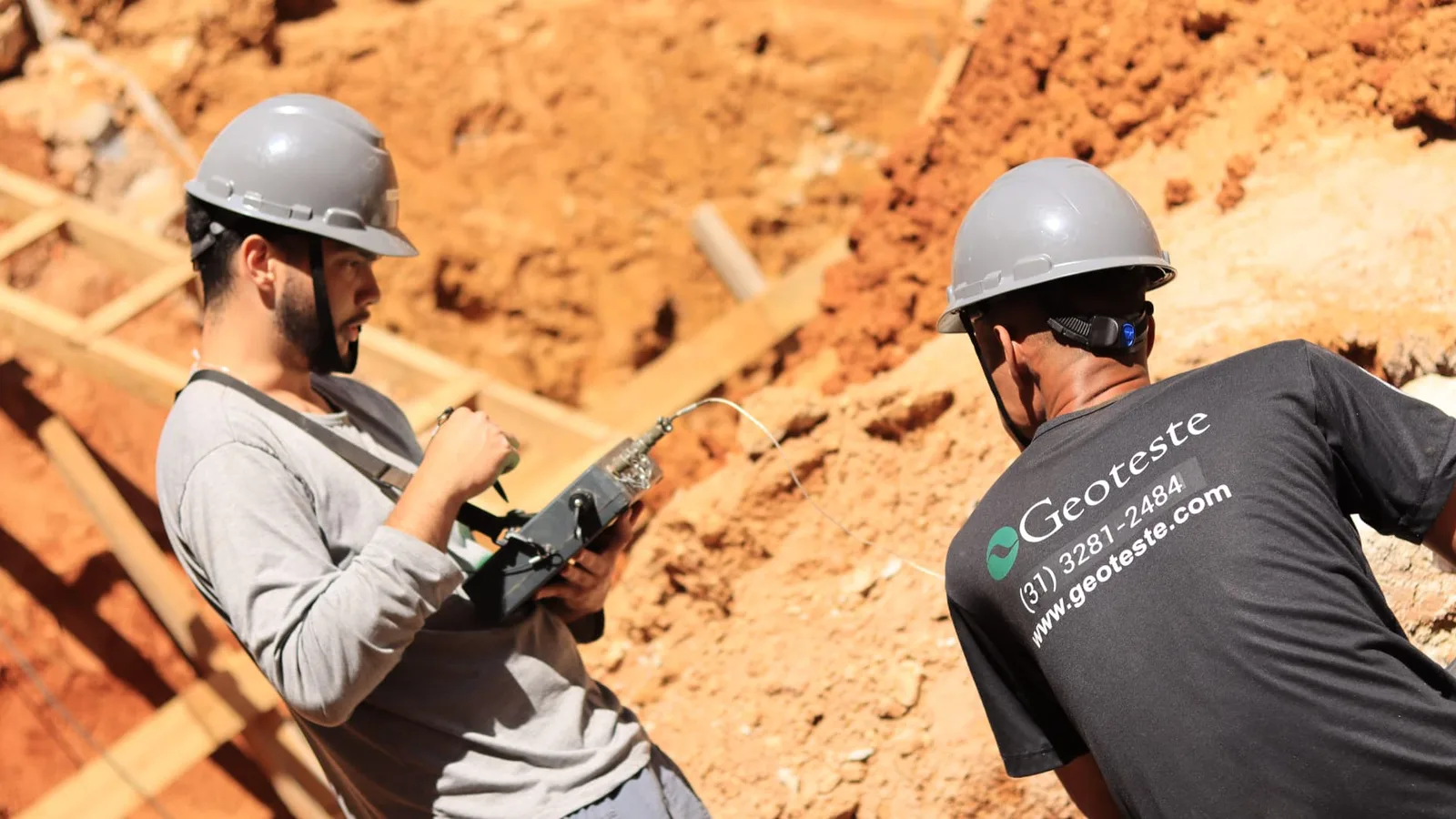
Monitoring pile setup requires performing tests at different ages after pile installation. Dynamic load testing, commonly performed with the aid of PDA equipment, consists of applying impact energy to the pile head, recording the force and velocity waves generated along the shaft.
From the field-measured signals, analytical processing is performed to estimate the static resistance mobilized at the time of the test. It is fundamental to distinguish between the dynamic response measured directly by the sensors and the static resistance interpreted through correlations and wave models. PDA provides valuable data on the variation of mobilized resistance over time when performed immediately after driving and at later stages, allowing quantification of the capacity gain associated with pile setup.
Limitations and interpretation considerations
The extrapolation of results obtained from a single tested pile to the entire foundation of a project requires careful analysis. The behavior observed at a specific point reflects the local subsurface conditions and the installation energy applied to that particular element. Variations in the geotechnical profile across the project area prevent the result of one pile from being treated as an absolute guarantee for the entire undertaking.
Furthermore, the temporal capacity gain should not be overestimated without proper experimental basis. Under certain specific conditions, the literature also records the inverse phenomenon, known as relaxation, in which the pile capacity may experience a temporal reduction. Therefore, the definition of the allowable load and the validation of pile setup must be conducted by geotechnical engineers based on field-obtained evidence.
Specialized technical support in foundation testing
The correct identification and quantification of temporal phenomena in deep foundations require high-precision equipment and a highly qualified technical team. Geoteste operates with scientific rigor in performing dynamic load tests with PDA, static load tests according to ABNT NBR 16903, and integrity tests, providing reliable data for the design and technological control of foundations throughout Brazil. Contact our technical team to discuss the specifics of your project and define the most suitable testing program for your needs.