The Importance of Foundation Control in Geotechnical Engineering
In foundation engineering, ensuring structural safety and adequate performance throughout a building's service life depends on rigorous quality control of deep elements. The standard NBR 6122:2022 (Foundation Design and Construction) establishes clear requirements for verifying the performance and integrity of piles, making correct technical specification indispensable in the geotechnical project.
The choice among the Pile Integrity Test (PIT), the Pile Driving Analyzer (PDA), and the Static Load Test (PCE) frequently causes doubts among designers, structural engineers, and construction managers. Although all are part of the scope of foundation control, each has distinct objectives, physical principles, deformation levels, and normative representativeness. Understanding the correct application when comparing PIT, PDA, or PCE is fundamental to avoid costly over-design or risks of severe structural pathologies.
Understanding the Three Main Geotechnical Tests
1. PIT (Low Strain Integrity Test)
The PIT (Pile Integrity Test), whose requirement in Brazil is established by ABNT NBR 6122 (Foundation design and construction), is a non-destructive, low strain test that evaluates the physical integrity along the pile shaft. The method is based on the theory of one-dimensional elastic wave propagation.
A gentle tap with a hand hammer on the pile head generates a low-energy stress wave that propagates to the toe and reflects back. A high-precision accelerometer installed on the pile head captures the response, allowing identification of concrete discontinuities, cross-sectional variations (necking or overconsumption), soil inclusions, or cracks.
- What it measures: Physical integrity, shaft continuity, and estimation of pile length.
- What it does NOT measure: Bearing capacity or foundation settlement.
- Main advantages: Quick execution, relatively low cost, allows testing 100% of the piles on a project in a short period.
- Typical applications: Systematic control in drilled piles, continuous flight auger piles, metallic sections, precast piles, and driven piles in general.
2. PDA (Dynamic Load Test)
The PDA (Pile Driving Analyzer), standardized by NBR 13208, is a high strain test designed to determine the ultimate or design bearing capacity of the pile, as well as the soil-structure interaction behavior under dynamic impact.
For its execution, a measurement system is installed at the top of the element containing pairs of strain gauges and piezoelectric accelerometers. The impact is generated by the free fall of an appropriate hammer or driving system (whose mass varies from 1% to 2% of the estimated bearing capacity of the pile). The force and velocity signals are recorded and processed in the field and subsequently submitted to numerical computational analysis using the CAPWAP (Case Pile Wave Analysis Program) method.
- What it measures: Total static bearing capacity, distribution of skin friction and toe resistance, compression and tension stresses during driving, and driving system efficiency.
- Main advantages: Lower cost and mobilization time compared to the Static Load Test, providing detailed results on geotechnical capacity and integrity.
- Typical applications: Validation of bearing capacity in precast piles, metallic piles, continuous flight auger piles, and large diameter drilled piles.
3. PCE (Static Load Test)
The PCE (Static Load Test), normatively governed by ABNT NBR 16903:2020, which replaced the old NBR 12131, and cited in ABNT NBR 6122, is considered the definitive and reference (gold standard) method among geotechnical tests for determining the stress-strain behavior of the foundation.
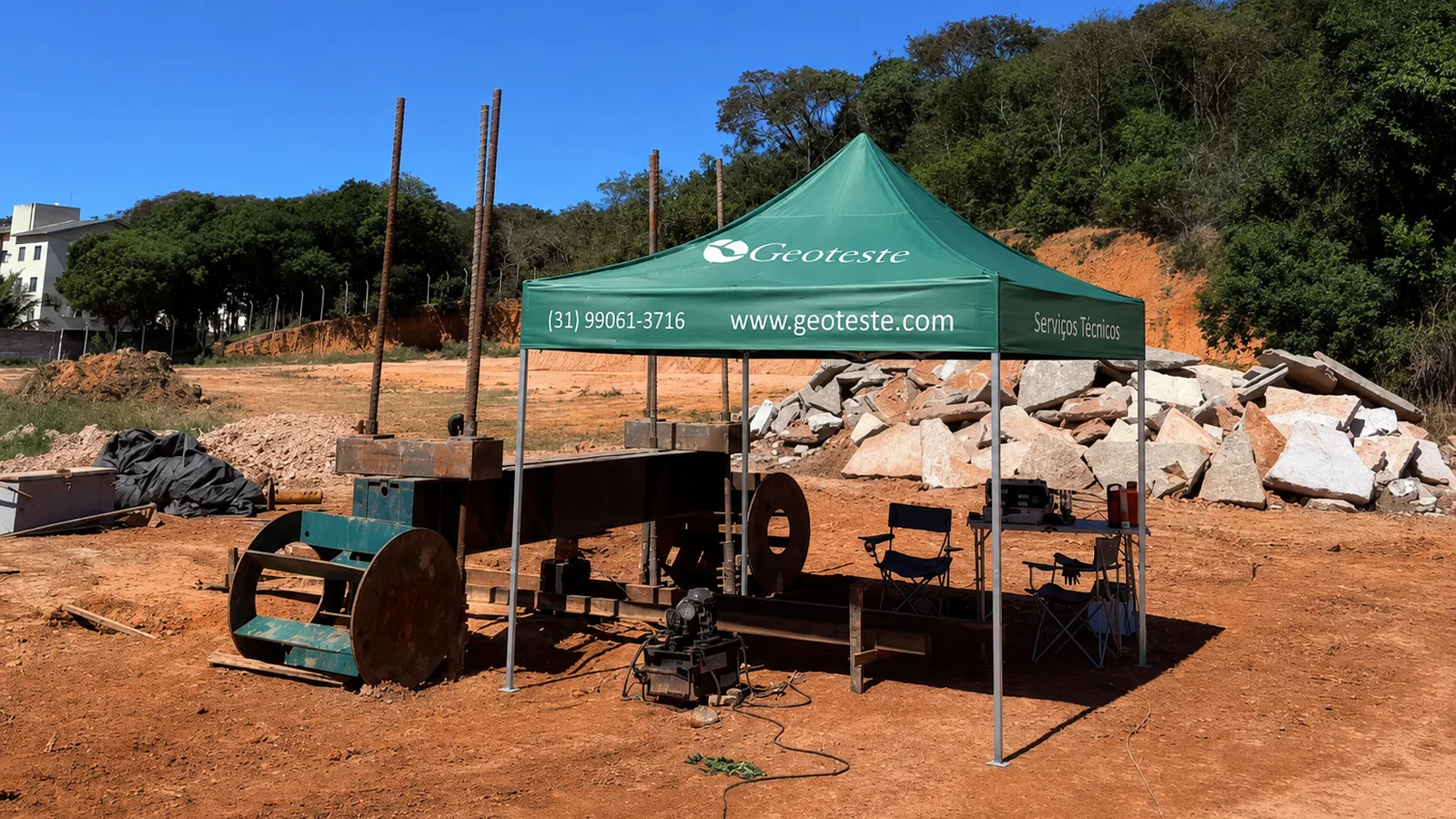
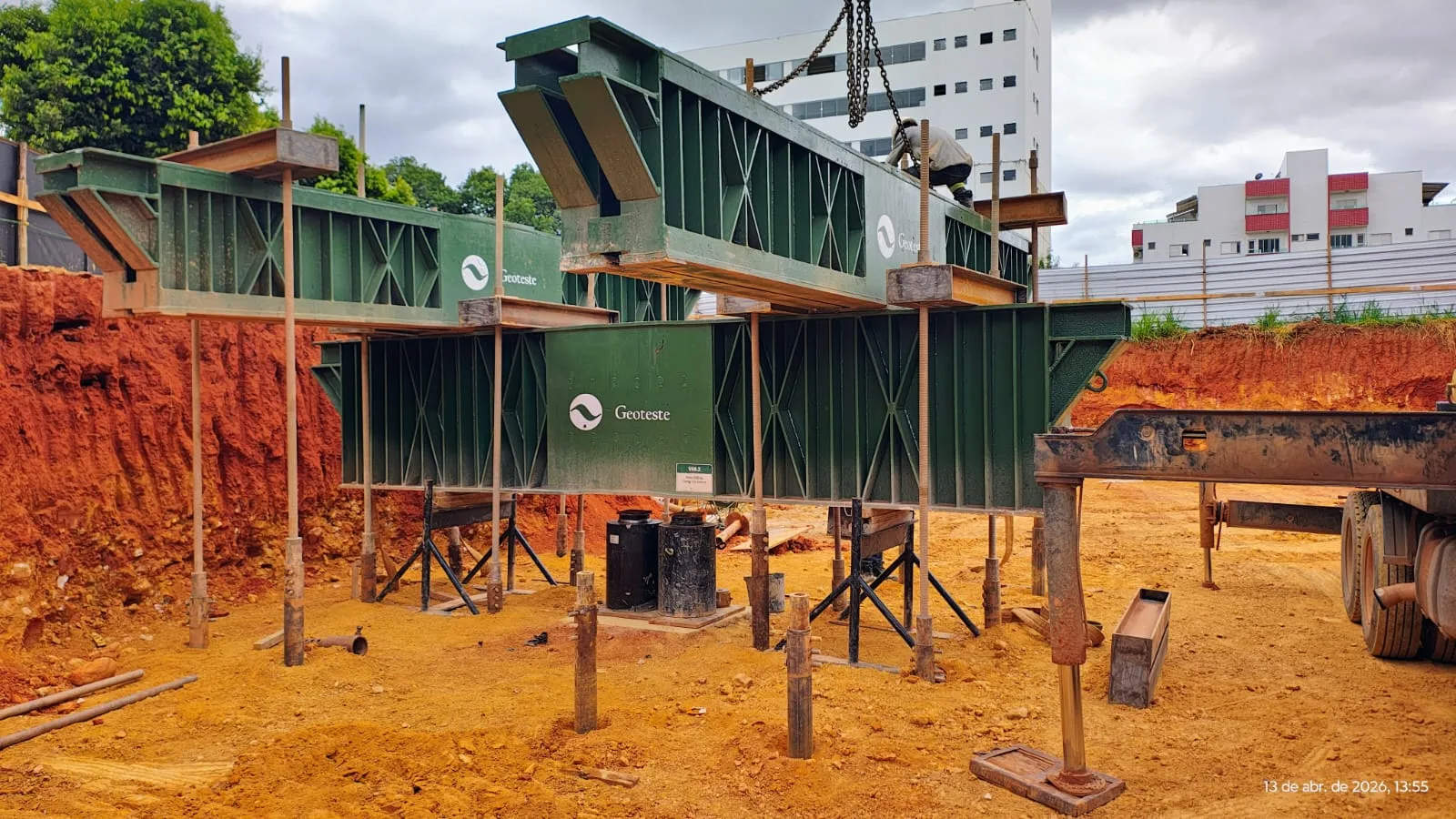
The test consists of the gradual application of static loads to the top of the pile using a hydraulic jack reacting against an anchored structure (tie-downs or reaction piles) or against a dead weight (reaction mass). Deformations (settlements) are recorded with dial gauges or LVDT transducers at each load stage, allowing the construction of the Load-Settlement curve.
- What it measures: Actual load-settlement curve, ultimate bearing capacity, stabilized settlement for the design load, and soil-pile system stiffness.
- Main advantages: Direct measurement without dependence on empirical or dynamic conversion models. Higher accuracy for predicting behavior under service loads.
- Limitations: High logistical and financial cost, complexity of setting up the reaction system, and longer execution time.
Comparative Table: PIT, PDA, or PCE
Before comparing numbers and costs, it is important to establish a point that avoids most specification errors: the three tests are not interchangeable, and none automatically replaces the other. They answer different technical questions. The PIT asks if the pile was constructed with continuity and a regular cross-section. The PDA asks what resistance is mobilized by the soil-pile system under impact and how it is distributed between the shaft and the toe. The PCE asks how the pile actually behaves in terms of load and settlement under static loading. A consistent testing plan combines all three according to the risk, pile type, and requirements of ABNT NBR 6122.
To support decision-making when choosing a test, the matrix below compares the intrinsic characteristics of each method:
| Parameter | PIT (Low Strain) | PDA (High Strain) | PCE (Static Load) |
|---|---|---|---|
| ABNT Reference Standard | ABNT NBR 6122 (requires integrity test) | ABNT NBR 13208 | ABNT NBR 16903:2020 |
| Main Objective | Shaft integrity | Geotechnical bearing capacity | Actual Load vs. Settlement Curve |
| Deformation Level | Low (Elastic) | High (Load mobilization) | Static (Up to failure or 2x design load) |
| Provides Bearing Capacity? | No | Yes (via CAPWAP analysis) | Yes (Direct measurement) |
| Execution Speed | Very high (up to 50+ piles/day) | Medium (2 to 6 piles/day) | Slow (1 to 2 days per test) |
| Relative Cost | Low | Intermediate | High |
| Reaction Requirements | None | Impact mass / Hammer | Reaction system (tie-downs or dead weight) |
| Evaluates shaft integrity? | Yes, that is the purpose of the test | Partially, the signal indicates relevant damage in the shaft | Does not evaluate integrity |
| Evaluates settlement? | No | Estimated by numerical modeling (CAPWAP) | Yes, settlement measured directly at each stage |
| Nature of result | Qualitative, with estimation of reflection depth | Quantitative, obtained by wave propagation modeling | Quantitative, direct physical measurement |
| Main limitations | Does not provide bearing capacity and loses resolution on very slender or very long piles | Depends on modeling and adequate mobilization of resistance during impact | High cost, long lead time, and need for a reaction system |
| Typical application situation | Large sampling scan for cast-in-place piles | Capacity verification for driven piles and setup retests | Measurement of load-settlement behavior in critical projects and design calibration |
How to Choose the Ideal Test for Your Project?
Practical Selection Criteria
The decision to specify PIT, PDA, or PCE should not be seen as a choice of one method to the exclusion of the others, but rather as the construction of a complementary geotechnical engineering strategy. The following factors should be evaluated in the project:
- Normative Requirement (NBR 6122:2022): The standard establishes a minimum number of load tests (static or dynamic) based on the total number of piles and the class of the structure. In projects with a large volume of piles, NBR 6122 allows partial replacement of PCEs with dynamic tests (PDA), optimizing timelines and costs.
- Pile Type and Construction Process: Cast-in-place piles (such as continuous flight auger, drilled with bentonite slurry or polymer) have intrinsic construction variability. In these cases, PIT is essential for large sampling to ensure concrete continuity. For precast piles and metallic sections, the focus is on bearing capacity and refusal, making PDA indispensable.
- Structure Criticality: Large-scale projects (bridges, viaducts, high-rise buildings, heavy logistical warehouses) require PCEs during the design phase or at the beginning of the project to adjust safety factors and validate the geotechnical parameters adopted in the design.
NBR 6122:2022 Guidelines for Sampling
The current version of NBR 6122 brought important advances regarding the volume of required tests. Generally, for projects with more than 100 piles, Static Load Tests are mandatory for at least 1% of the piles, respecting a minimum of 1 test. However, the standard allows replacing one PCE with an equivalent group of dynamic tests (PDA), provided they are technically correlated.
The integrity test (PIT) is widely indicated for verifying the construction process, especially for drilled piles and continuous flight auger piles, serving as an agile scanning tool (quality and shaft control).
Conclusion and Specialized Geotechnical Support
The appropriate specification among PIT, PDA, or PCE ensures the structural safety required by Brazilian standards, while avoiding unnecessary expenses in the foundation budget. Integrating integrity control with bearing capacity tests is the most efficient way to manage risks in civil construction.
Do you need specialized support to define the testing plan for your project or to execute geotechnical tests with normative rigor? Contact the Geoteste engineering team and ensure maximum reliability for your foundation project.