What is the PIT test?
In the world of civil engineering and construction, the safety and integrity of structures are fundamental aspects. One of the most effective and innovative techniques for evaluating the quality and reliability of foundations in infrastructure projects is the PIT test, or Pile Integrity Test. This is a powerful tool that allows engineers and constructors to verify the integrity of deep foundation structures, identify possible defects or damages (pathologies), and ensure that structures are built on solid and safe bases.
In this text, we will unveil the main information related to the PIT test, exploring what it is, how it works, what its advantages are, and why it is so essential in the construction of buildings, bridges, highways, and other large-scale works. We will discover the history of this technique, highlight its importance in the geotechnical engineering scenario, and share valuable information on how the PIT test contributes to the construction of safer buildings. So, prepare for a journey behind the scenes of foundation investigation and discover why PIT is an indispensable tool for civil construction professionals worldwide.
How did the PIT test originate?
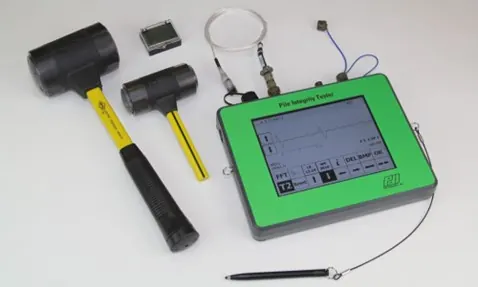
The PIT test originated in Europe, where there was a growing demand for testing of drilled piles. But it was in the United States, in the late 1980s, through the company Pile Dynamics, Inc. (PDI), that the first equipment for this test was developed. From that milestone, the test began to gain popularity in the United States, and later, the first PIT test equipment was introduced in Brazil in the early 1990s.
Since then, the PIT test has been refined with the development of advanced technologies, such as high-precision sensors and data analysis software. This technique has become a standard tool in the civil engineering industry and is widely used worldwide to evaluate the integrity of piles in a variety of construction and infrastructure projects.
PIT test procedures
Also known as the “Sonic Method Test” or “Pulse Echo,” the PIT (Pile Integrity Test) is a low-cost test that results in determining the effective length of cast-in-place piles and detecting possible pathologies, such as sectioning, necking, breakage, among others. Furthermore, with PIT, it is also possible to indicate relevant alterations in the pile material, for example, poor quality concrete.
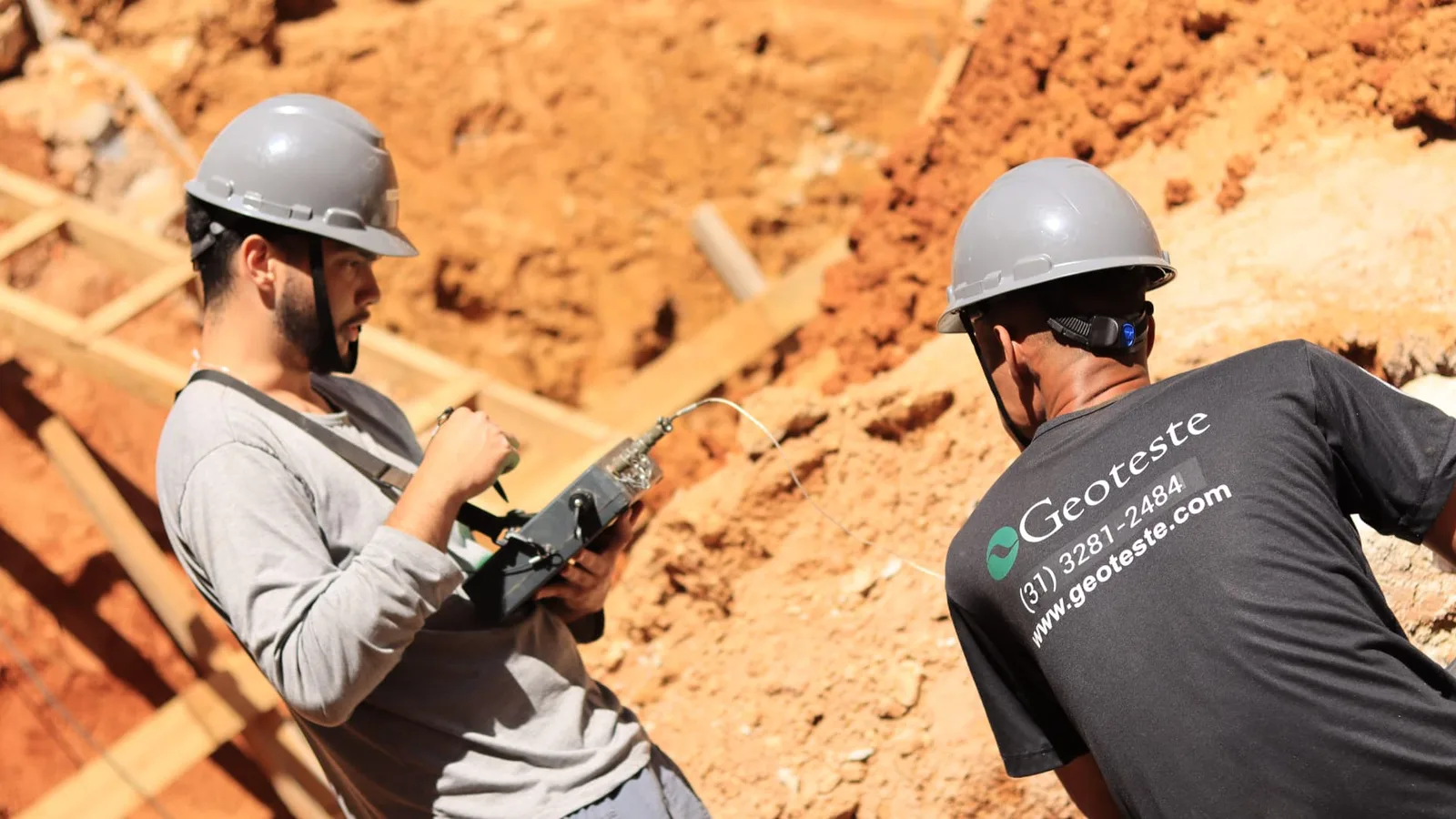
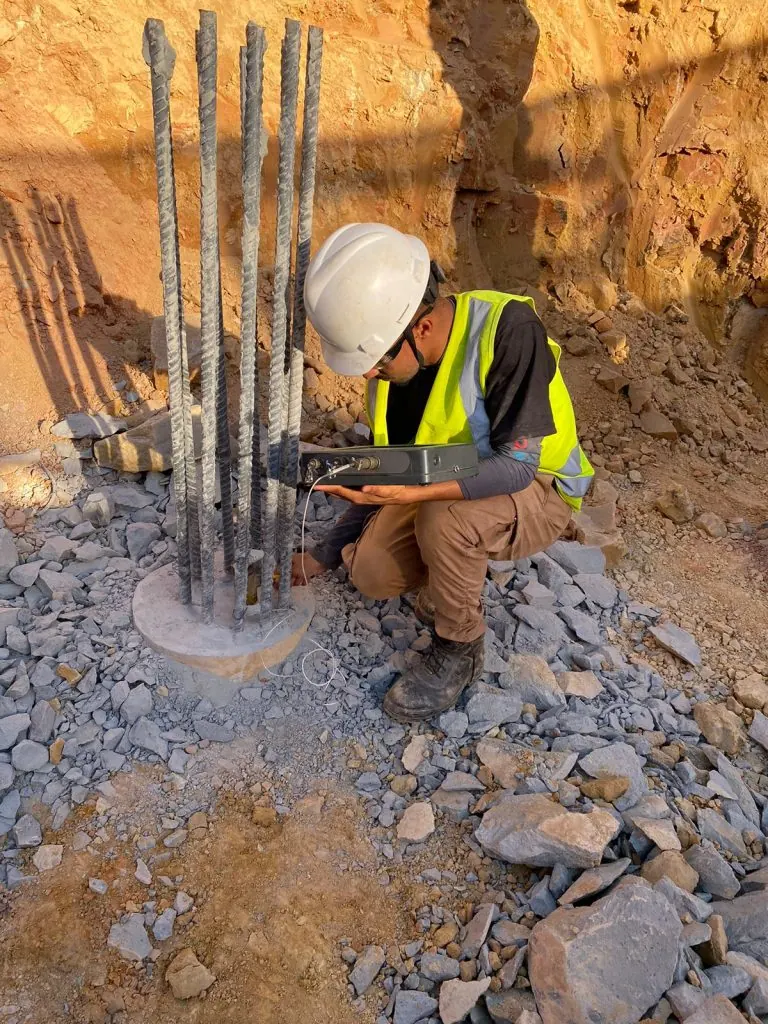
Regarding the execution of this test, initially, a high-sensitivity accelerometer (velocity sensor) is positioned at the top of the pile to be studied. From there, a hand hammer, with predefined characteristics, is used to generate a series of controlled blows. With these impacts, waves are propagated through the pile, which are read by the accelerometer. Through the analysis of these signals, the test results are obtained.
Interpretation of test results
The data collected during the test are analyzed in real-time or later. The analysis includes evaluating the propagation velocities of stress waves and identifying any variation or irregularity in the pile responses.
The obtained results are compared with reference data or with the expected characteristics of the foundation pile. Any significant deviation from the expected responses may indicate possible problems in the pile's integrity.
Based on this data analysis, engineers can determine whether the foundation pile is in good condition or if there are indications of defects, such as cracks, segmentation, or foreign inclusions in the concrete. This interpretation is fundamental for making informed decisions about the acceptance or the need for reinforcement for the piles.
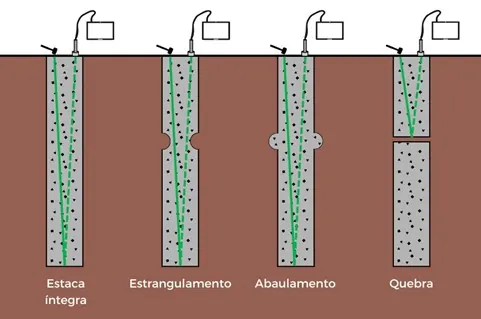
As the image demonstrates, the wave emitted by the hammer's impulse travels through the pile and returns to the sensor. When read by the equipment, it is possible to identify possible interferences in the piles (called pathologies). There are several types of pathologies that can occur during pile execution, which may be associated with the execution methodology, the type of soil, the type of concrete, or other causes. Therefore, it is important to perform this verification to ensure quality, safety, and durability for constructions, since foundations are fundamental elements for any type of work.
Advantages of executing the PIT
Regarding civil construction and geotechnical engineering, it is important to highlight that ensuring the integrity of deep foundations, meaning piles in general, is crucial. This is because foundations are, for the most part, the main elements responsible for the stability of buildings. Thus, performing the integrity test offers great advantages.
Initially, being a simple and non-destructive technique, the PIT test is an economical option for identifying valuable information for the engineers responsible for the project. Furthermore, by detecting pathologies in piles at the early stage of the works, this test allows solutions to be proposed to prevent these problems from worsening and generating more expenses for the project, leading to even greater savings, both in money and time.
Secondly, it is also worth noting the potential of the PIT test to bring more safety to the works. With this test, it is possible to ensure that the piles meet resistance and reliability requirements, contributing to safer structures in the long term. Moreover, being a simple test to execute, PIT is an efficient technique, performed quickly at the construction site, without interfering with the schedule and without the need for major prior interventions, since it only requires access to the pile head and that it is regularized, meaning without superficial damage or excessive cracking.
In general, the PIT integrity test is a valuable tool for engineering, as it ensures the quality and reliability of foundation piles. The ability to identify integrity problems early, save time and resources, and guarantee the safety of foundations makes PIT a recommended practice in the civil construction industry. Therefore, why not perform this test with Geoteste and build your enterprise with safety and quality?