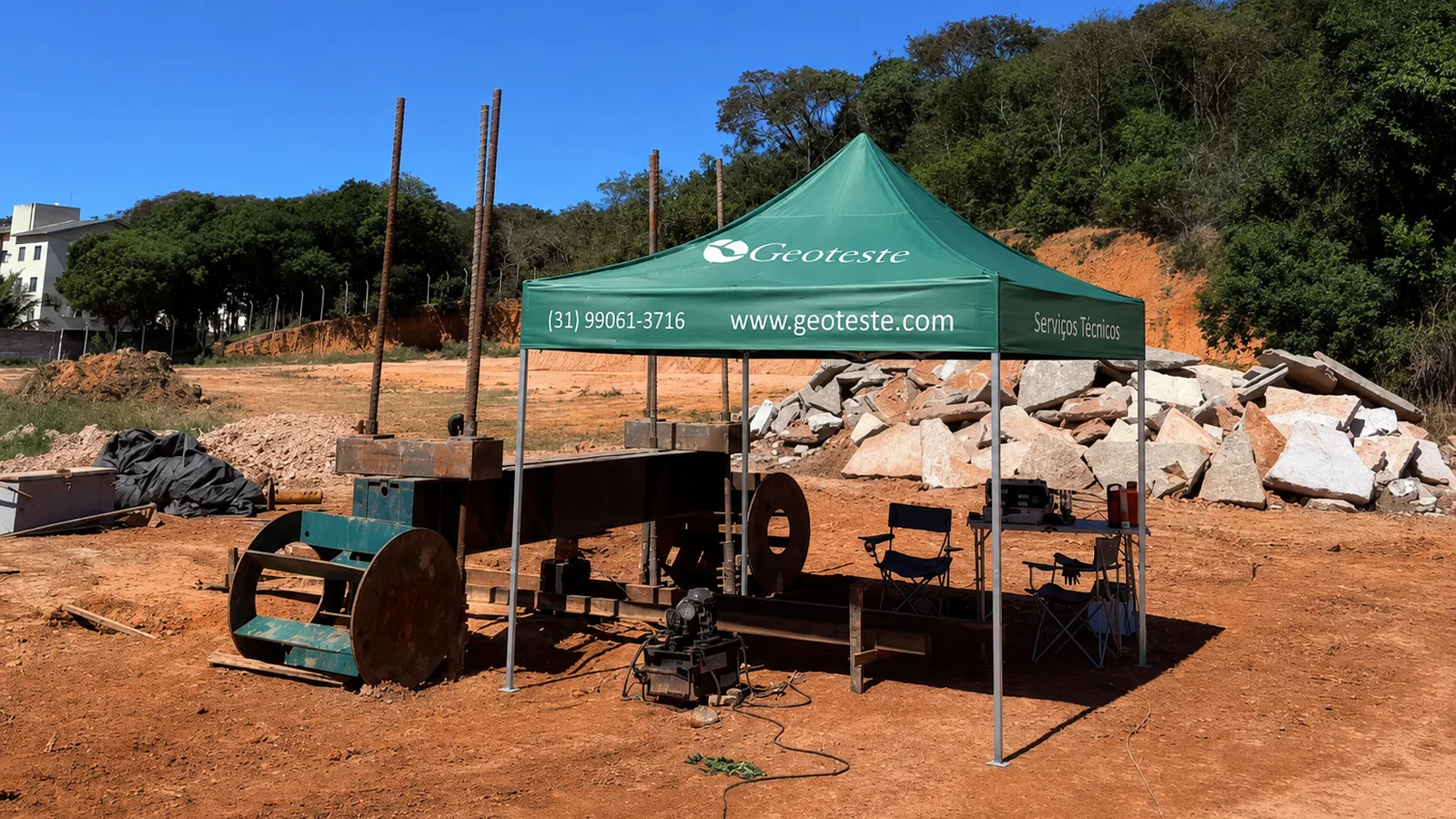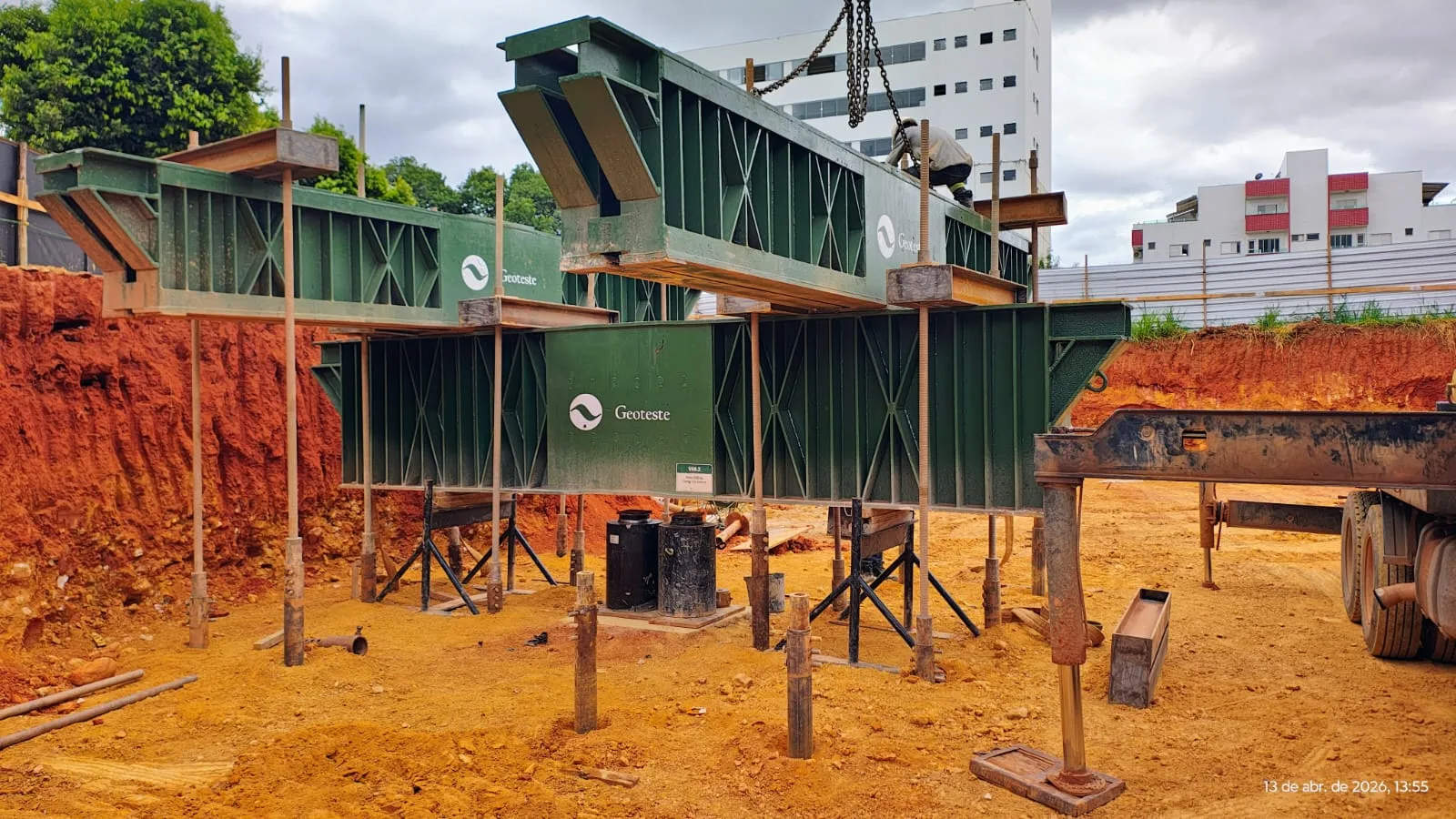
“In the world of geotechnical engineering, the Direct Plate Bearing Test is a very important test. It helps us understand how much weight the soil can support and how it deforms. It is an essential method to ensure the safety and good performance of large structures, such as roads and foundations, and it is all performed following rigorous technical standards like DNIT 410-17 and NBR 6489-19.”
What is it for and where is it applied?
The main objective of this test is to determine the Modulus of Deformability (EV2) of soil or rockfill layers. This number is fundamental to ensure the quality of embankments in roads, guaranteeing that the soil will support the loads without excessive deformation. For foundations, the test is used to plot a stress-displacement curve, which helps us estimate how much the soil will deform and what the foundation's resistance is.
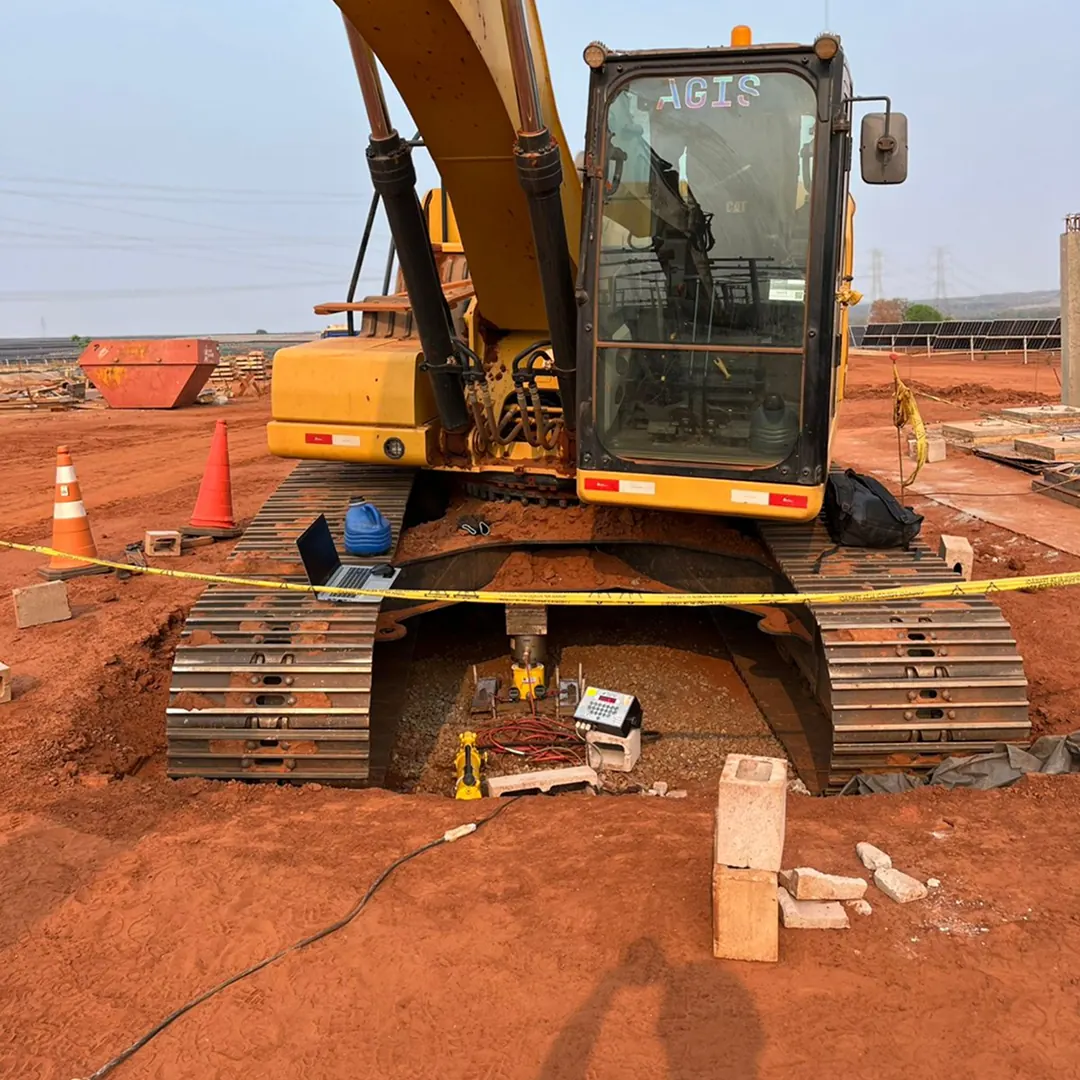
What do we use and how do we set it up?
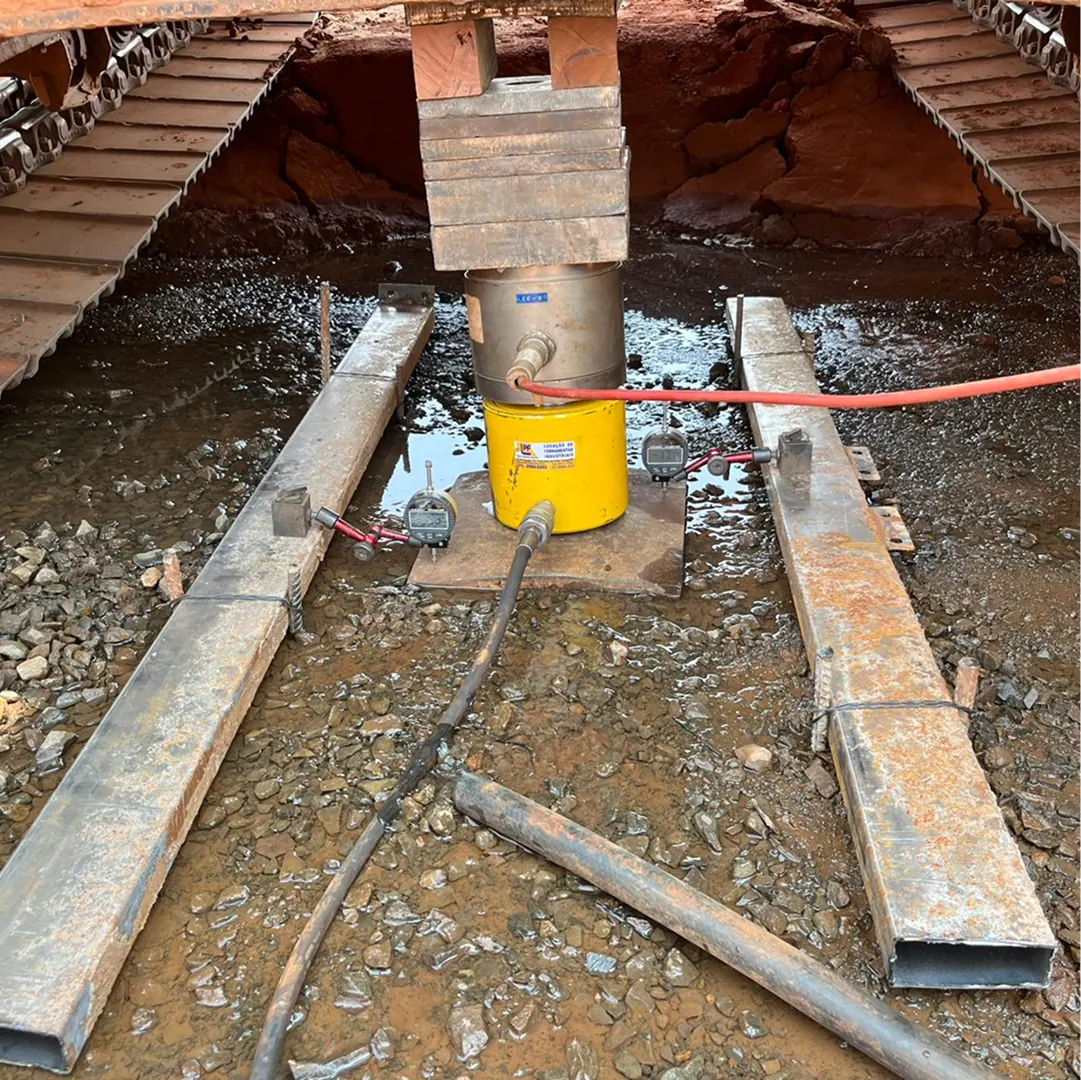
To perform the test, we need some specific equipment:
• Test Plate: This is a round and very rigid plate, which will transfer the load to the soil.
• Deflectometers: These are measuring instruments that record how much the plate moves downwards.
• Reaction System: This is a structure that supports the force we apply (usually a loader or a heavy truck).
• Hydraulic Jack: To apply the load in a controlled manner.
The setup must be done with great care, so that everything remains stable and the results are accurate. This includes preparing the soil with a sand bed and aligning everything properly.
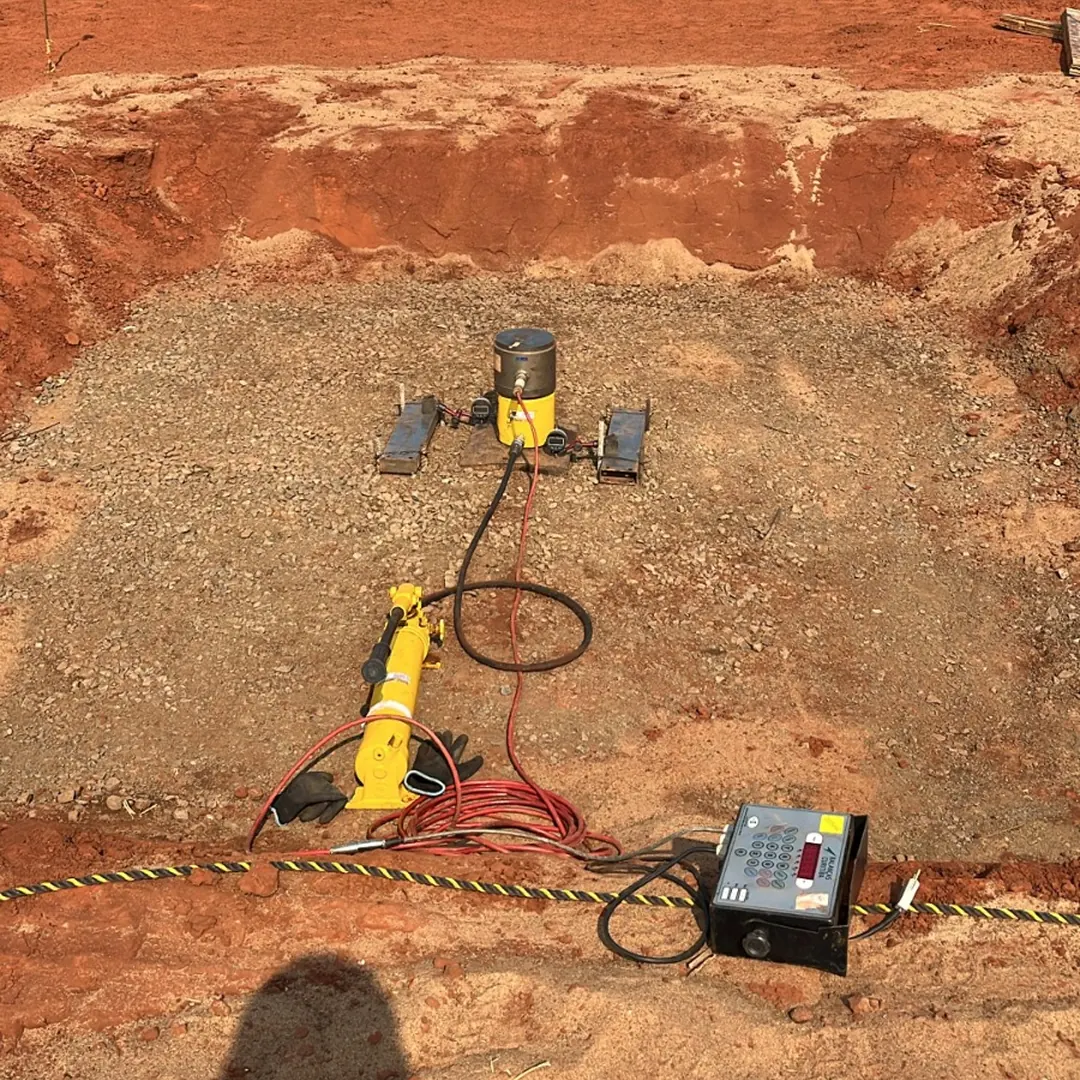
Preparing the site:
Site preparation for the test is a crucial step. We need to ensure that there is an area clear of at least 2 meters in diameter around the point where the load will be applied. The surface must be leveled, and the plate should be supported on a sand layer no more than 2.5 cm thick. It is vital that the plate does not directly touch large stones, otherwise the results may be inaccurate. Ideally, the test point should be at the same elevation as the future foundations. Additionally, a soil investigation is always required to thoroughly understand the ground conditions.
How is the test performed?
The test follows a very rigorous sequence:
- Pre-loading: We apply an initial load for everything to settle.
- Increasing Loads: We apply the load in at least six stages, gradually increasing it.
- Specific Timings: At each stage, the load remains for a certain time to observe the stabilization of deformations.
- Unloading: Finally, the load is gradually removed.
This procedure aims to ensure the stability and repeatability of the data, with adequate control and stability, avoiding external disturbances such as wind, movement, or rain.
Calculating and interpreting the data:
With the data we collect, it is possible to calculate the Modulus of Deformability (EV2). This modulus shows us how the soil deforms and is a key parameter for assessing embankment quality and for designing foundations. The stress-displacement curve that we generate from these data is fundamental for this analysis.
What do the standards say?
To ensure that everything is done with the same quality and in a standardized manner, we follow some specific standards:
DNIT 410-17: Soils - Static Plate Load Test
This standard from the National Department of Transport Infrastructure (DNIT) defines how to determine the Modulus of Deformability (EV2) in soil-rockfill layers. It is widely used in road projects and details everything: equipment, site preparation, and the test sequence to ensure embankment quality.
NBR 6489-19: Static Load Test on Shallow Foundations
This Brazilian Standard (NBR) from the Brazilian Association of Technical Standards (ABNT) establishes the test method for plotting the stress-displacement curve of soil under load for shallow foundations. It specifies the need for soil investigations, equipment configuration (with a stable reaction system), how to apply the load (with control and without disturbances), and the different types of tests (slow, rapid, mixed, and cyclic). The standard also explains what should be included in the results report, such as location, date, soil characteristics, and any unusual occurrences.
In summary, the direct plate bearing test is a powerful tool for quality control in embankment construction and foundation planning. By providing us with precise information on how the soil deforms, it helps us identify potential problems that could compromise the safety and stability of the structure. Following the standards, such as those from DNIT and ABNT (which also follow international standards like DIN and ASTM), ensures that the procedure is standardized, bringing safety and reliability to the results for your engineering project.
If you have any questions, feel free to contact us and clarify your doubts with our specialists.
Do you have any questions about the necessity of these tests in your project, contact us!