The participation of foreign investors, designers, and construction companies in projects executed in Brazil has increased the frequency of requiring geotechnical testing according to international technical specifications.
Although ABNT NBR 6489 is the main Brazilian reference for plate load tests, some projects may require specific procedures defined by the contractor or based on foreign standards, including Chinese technical references, such as JGJ 340.
In these cases, the test plan must consider the technical requirements of the project so that the adopted methodology is compatible with the criteria established by the design.
In this article, we present the main aspects related to the execution of plate load tests in projects that require national and international procedures.
What is a plate load test?
The plate load test is used to evaluate the bearing capacity, deformability, and stress-settlement behavior of soils, compacted fills, working platforms, improved ground, and shallow foundations.
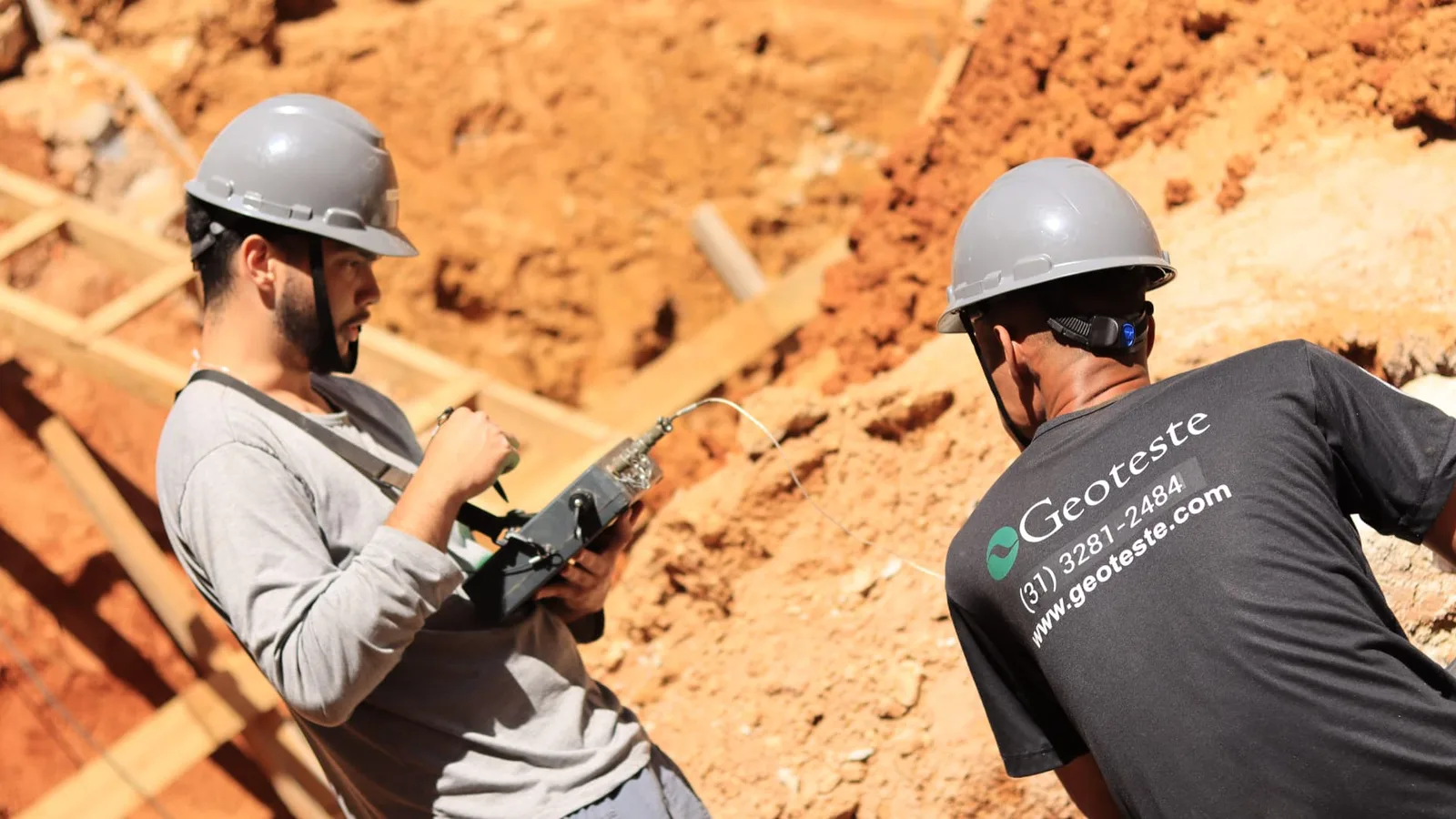
During the test, a metal plate is positioned on the ground and subjected to controlled loads. At each stage, the deformations caused by the load application are recorded, allowing for the analysis of the soil's behavior under conditions representative of the construction site.
Among the main parameters evaluated are:
- bearing capacity,
- stress-settlement behavior,
- deformation modulus,
- ground deformability,
- failure criteria.
The information obtained assists designers and consultants in evaluating ground behavior and making project decisions.
Where can the plate load test be applied?
The plate load test has several applications in geotechnical engineering and can be used in:
- natural soils,
- compacted fills,
- working platforms,
- improved ground,
- shallow foundations,
- composite foundations,
- areas treated by geotechnical improvement techniques.
It is also widely employed in industrial, mining, logistics, energy, and infrastructure projects.
Why do some projects require international standards?
Projects of Chinese origin or those involving international designers, investors, construction companies, and suppliers may require different procedures than those traditionally adopted in Brazil.
In these situations, the test plan is developed according to the technical specifications of the project, which may include requirements different from those provided in conventional practices.
Among the most common adaptations are:
- different plate dimensions,
- specific loading levels,
- load stages defined by the designer,
- specific criteria for settlement stabilization,
- slow, rapid, cyclic, or combined loadings,
- electronic and continuous data acquisition,
- simultaneous measurement of load, displacement, and time,
- specific methodologies for interpreting results.
What is JGJ 340?
JGJ 340 is a technical reference used in certain Chinese projects to guide procedures related to geotechnical investigation and ground behavior evaluation.
Depending on project requirements, this specification may establish criteria for test planning, loading sequence, settlement stabilization, data acquisition, result interpretation, and technical report preparation.
Its application always depends on the specifications defined for each project and can be used in conjunction with Brazilian standards when necessary.
The importance of instrumentation
The reliability of the results is directly related to the quality of the instrumentation used during the test.
Depending on the project characteristics, the following may be employed:
- calibrated load cells,
- electronic displacement transducers,
- precision dial gauges,
- automated data acquisition systems,
- hydraulic jacks and controlled loading pumps.
Electronic acquisition allows continuous recording of load, displacement, and time, providing greater traceability and reliability to the obtained information.
Reaction systems
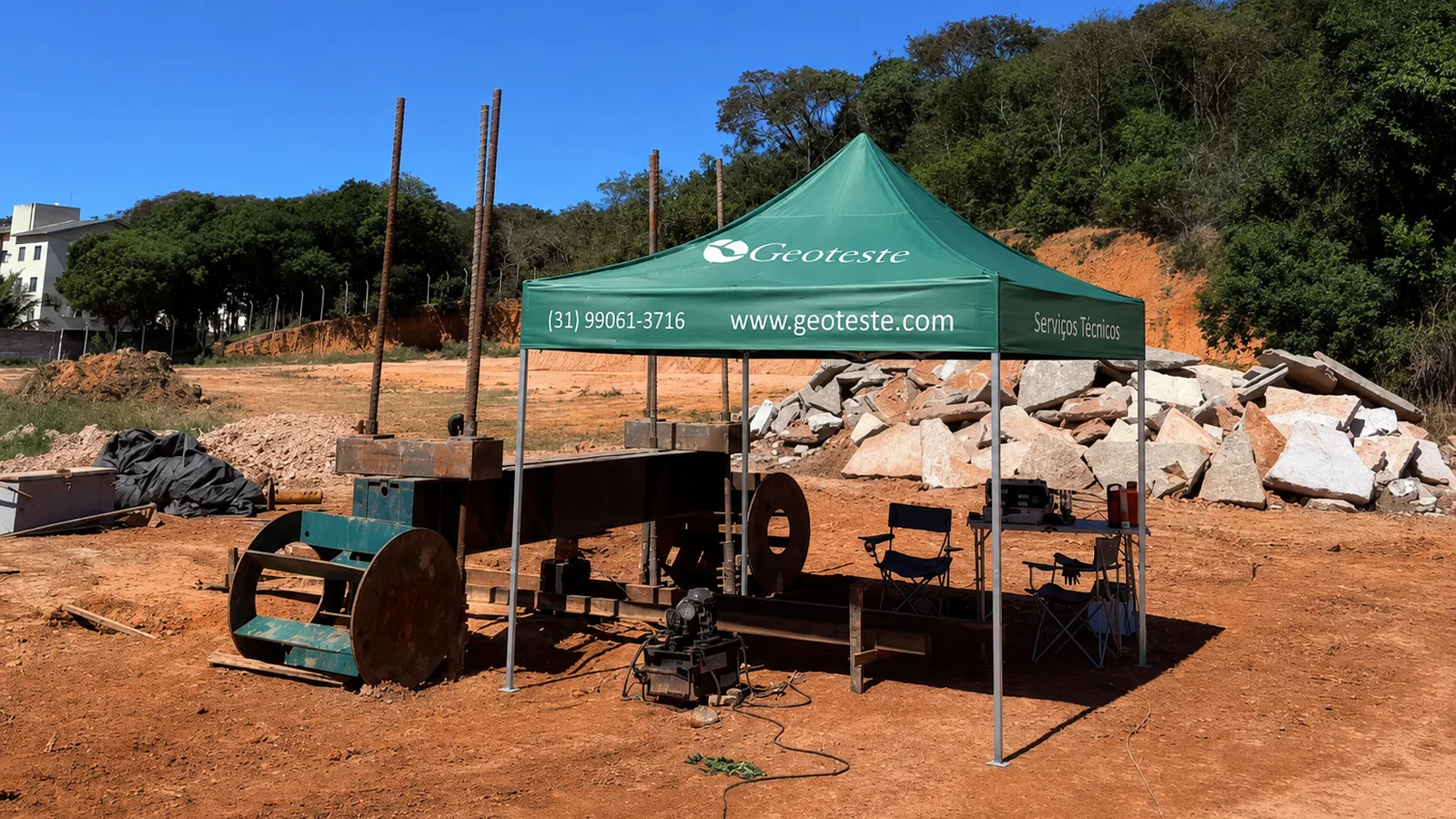
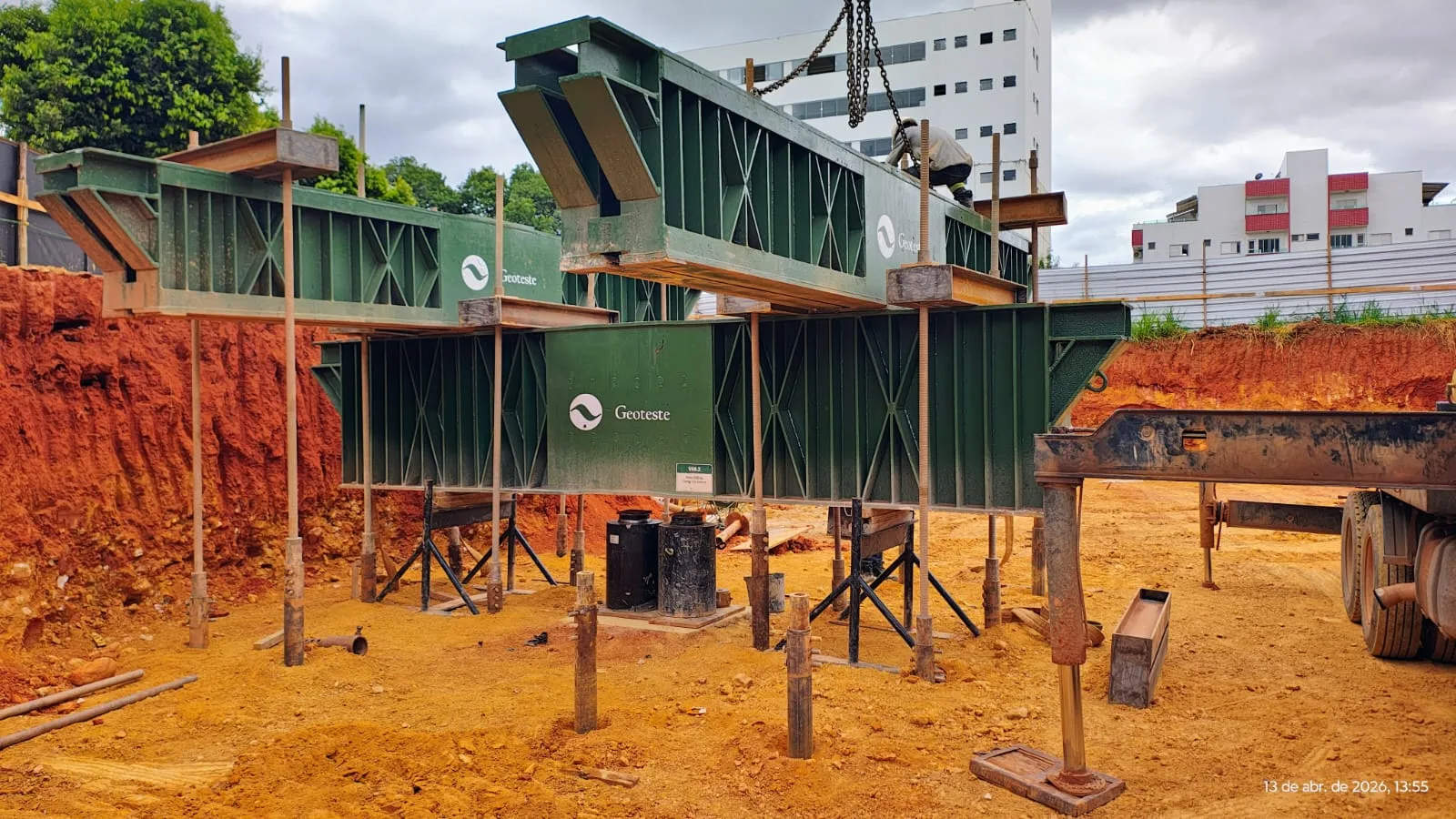
The definition of the reaction system depends on the project characteristics and the loads expected for the test.
Systems can be used by:
- kentledge,
- steel beams,
- tie rods,
- anchors.
The choice considers the geotechnical characteristics of the ground, the foundation geometry, and the investigation objectives.
Tests on improved ground
The plate load test can also be used to evaluate the behavior of areas subjected to geotechnical improvement techniques.
Among the most frequent applications are:
- soil-cement columns,
- stone columns,
- deep compaction,
- soil replacement,
- rigid inclusions,
- reinforced platforms,
- composite foundations.
In these situations, the test plan can be developed to evaluate the combined behavior of the soil and improvement elements.
How is a test plan prepared?
Before mobilization, various aspects of the project are analyzed, including:
- project documents,
- applicable standards and specifications,
- predicted loads,
- geotechnical characteristics,
- foundation dimensions,
- acceptance criteria,
- need for special instrumentation,
- most suitable reaction system.
Based on this information, a specific test plan is prepared to meet the investigation objectives and the technical requirements of the project.
What comprises a technical report?
A complete technical report may include:
- description of the site and ground conditions,
- reaction system configuration,
- plate dimensions and characteristics,
- calibration certificates,
- adopted methodology,
- loading history,
- settlement readings,
- load-settlement curves,
- load-time curves,
- settlement-time curves,
- interpreted bearing capacity,
- deformation modulus,
- analysis of failure criteria,
- comparison between different normative procedures,
- technical conclusions.
This information allows results to be analyzed consistently and traceably.
Is it possible to simultaneously comply with Brazilian and international standards?
Yes.
When requested, the test can be planned to allow simultaneous analysis according to ABNT NBR 6489, specific criteria defined by the project, and procedures based on international standards, including Chinese technical references.
This approach allows results to be evaluated both by Brazilian practice and by the criteria required by the project.
Geoteste's experience in projects with special requirements
The execution of plate load tests in international projects requires planning, technical knowledge, and the ability to adapt the methodology to the specifications of each undertaking.
As part of Grupo Gontijo, a national reference in special foundations for over 60 years, Geoteste brings together a specialized team, qualified engineering, and state-of-the-art equipment for executing geotechnical tests throughout Brazil.
In addition to tests performed according to ABNT NBR 6489, the company has the technical and operational capacity to develop customized test plans, meeting international project specifications, particular client requirements, and procedures based on foreign standards, including Chinese technical references.
Its structure includes modern instrumentation systems, electronic data acquisition, calibrated equipment, and different reaction system configurations, allowing tests to be executed with high technical rigor, traceability, and reliability.
This set of differentials positions Geoteste among the prominent companies in executing geotechnical tests for high-complexity projects, serving industrial, mining, logistics, energy, and infrastructure projects throughout the national territory.
If the project has specific requirements for plate load tests, prior analysis of the project's standards and specifications is fundamental to define the most appropriate methodology and ensure that the test fully meets the established technical criteria.