The plate load test is currently one of the most direct and reliable methods for evaluating the bearing capacity and deformability of soil for shallow foundations.
Furthermore, Brazilian Association of Technical Standards (ABNT) NBR 6122:2022 explicitly cites it as one of the possible bases for defining the allowable stress for shallow foundations.
Role of the plate load test in foundation design
Modern foundation design cannot rely solely on empirical correlations with SPT, especially in complex soils or structures more sensitive to settlements.
In this context, the plate load test provides a stress vs. settlement curve measured directly in the field, approximating the real behavior of the shallow foundation.
Additionally, NBR 6122 indicates the plate load test as one of the formal alternatives for determining the allowable stress based on the ultimate limit state in shallow foundations.
Thus, the test result can support more economical solutions, while still complying with safety and in-service performance requirements.
What is a plate load test
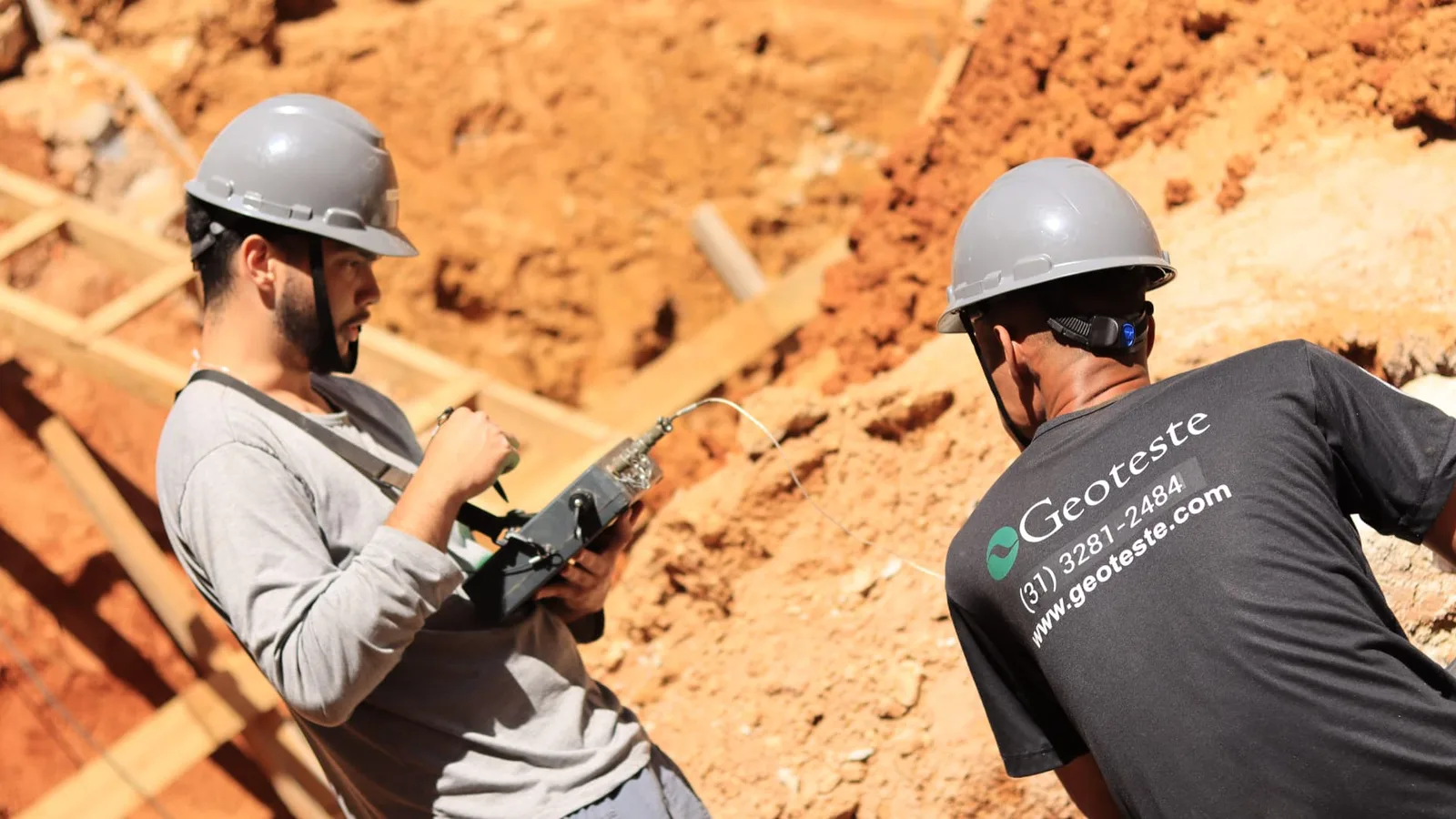
The plate load test, also called a direct static load test on the ground, consists of applying static compressive loads to a rigid plate resting on the soil and measuring the corresponding settlements.
Therefore, it is an in situ test that evaluates the plate + soil system, simulating in a reduced manner the behavior of a shallow foundation.
The main reference standards are ABNT NBR 6489:2019, which specifies the test method for static load tests on direct foundations, and DNIT 410, focused on road pavement layers.
NBR 6122:2022, which deals with foundation design and execution, refers to NBR 6489 when addressing the experimental determination of allowable stress by plate load test.
Where the plate load test is most useful
The plate load test is especially recommended in situations where the stress vs. settlement behavior of the soil is critical for the shallow foundation solution.
Among the most frequent applications are:
- Design of isolated footings, foundation beams, and rafts in residual or collapsible soils.
- Verification of bearing capacity for compacted fills for tanks, silos, and industrial structures.
- Quality control of pavement layers, when the modulus of deformability EV2 is sought using specific plates.
Furthermore, the plate load test is particularly valuable in unsaturated soils, where suction, collapse, and viscous effects can significantly alter the ground's response.
In these soils, the combination of plate load testing and suction and moisture instrumentation allows for a better understanding of the viscous deformation component and collapse due to inundation.
Basic concepts for interpreting the test
The central objective of the plate load test is to obtain the stress vs. settlement curve of the plate + soil system under monotonic loading in stages.
From this curve, the designer primarily extracts:
- Geotechnical failure stress or a reference stress, according to the adopted failure criterion.
- Allowable stress, obtained by dividing the failure stress by an appropriate safety factor compatible with standards and usage.
- Deformability parameters, such as modulus of deformability and coefficient of vertical subgrade reaction, used in settlement analyses and structural modeling.
In many research works, the stress vs. settlement curve obtained from a plate load test serves as a reference for evaluating the accuracy of semi-empirical settlement prediction methods, such as those by Schmertmann, Décourt, or Burland.
Thus, the plate load test functions both as a design tool and as a source for local calibration of calculation methods.
Relation with NBR 6122: emphasis on limit states
NBR 6122:2022 organizes foundation design around ultimate and service limit states, including geotechnical failure and excessive settlements.
For shallow foundations, the standard allows for evaluating the resistant stress using theoretical methods, semi-empirical methods, or plate load tests, among others.
When using the plate load test according to NBR 6489, the soil failure stress under the plate can be used as a basis to define the design resistant stress or the allowable stress.
Furthermore, the design standard reminds us that it is necessary to consider the scale difference between the plate and the actual foundation, which usually requires correction factors for settlements and, eventually, for stress.
Equipment and setup for the plate load test
Although NBR 6489 details the experimental arrangement, some elements are practically universal in any well-executed plate load test.
In summary, the complete system includes:
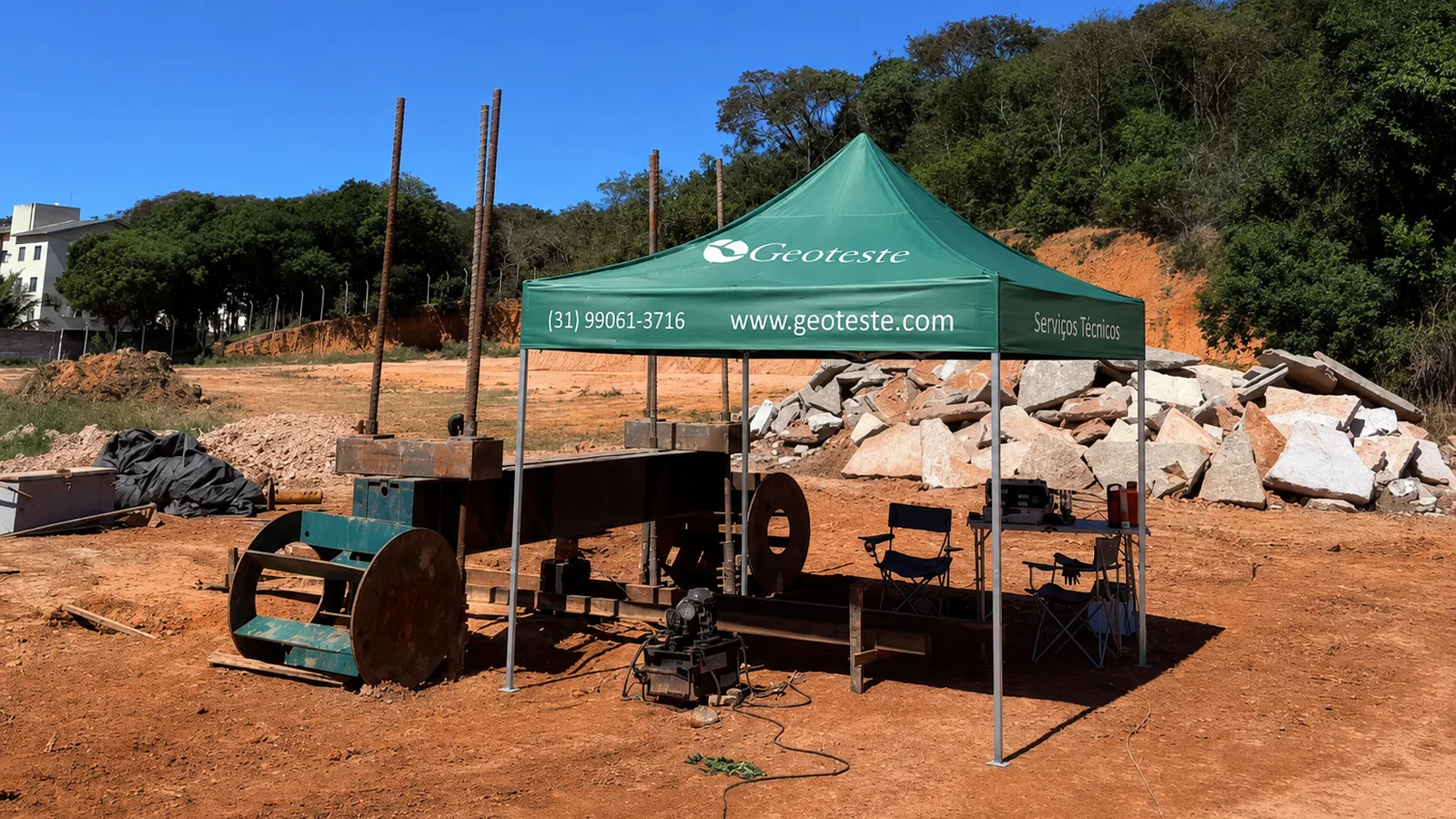
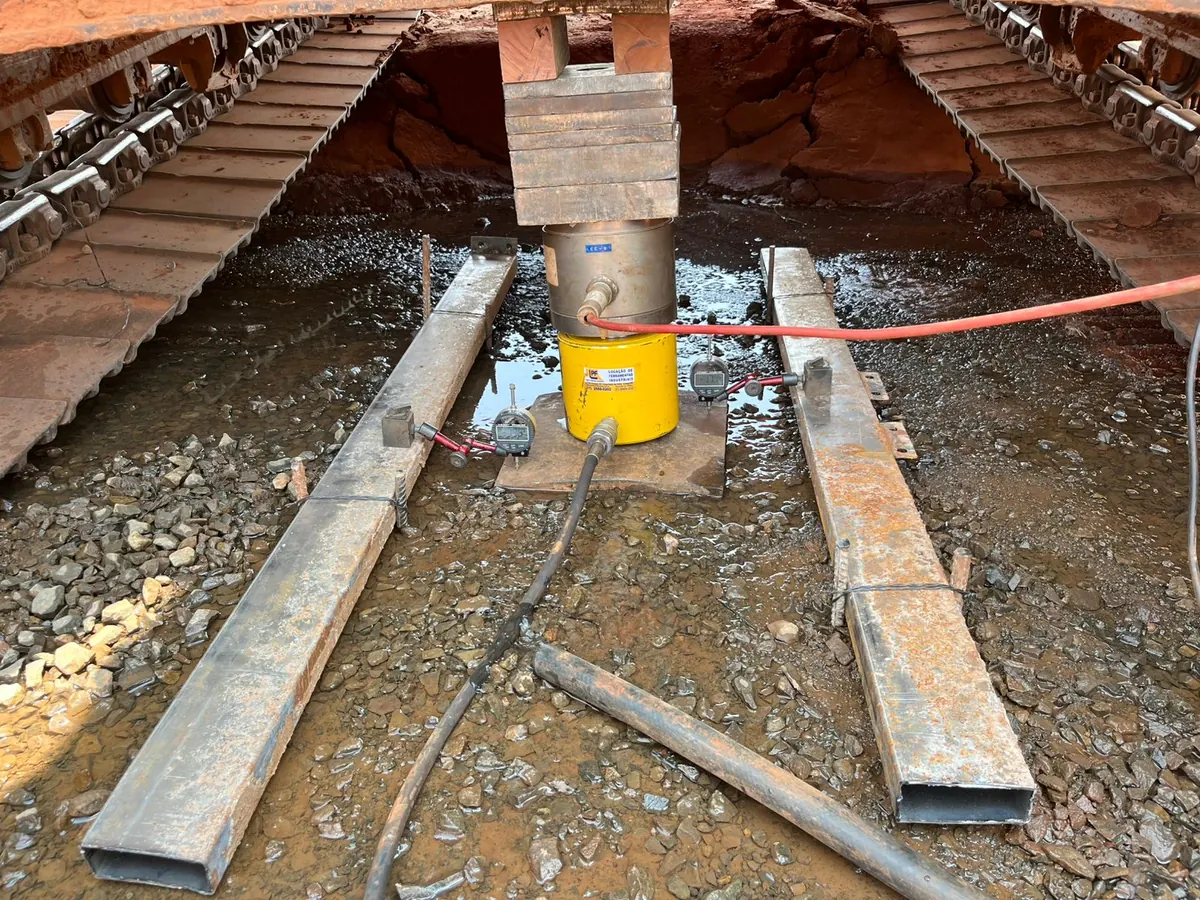
- Test plate: usually circular, rigid, with an area not less than 0.50 m², made of thick steel to prevent significant deformations.
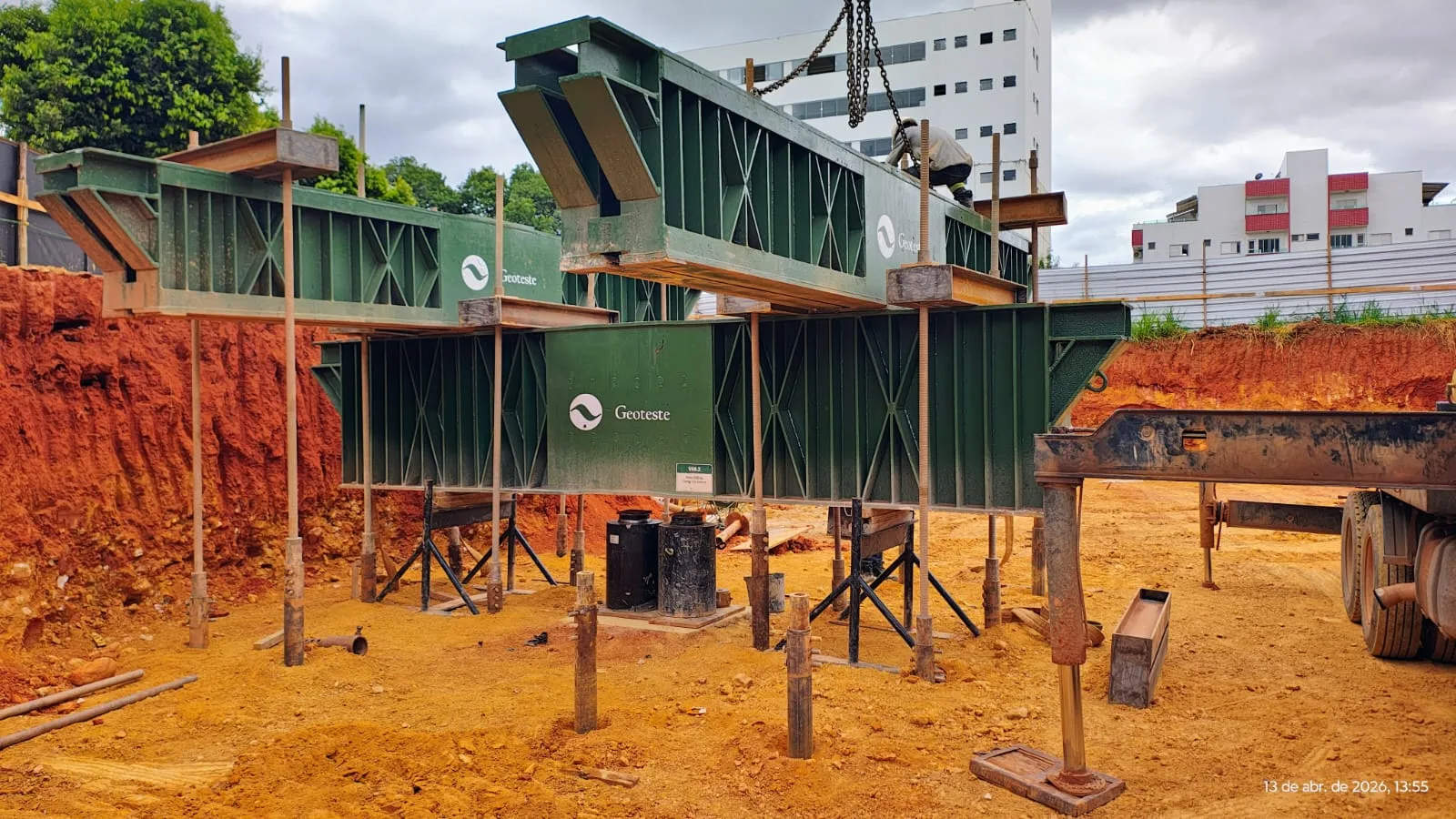
- Reaction system: a structure capable of providing static reaction, such as metallic beams anchored to reaction piles or heavy vehicles carefully positioned.
- Hydraulic jack and load cell: apply and measure the vertical force transmitted to the plate with adequate control and reliable readings.
- Settlement measurement system: deflectometers or dial gauges supported on independent bases, ensuring that only the soil displacement under the plate is measured.
Additionally, ground preparation is a critical part of the process.
The surface must be leveled, with a thin, uniform sand layer under the plate, and the test elevation should, whenever possible, coincide with the actual bearing elevation of the designed foundation.
Plate load test: execution sequence
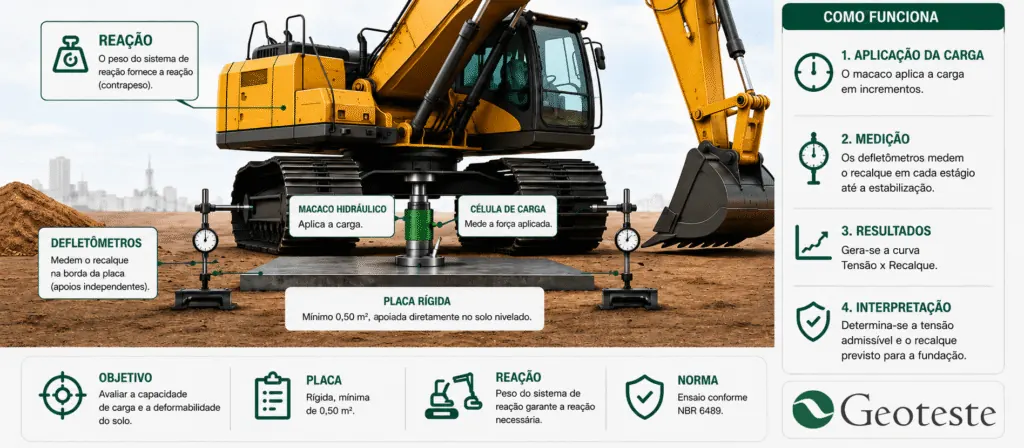
Figure 2: illustrative scheme of the plate load test.
Planning and positioning of test points
Initially, the designer defines the number and location of plate load tests, considering the heterogeneity of the subsoil and the scale of the project.
Test points near the most heavily loaded foundations or in regions with greater geotechnical uncertainty are usually prioritized.
The location must respect minimum distances between tests, slope edges, and retaining elements, in order to avoid interference with the stress bulbs generated by the loading.
In this way, the test truly represents the soil under conditions similar to what the foundation will encounter in the actual construction.
Loading execution
Loading occurs in stages, with stress increments predetermined by the designer or the standard.
For each load level, plate settlements are measured as a function of time, until a stabilization criterion is met, usually defined by displacement variations below a limit within a certain interval.
NBR 6489 recommends that the test proceed to at least double the predicted allowable stress for the ground or until a maximum settlement specified by the designer, whichever occurs first.
Therefore, it is fundamental that the loading level exceeds the working range anticipated in the design, allowing observation of the transition between quasi-elastic behavior and failure or excessive settlements.
Loading rate and viscous effects
The loading rate directly influences the result, especially in clayey and unsaturated residual soils, where deformations occur over time.
Studies with rapid and slow tests in basaltic residual soils showed that slow loading can produce a viscous deformation component about 45% greater than rapid loading.
Furthermore, when loading is too rapid, part of the drained deformation does not fully develop during the load stage, which can overestimate the apparent stiffness of the soil.
Thus, in soils with relevant viscous behavior, it is worthwhile to adopt loading sequences that allow observing the evolution of settlement over time at each stress level.
Failure criteria in plate load testing
Geotechnical failure does not always appear as a clearly defined plateau in the stress vs. settlement curve.
Therefore, the engineer needs to adopt conventional criteria consistent with the soil type and observed behavior.
Among the most common criteria are:
- Failure by limit settlement: stress corresponding to a settlement equal to approximately 10% of the plate diameter, inspired by classical Terzaghi criteria.
- Graphical extrapolation: methods such as Van der Veen's, which adjust a theoretical curve to the initial part of the experimental curve to estimate the failure stress.
- Stiffness change criterion: identification of a sharp change in the tangent modulus of the curve, marking the transition from a quasi-elastic regime to significant plastification.
Additionally, in collapsible soils tested before and after inundation, failure can be associated with the combination of sudden suction loss and rapid increase in settlements, which requires careful attention when reading the graphs.
In these cases, testing with controlled inundation is crucial to evaluate the safety of shallow foundations in unsaturated soils.
How to obtain the allowable stress from the test
Once the conventional failure stress is defined, the next step is to transform this value into an allowable stress for design.
In general, Brazilian practice uses safety factors of around 2 when the failure stress derives directly from well-conducted load tests, as recommended by classic foundation texts and NBR 6122 practices.
Thus, the typical allowable stress results from dividing the failure stress by a safety factor that accounts for remaining uncertainties, soil variability, and the consequences of eventual excessive settlements.
However, the exact value of the factor must also consider the quality of the investigation campaign, the importance of the structure, and the existence of monitoring during the operational phase.
Brazilian authors such as Silveira and Hachich show practical examples where allowable stress values obtained from plate load tests significantly exceed empirical estimates based solely on SPT, while still maintaining comfortable safety margins.
Therefore, well-planned plate load tests can enable more economical foundations, without compromising geotechnical rigor.
From plate load test to real foundation: settlement corrections
The tested plate has dimensions and bearing depth different from the real foundation, which requires corrections to estimate the settlement of the footing or mat from the plate load test.
In practice, similarity relationships are used that take into account the soil type, the diameter of the plate and the foundation, and, in some cases, the square of these dimensions, especially in sandy soils.
Qualitatively, research results show that:
- In clayey soils, settlement tends to scale approximately with the ratio between the characteristic dimensions of the foundation and the plate.
- In sandy soils, the influence of width is stronger, and relationships involving the square of the dimensions appear to better represent the variation in settlements.
Additionally, the depth of the compressible layer, the presence of stiffer layers below, and the position of the water table directly influence the corrections, always requiring the judgment of an experienced geotechnical engineer.
Therefore, the plate load test does not eliminate the need for settlement calculations, but it provides a robust experimental parameter to calibrate such analyses.
Interaction with other settlement prediction methods
Several authors have compared the settlement estimated by semi-empirical methods with the settlement measured in plate load tests, especially in granular soils.
Recent work with a 50 cm diameter plate, in an experimental field in Northeast Brazil, showed good agreement of Schmertmann and Sandroni's methods with the experimental curve, while other formulations showed greater deviations.
Furthermore, studies with reduced diameter plates showed that, with adequate calibration, it is possible to obtain allowable stresses compatible with those from conventional 80 cm plate tests, which opens up possibilities for more economical solutions in small projects.
Thus, the plate load test can be seen as a primary reference, against which different calculation models adopted in the office are compared.
Unsaturated soils and plate load test
In collapsible soils, the plate load test gains complexity but also importance.
Brazilian research combined plate load tests with controlled inundation, tensiometers, moisture sensors, and suction measurements to investigate the influence of saturation on soil collapse under shallow foundations.
The results show that bearing capacity and collapse depend strongly on suction and the applied stress level.
Therefore, for sensitive structures supported on unsaturated soils, it is not enough to know only the stress vs. settlement curve under natural conditions; it is also advisable to evaluate behavior under critical wetting conditions.
Integration with design practice according to Vinícius Lorenzi
Technical content by Vinícius Lorenzi, in the Fundações Sem Complicações (Foundations Without Complications) project, emphasizes that the designer should see the plate load test as part of an intelligent investigation campaign, and not as an isolated test out of curiosity.
Thus, the test complements SPT soundings, CPT, laboratory tests, and pile load tests, forming a more solid picture for foundation decisions.
Moreover, the author highlights in various materials that well-chosen tests, carried out during the design phase, can reduce excessively conservative safety factors, resulting in more efficient foundations with lower overall costs, without loss of reliability.
This philosophy applies directly to the plate load test, which provides objective evidence of soil performance under loads representative of shallow foundations.
When is a plate load test worthwhile?
In small projects, the cost of the test sometimes leads the designer to rely solely on correlations with SPT, but this can result in overdesigned foundations.
On the other hand, in medium and large projects, or in difficult soils, the cost of a plate load testing program tends to be small compared to the potential for savings in concrete, steel, and execution times.
Practically, the plate load test is especially recommended when:
- The adopted solution strongly depends on settlement control, such as rafts under tall buildings or sensitive equipment.
- The subsoil presents residual, collapsible soils, or soils with significant viscous behavior, where the uncertainty of empirical models is greater.
- There is a relevant discrepancy between parameters estimated via SPT and performance expectations, suggesting that the empirical model may be excessively conservative or optimistic.
Thus, the plate load test acts as a strategic decision-making tool, allowing the engineer to assume stresses closer to reality, based on field measurements and not just empirical relationships.
Cautions and limitations of the plate load test
Despite its advantages, the plate load test has limitations that need to be recognized to avoid erroneous interpretations.
The main one is that it reflects the behavior of a relatively small volume of soil under localized loading, which requires careful selection of test points and correlation with the overall geotechnical model.
Furthermore, the test does not replace reconnaissance soundings or stability analyses; it should be regarded as a complement to define more realistic parameters for bearing capacity and deformability.
Finally, the quality of execution is crucial: errors in plate alignment, load eccentricity, insufficient reaction system, or unstable reading bases can compromise the entire campaign.
Good practices for the foundation engineer
For the plate load test to effectively contribute to foundation design, some good practices are recommended:
- Define the objective of the test at the conception stage of the campaign, whether to calibrate allowable stress or to validate settlement predictions.
- Choose test points representative of the most stressed regions and the most critical soil transitions.
- Clearly specify maximum loads, stabilization criteria, loading rate, and, in unsaturated soils, eventual controlled inundation phase.
- Integrate the results with theoretical and semi-empirical methods, adjusting parameters whenever there is consistent evidence of behavior different from predicted.
Thus, the plate load test ceases to be just a graph filed in a report and becomes a central piece in geotechnical decision-making.
Geoteste performs plate load tests throughout Brazil. Consult serviced regions and request a quote.