Foundation and the need for validation
Foundation design is one of the most critical stages of any civil engineering project. In Brazil, the most traditional field geotechnical investigation is the Standard Penetration Test, widely known as the SPT test. As established by ABNT NBR 6122:2022, which governs the design and execution of foundations, knowledge of the subgrade profile obtained through boreholes is the mandatory starting point for estimating pile bearing capacity.
However, calculating the bearing capacity of a deep foundation using only empirical and semi-empirical formulas based on SPT presents inherent limitations. The dispersion of test results, the geological variability of the soil, and uncertainties regarding the actual behavior of the soil-pile interface create the need for experimental validation. It is in this scenario that the execution of load tests and dynamic tests gains absolute prominence to ensure the safety and economy of the project.
Understanding the difference between prediction and actual performance
The prediction of bearing capacity obtained by SPT correlations is, by definition, an indirect estimate. Empirical formulas use penetration resistance parameters to infer the lateral and tip resistance of the pile. However, these equations often adopt high global safety factors to compensate for uncertainties, which can result in overly conservative foundations or, in unfavorable cases, overestimated geotechnical capacity estimates.
On the other hand, the actual performance of the pile refers to its behavior when subjected to the effective loading of the structure. Factors such as the pile installation method, the cleanliness of the borehole bottom, the mobilized lateral friction, the soil deformability modulus, and the stiffness of the structural element itself directly influence the actual response of the foundation. The SPT cannot accurately predict the load versus settlement curve, a fundamental parameter for controlling serviceability limit states in modern buildings.
The normative role in performance verification
ABNT NBR 6122:2022 clearly stipulates the criteria for carrying out static and dynamic load tests, defining when and how these procedures should be applied. The combined use of SPT and load testing allows for calibrating soil parameters and adjusting calculation methods for the specific conditions of the construction site.
Main standards applicable to foundation tests
- ABNT NBR 6122: Design and execution of foundations
- ABNT NBR 16903:2020: Soil - Static load test on deep foundation, standard that replaced the old NBR 12131
- ABNT NBR 6489: Soil - Direct load test on foundation ground
- ABNT NBR 13208: Piles - Dynamic loading test
- ABNT NBR 6122:2019, with Amendment 1:2022: Design and execution of foundations, which establishes the requirements for integrity tests and load tests
Technical advantages of load testing over SPT
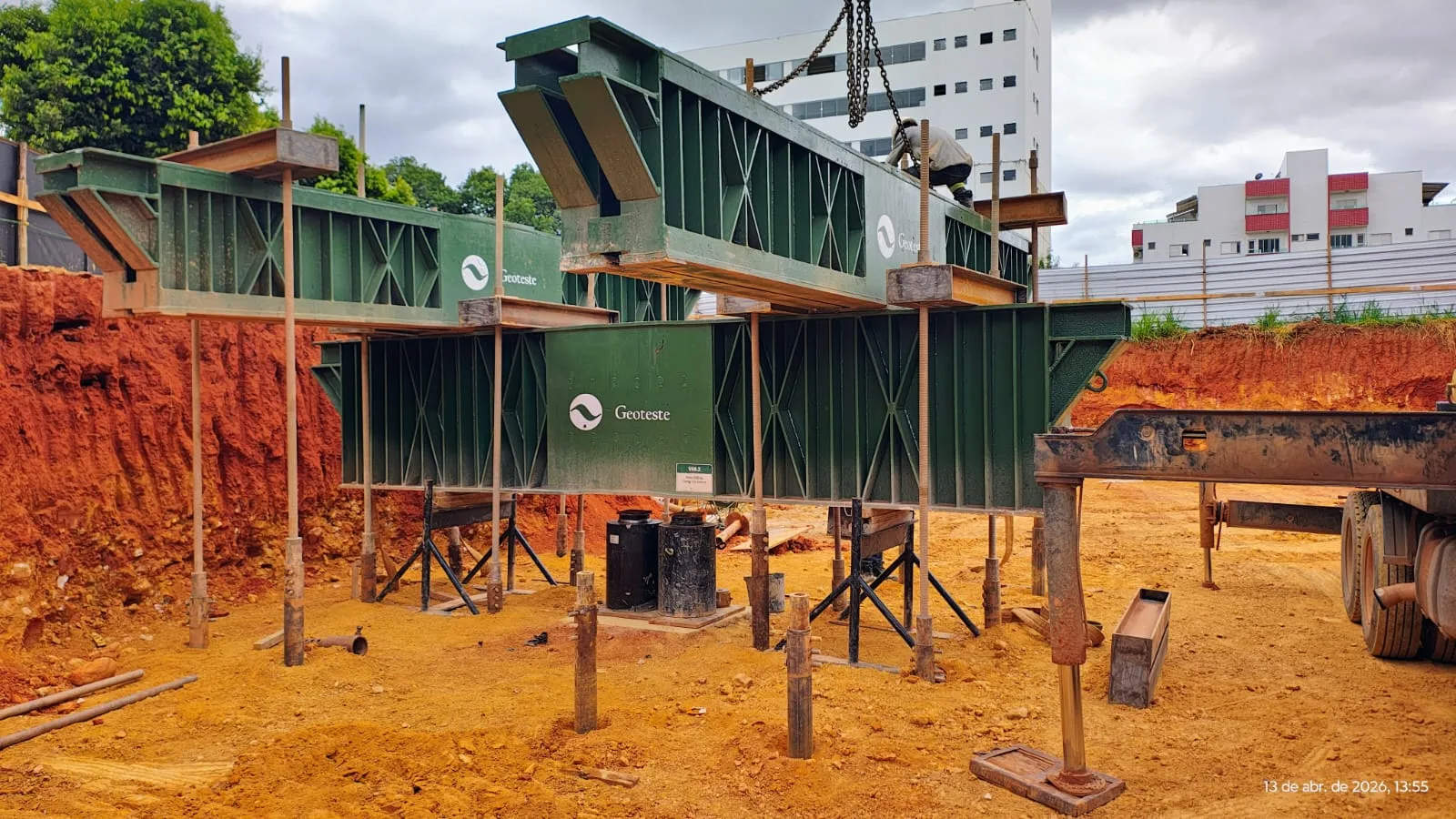
While the SPT provides punctual resistance indices at each meter of drilling, the static load test evaluates the global behavior of the foundation element at a real scale. Below, we highlight the main differences between the purely borehole-based approach and experimental validation through load tests.
Comparative table: SPT versus Static Load Test
| Criterion | SPT Test | Static Load Test |
|---|---|---|
| Nature of the test | Indirect geotechnical investigation | Real-scale loading test |
| Parameter evaluated | Penetration resistance (NSPT) | Bearing capacity and load-settlement curve |
| Accuracy for design | Empirical estimate with high dispersion | Direct measurement of actual behavior |
| Identification of settlements | Does not evaluate deformations under structural load | Accurately measures elastic and permanent settlement |
| Normative compliance | Mandatory for design (NBR 6122) | Mandatory for high loads or large diameter piles |
Project optimization and cost reduction
The performance of loading tests, such as the static load test or the high-strain dynamic test (PDA), should not be seen merely as a bureaucratic requirement for normative compliance. In geotechnical engineering practice, performance verification through testing allows for optimizing foundation design. When the proven actual bearing capacity in the field exceeds the values conservatively estimated by SPT, the designer can reduce the length of the piles, decrease the number of elements per cap, or admit larger service loads per pile.
This calibration generates significant financial savings in the total infrastructure cost, amply compensating for the investment made in carrying out the tests. Furthermore, the combination of integrity tests (such as PIT) with loading tests ensures that the subterranean structure is free from executive defects that would go unnoticed with only the analysis of the original SPT soundings.
Consult Geoteste's technical team for your project
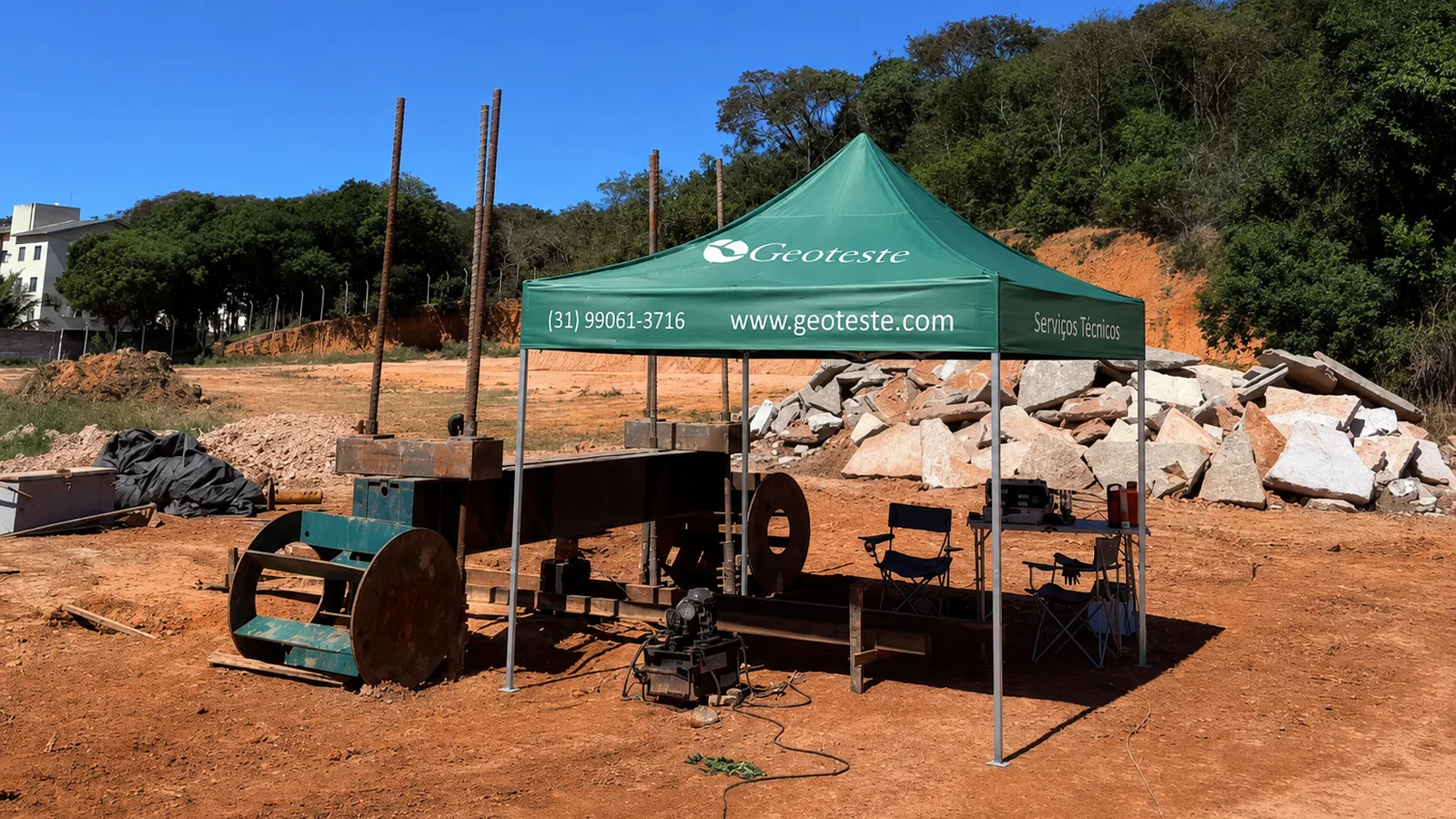
Ensuring that the theoretical prediction of SPT corresponds to the actual performance of your foundation requires high-precision equipment and methodological rigor. Geoteste has specialized engineers and cutting-edge technology for carrying out static load tests in accordance with ABNT NBR 16903:2020, PDA tests in accordance with ABNT NBR 13208, as well as integrity tests and bidirectional load tests, strictly complying with NBR 6122 in all stages of your project.
Contact our technical team to evaluate your foundation design and define the safest and most economical testing plan for your construction site.