Introduction to the objectives of the testing program
Defining the maximum load to be applied in a static load test represents one of the most important decisions in the planning of deep foundation tests. Geotechnical engineers and designers need to establish clear parameters that meet safety and structural performance requirements, avoiding both insufficient tests and unnecessary excessive loading. Proper planning considers the specificities of the project and the expected behavior of the pile under different stress levels.
Understanding fundamental loading concepts
To determine the maximum loading level, it is necessary to rigorously differentiate the concepts involved in the instrumentation and interpretation of geotechnical results. Confusion between terms can compromise the safety of the structure or generate unnecessary operational costs on the construction site.
Working load
Corresponds to the force acting on the foundation obtained through the combinations of actions in ultimate limit state and serviceability limit state foreseen in the structural and geotechnical design. It is the stress that the pile will effectively receive during the service life of the building.
Test load
Refers to the maximum force value that will be applied in a controlled manner during the execution of the static load test. This value is defined in the design and normally represents a multiple of the working load, depending on the applicable standard and the importance class of the structure.
Bearing capacity and ultimate resistance
Geotechnical capacity represents the maximum resistance that the soil-pile system is capable of mobilizing. The determination of this capacity depends on interpretative models applied to the data measured during the test, and should not be confused with the simple maximum load applied by the hydraulic jack if failure is not reached.
Relationship between working load and test load
The definition of the test load is intrinsically linked to the main objective of the static load test. When the objective is only to prove that the foundation supports the working load with an adequate safety margin and controlled deformations, the test can be interrupted at lower levels, generally fixed at multiples of the working load as stipulated by the designer.
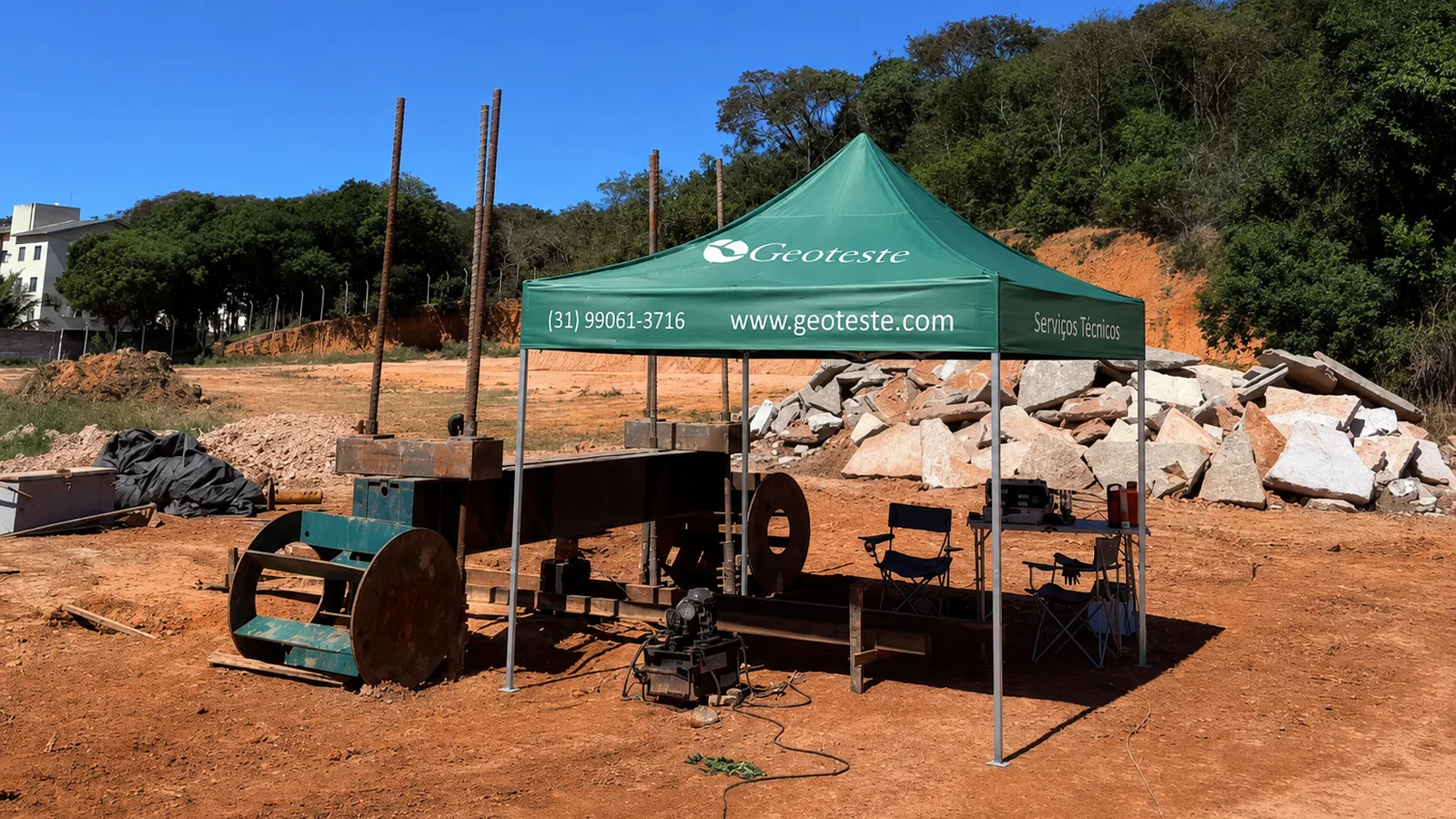
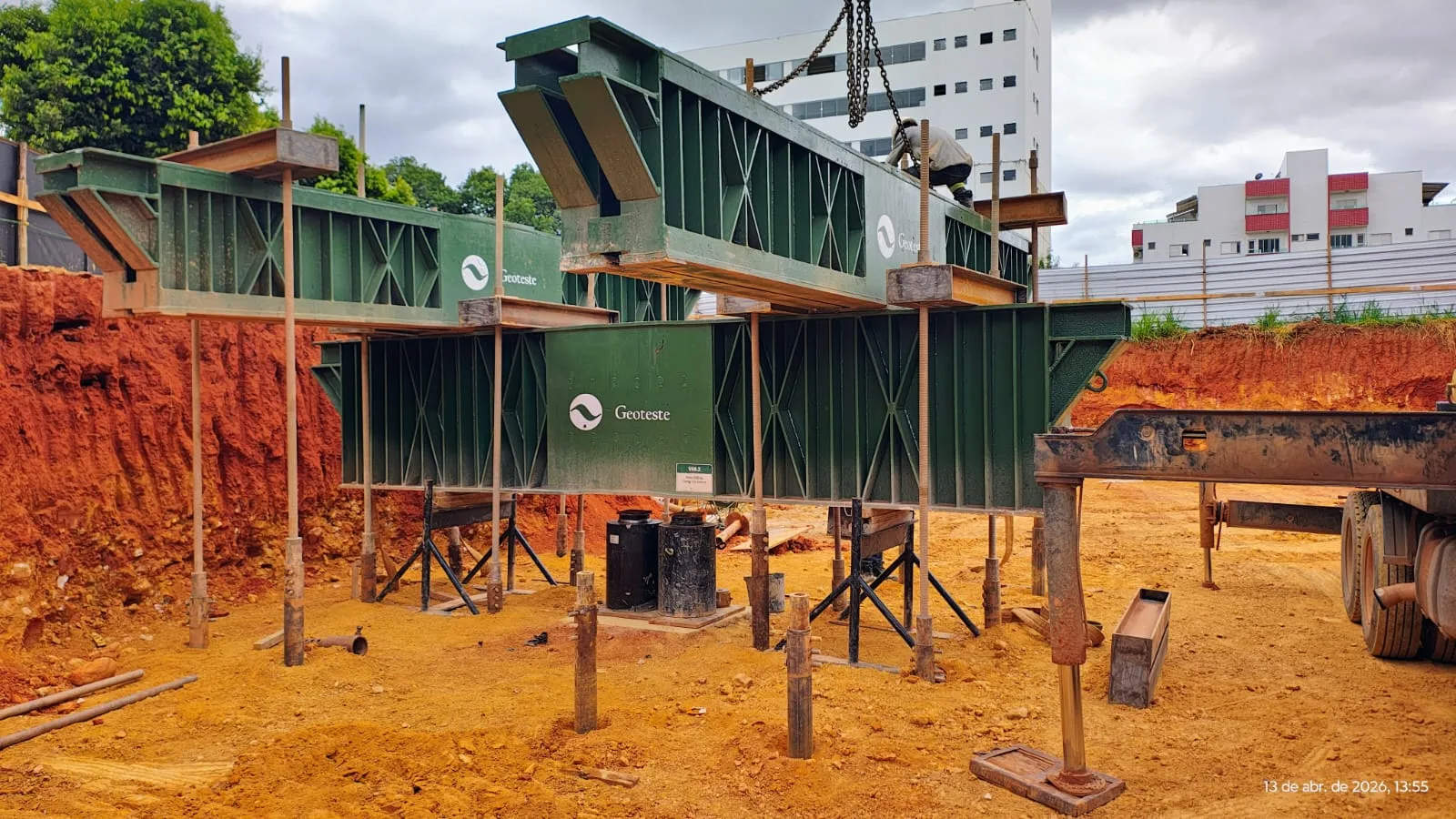
On the other hand, when the objective involves determining the ultimate bearing capacity of the foundation element, the loading must be conducted until the total mobilization of side and toe resistance, or until displacements indicate the imminence of geotechnical failure. In these cases, the test requires rigorous instrumental care and a reaction system compatible with the high forces involved.
Applicable normative guidelines
The execution of static load tests on deep foundations in Brazil is governed by standard ABNT NBR 16903, which establishes specific procedures for axial compression loading tests. This standard defines the requirements for load application, displacement readings, stabilization criteria, and results presentation.
In parallel, the design and general performance criteria for foundations are regulated by ABNT NBR 6122, which establishes the conditions required for the design of shallow and deep foundations, including recommendations on the need for load tests and the safety factors to be adopted in checking bearing capacity.
| Test Aspect | Working Load | Test Load | Bearing Capacity |
|---|---|---|---|
| Definition | Acting design stress | Maximum force applied in the test | Ultimate mobilized resistance |
| Origin | Structural and geotechnical analysis | Design definition | Results interpretation |
| Purpose | Superstructure dimensioning | Performance verification | Validation of soil parameters |
Stop criteria and test limitations
The decision to stop loading before reaching failure does not invalidate the test, provided that the maximum test load foreseen in the design has been successfully achieved and permanent displacements are within tolerable limits. The test should not be forced beyond the structural capacity of the foundation element or the capacity of the reaction system, under risk of damaging the tested pile.
It should be noted that the result obtained from a static load test reflects the behavior of the tested element under the specific conditions of that location, at that moment, and should not be automatically extrapolated to the entire work without proper critical analysis of the geotechnical variations of the ground.
Specialized technical support in load tests
The correct definition of the test load and the rigorous execution of static load tests (SLT) require calibrated equipment, high-precision instrumentation, and a highly qualified technical team. Geoteste performs static and dynamic loading tests with excellence, offering complete support from the planning phase to the advanced interpretation of results according to the requirements of ABNT NBR 16903 and ABNT NBR 6122. Contact our technical team to discuss the appropriate parameters for your foundation project.