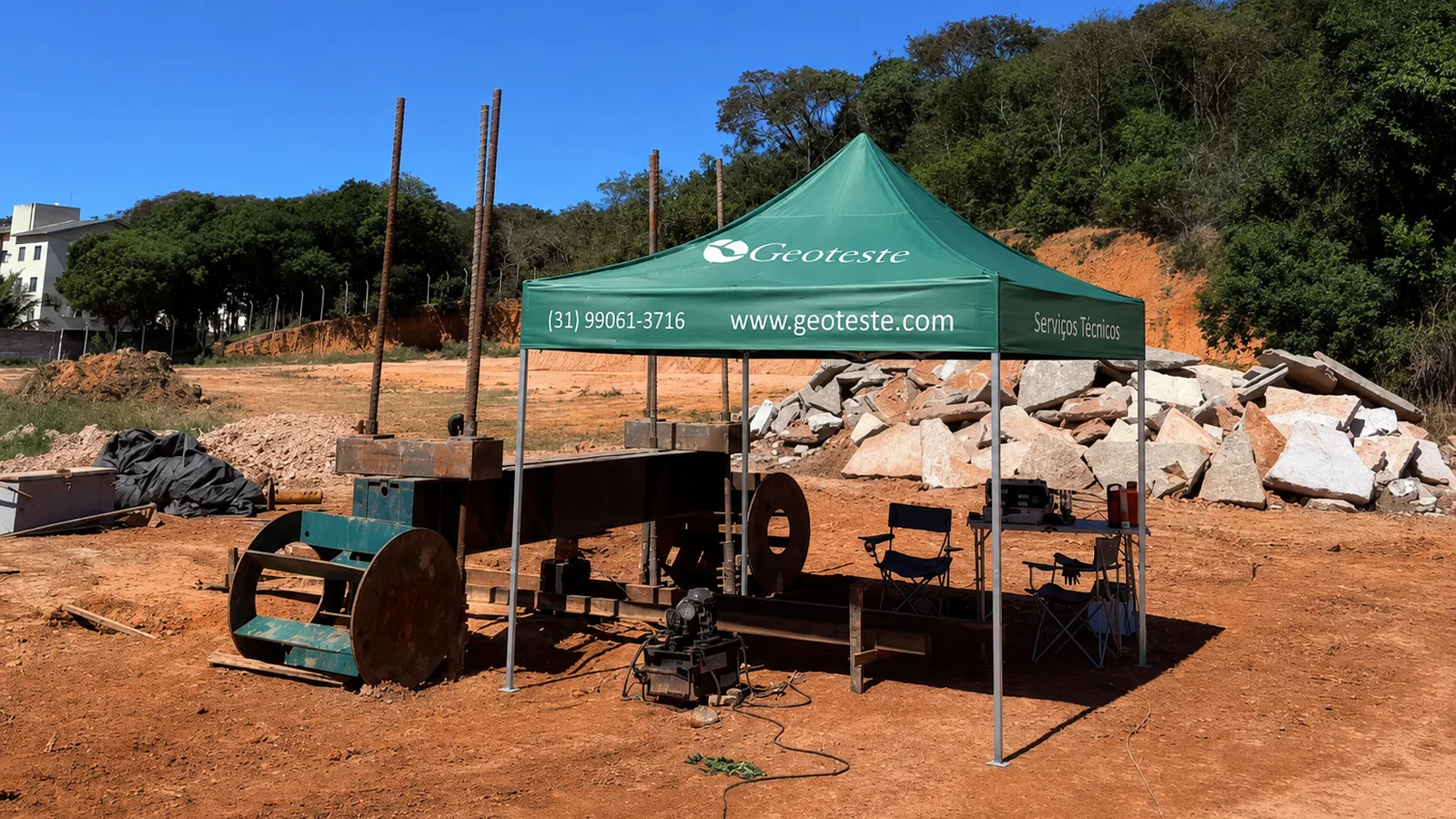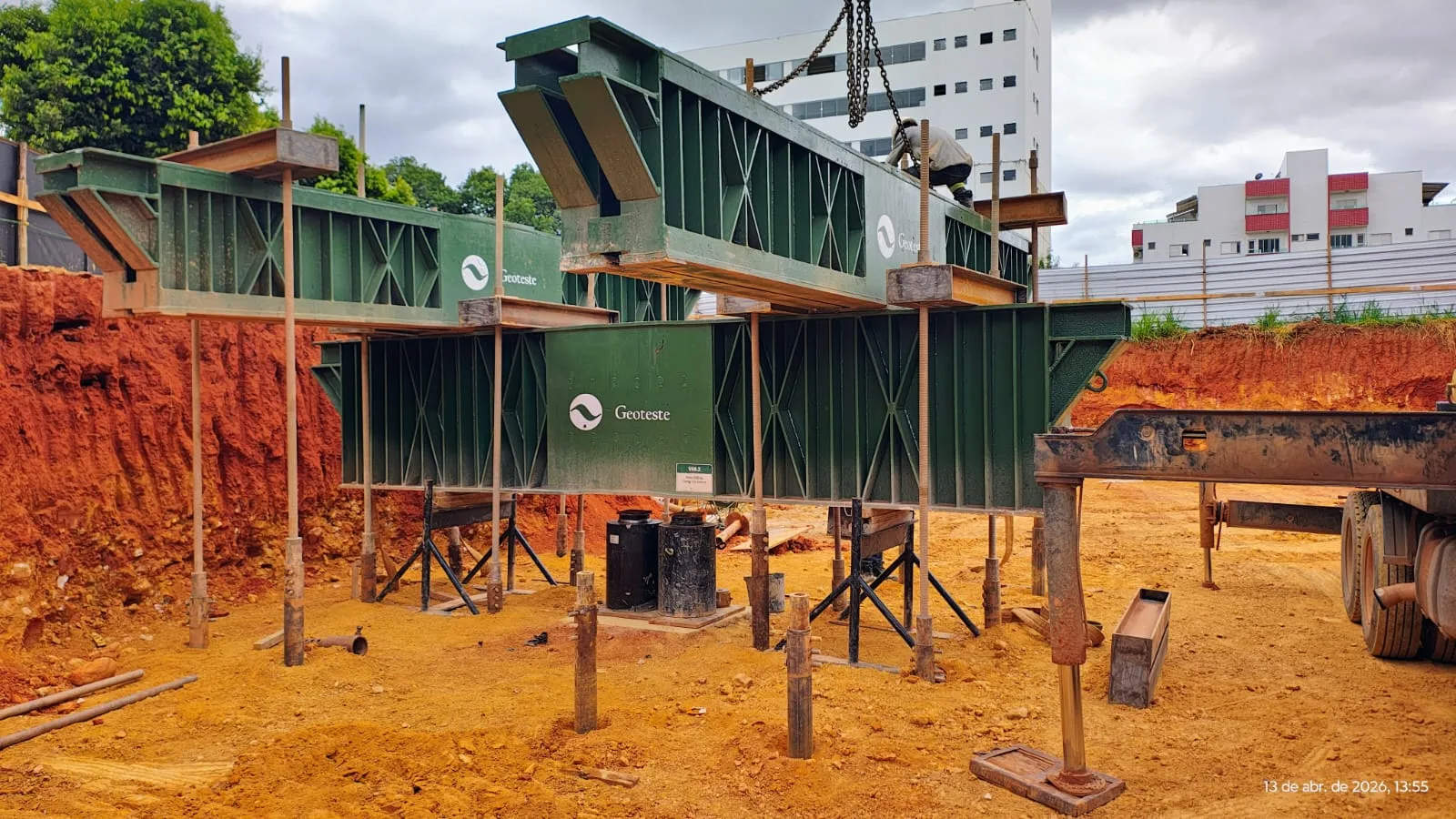
Understanding the foundation performance problem
During the execution of an infrastructure project, performing a static load test represents a fundamental milestone for verifying the behavior of a deep foundation under controlled loading. However, situations where the results fall below initial predictions require rigorous methodological investigation. Before any hasty conclusion, the geotechnical engineer must audit the execution records, field data, and particular conditions of the tested element.
The static load test procedure for deep foundations must strictly follow the guidelines of ABNT NBR 16903:2020. This standard establishes the test methods for axial compression loading, defining the criteria for load application, displacement readings, and unloading. When performance deviates from the design, the analysis should not be limited to a single factor, as the foundation's response involves the complex interaction between the shaft, the toe, and the surrounding soil mass.
Investigation roadmap for below-expected results
Given a discrepancy between the predicted capacity and that mobilized during the test, a structured technical roadmap must be followed to identify the source of the deviation. Consulting engineering applies successive steps to separate operational issues, executive deviations, and geotechnical limitations.
Audit of the execution process and field records
The first step consists of comparing the behavior observed in the load test with the execution history of the specific pile. The following operational aspects must be verified:
- Drilling or driving records, comparing the effective depth with that predicted in the design.
- Concrete consumption or injected grout volume in cast-in-place piles, evaluating possible necking or voids.
- Location and verticality deviations, which can introduce unforeseen eccentricities and additional bending moments.
- Execution sequence of the foundation group and eventual interference with soil compaction or decompression.
Assessment of local geology and geotechnical parameters
Often, the divergence arises from local variations in the subsurface profile that were not fully captured by the initial investigation boreholes. It is crucial to re-evaluate SPT boring logs, CPT tests, or complementary investigations in the vicinity of the tested element. Geotechnical capacity directly depends on the strength and stiffness of the bearing layers, and punctual heterogeneities can significantly alter load transfer by side friction and toe bearing.
The role of time and time-dependent phenomena
Time is a critical geotechnical variable that can explain unsatisfactory performance in tests conducted prematurely. In saturated cohesive soils, the installation of displacement piles generates excess pore pressure that temporarily reduces the effective strength of the soil. The phenomenon known as time-dependent strength gain or pile setup occurs with the gradual dissipation of pore pressure and reconsolidation of the soil over time.
Performing the static load test before the appropriate foundation resting period has elapsed can result in a mobilization of resistance lower than the real long-term bearing capacity. On the other hand, in certain contexts, the opposite phenomenon of relaxation can occur, depending on the rheological characteristics of the soil and the installation process. Temporal analysis requires rigorous monitoring and consideration of the consolidated properties of the soil mass.
Differentiation between tests and their objectives
To define the next engineering steps, it is essential to understand that different tests have distinct purposes and their conclusions should not be conflated:
- The static load test directly evaluates load-displacement behavior under controlled loading, in accordance with ABNT NBR 16903:2020.
- The dynamic load test governed by ABNT NBR 13208:2007 provides the dynamic response and an estimate of the mobilized resistance through wave equation analysis, serving as a complementary tool and not as a substitute for the Static Load Test (PCE).
- Low strain integrity tests or ultrasonic methods assess the physical continuity of the shaft, aiding in the identification of structural discontinuities that may justify the loss of capacity.
Next engineering steps and design guidelines
When the investigation confirms that the pile indeed has insufficient capacity compared to the design requirements established by ABNT NBR 6122:2022, engineering solutions must be implemented. The structural and geotechnical design needs to be revised to determine the necessary corrective interventions.
- Perform a numerical or empirical analysis to verify the redistribution of loads within the pile cap and the remaining capacity of the group.
- Evaluate the possibility of incorporating reinforcement piles near the deficient element, resizing the pile cap.
- Execute complementary tests on other piles of the project to verify if the problem is isolated or systemic.
- Review the design parameters and applied safety factors, ensuring compliance with current standards.
Specialized technical support in foundation testing
The correct interpretation of atypical results in static load tests requires methodological rigor, high-precision instrumentation, and deep knowledge in soil mechanics. Geoteste works with a senior team of geotechnical engineers to perform static load tests (PCE), dynamic load tests (PDA), bidirectional load tests, and integrity tests, strictly following ABNT standards. Our experience in conducting and critically analyzing complex tests ensures reliable diagnoses to support safe decision-making on construction sites.
If your project presents performance discrepancies in foundations or if you need to plan a complete investigation and quality control campaign, contact the Geoteste technical team and speak with our specialists.