The role of static load testing in the quality control of foundations
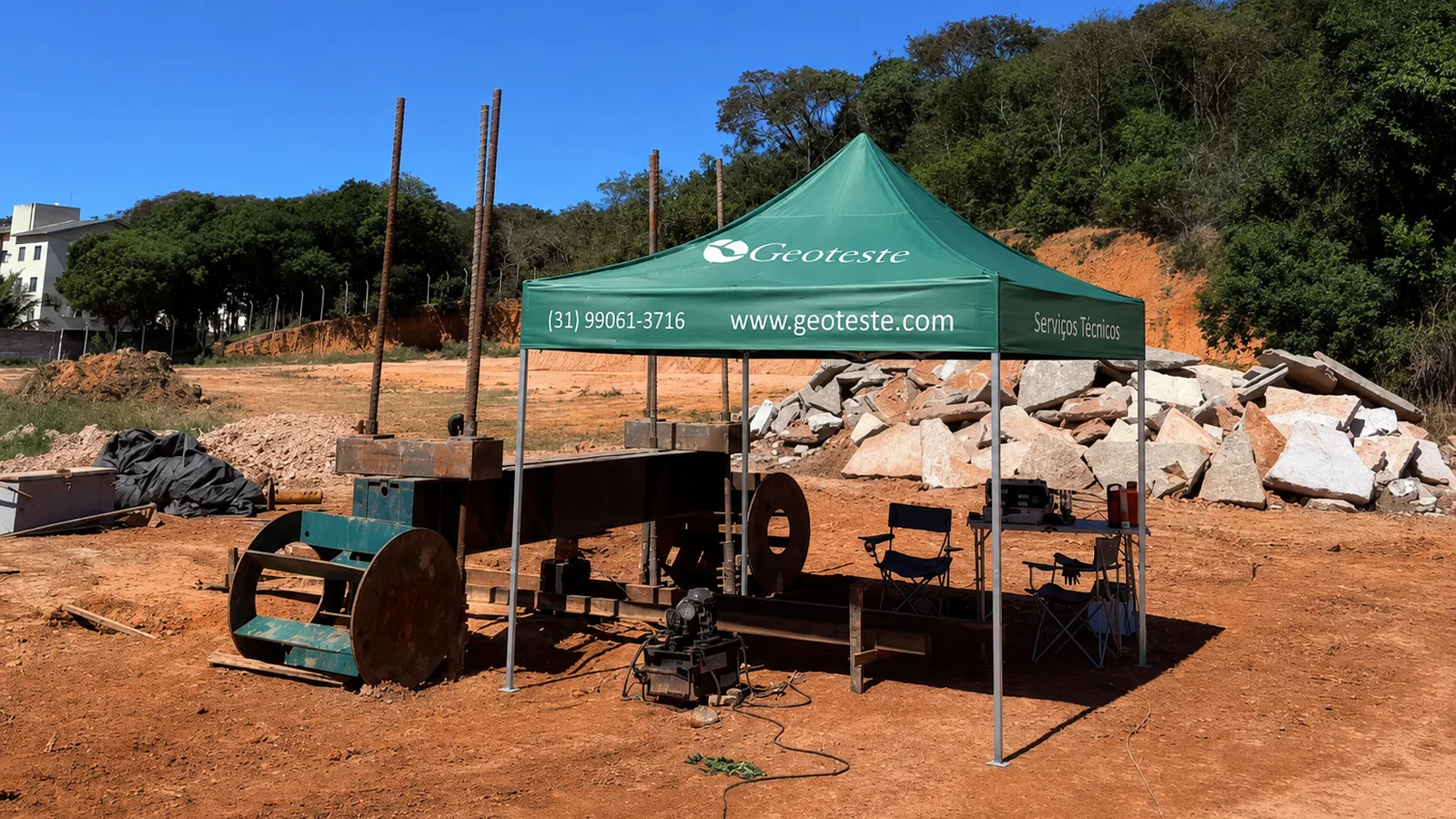
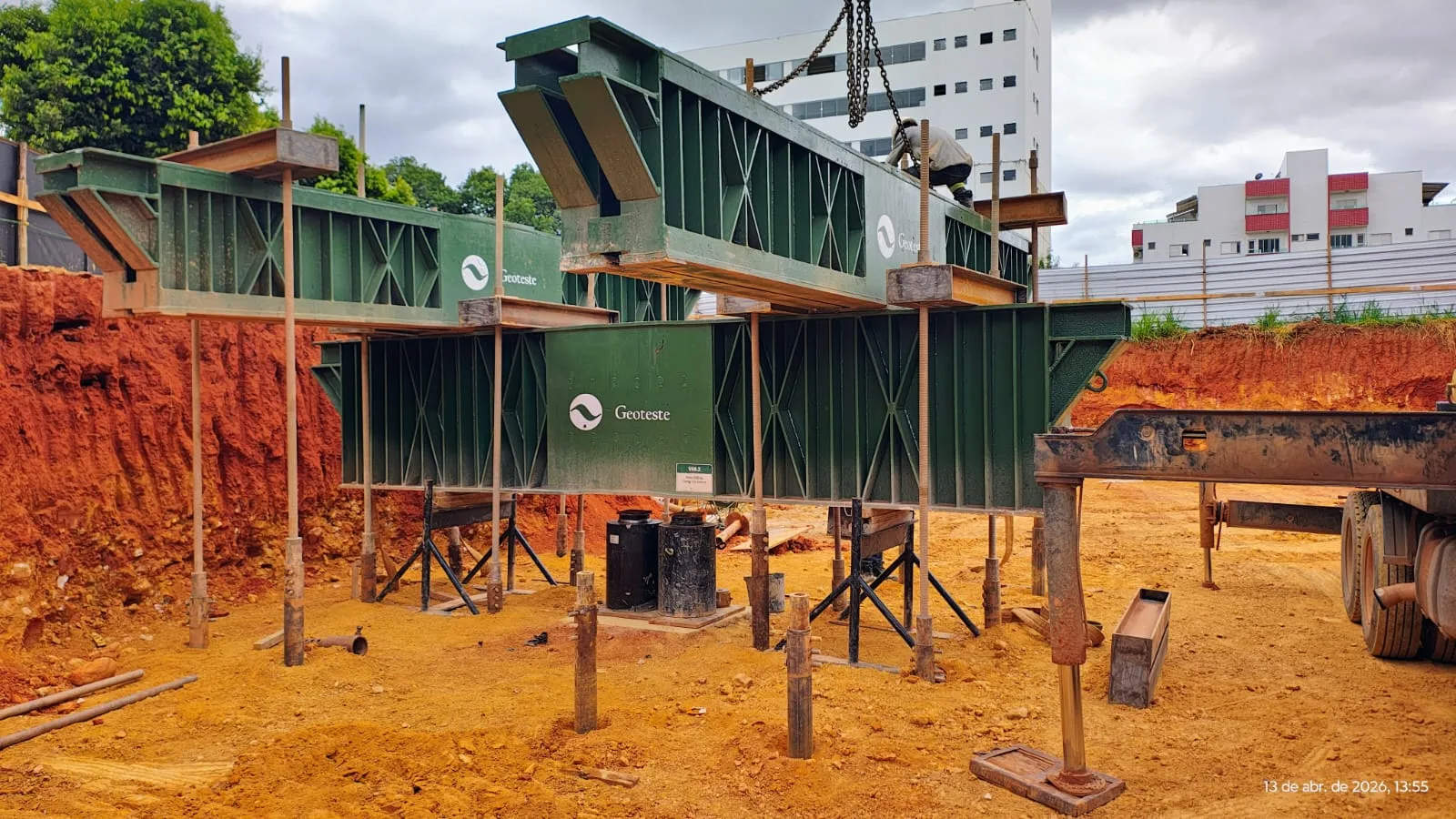
Static load testing on deep foundations represents the most direct and conclusive method for determining the load-displacement behavior of a foundation element. Regulated in Brazil regarding its execution procedure by ABNT NBR 16903:2020 and regarding design and control criteria by ABNT NBR 6122:2022, static load testing consists of the gradual application of axial or transverse forces with continuous measurement of deformations at the top and along the shaft.
Many civil construction professionals and designers question precisely when to perform pile load tests, whether due to normative obligation or as a result of a geotechnical risk management decision. The definitive answer is structured in ABNT NBR 6122:2022, which establishes the minimum performance requirements, quantity of tests, and quality control to ensure the stability of civil structures.
Normative mandatory criteria according to NBR 6122
The quality control of deep foundations should not be treated as an optional measure in medium and large-scale projects. The current version of ABNT NBR 6122 establishes that the performance of performance tests depends on a matrix of combined factors. These factors include the total number of piles in the work, the executive typology of the element, the level of compressive stress acting on the concrete, and the variability of the geotechnical mass identified in field investigations.
The mandatory nature aims to mitigate uncertainties inherent in semi-empirical methods of predicting bearing capacity. When a project reaches certain operational thresholds, experimental validation ceases to be discretionary and becomes a contractual and legal requirement for technical compliance.
Detailed analysis of Table 6 of ABNT NBR 6122:2022
The focal point for defining the necessity and volume of static tests in a work is Table 6 of ABNT NBR 6122:2022. This table quantifies the minimum number of static load tests based on the number of elements of the same typology and the working stress in the concrete.
| Pile type | Boundary criterion or working stress | Minimum number of static load tests |
|---|---|---|
| Excavated cast-in-place piles without continuous monitoring | Works with more than 75 piles of the same type and diameter | 1% of the total number of piles, with a minimum of 1 test |
| Excavated piles with continuous electronic monitoring (e.g., continuous flight auger) | Works with more than 100 piles or high average compressive stress | 1% of the total number of piles exceeding the normative limit, minimum of 1 test |
| Driven piles (prefabricated concrete, steel profiles or rails) | Works with more than 100 piles of the same typology | 1% of the total number of piles, with a minimum of 1 test |
| Piles with average working stresses higher than the limits of Table 4 of the standard | Any quantity of piles in the foundation | Execution of at least 1 prior static or performance test is mandatory |
The standard makes it clear that the counting of piles is done by identical executive typology. If a project's foundation uses two distinct solutions, such as continuous flight auger in the main block and driven piles in the perimeter retaining walls, the application of Table 6 must be done separately for each family of elements.
Influence of pile typology and stress levels
The execution method directly influences the required level of control. Driven prefabricated piles have prior structural control in the factory, but strongly depend on the dynamic response during driving and eventual temporal phenomena of the soil, such as gain in strength over time or relaxation. Excavated and cast-in-place piles present additional variables, such as borehole wall stability, base cleanliness, and concrete integrity.
When structural and geotechnical engineers decide to work with allowable compressive stresses in the shaft that approach the regulatory limits stipulated by ABNT NBR 6122, experimental verification becomes compulsory. In these concentrated loading scenarios, the tolerance for variations in end-bearing resistance or lateral friction is reduced, justifying the imposition of static tests to approve the models adopted in calculation.
Substitution by dynamic loading tests
One of the most discussed points in engineering projects concerns the possibility of replacing static load tests with dynamic loading tests, also known as PDA, governed by ABNT NBR 13208.
ABNT NBR 6122:2022 allows the substitution of static load tests with dynamic tests under specific normative conditions. In general terms, the standard admits that 1 static load test can be replaced by a set of dynamic tests, usually at a ratio of 4 or 5 dynamic loading tests for each dispensed static test, provided the following premises are respected:
- Prior validation by the foundation designer, assessing the soil-structure behavior and the homogeneity of the geotechnical profile.
- Continuous analysis of wave propagation and determination of mobilized resistance by recognized numerical procedures, such as the signal matching method.
- Guarantee that the energy of the percussion system is sufficient to mobilize the ultimate resistance of the tested element or reach the proof load stipulated in the design.
- Calibration of the dynamic model when there is an initial reference static load test at the same geotechnical site.
The static load test should not be seen as interchangeable on all occasions. While the dynamic test provides excellent evaluation of driving stresses, integrity, and static resistance estimation by signal adjustment, the static test under ABNT NBR 16903:2020 is the only one that directly and prolongedly measures static displacements, allowing verification of creep settlement phenomena and service behavior under slow loading cycles.
Optimization of safety factors with early load testing
In addition to the pure mandatory nature resulting from the number of executed elements, there is a determining strategic application for performing pile load tests in the preliminary phase of the work. ABNT NBR 6122:2022 allows for the reduction of global geotechnical safety factors or the increase of resistance reduction factors for design when the project foresees the execution of static load tests in the initial phase of the services.
By performing a static load test before the final consolidation of the project or at the beginning of the piling, the designer can calibrate the lateral friction and end-bearing curves. This empirical validation reduces the uncertainty margin of the calculation model, enabling the optimization of lengths, diameters, or total number of piles, which usually results in substantial reductions in steel and concrete consumption for the infrastructure.
How Geoteste supports the quality control of your work
Geoteste operates in all stages of deep foundation quality control, performing axial static compression, tension, and horizontal force load tests in strict accordance with ABNT NBR 16903:2020 and the design guidelines of ABNT NBR 6122:2022. We have load application systems with calibrated hydraulic sets, high-precision load cells, electronic instrumentation with linear displacement transducers, and continuous monitoring systems for stable data acquisition.
For scenarios where the foundation design includes supplementation or substitution by dynamic loading tests according to ABNT NBR 13208, our engineering team performs dynamic monitoring with real-time computational wave propagation analysis and numerical modeling for geotechnical capacity calibration. Contact our technical specialists to evaluate your project's requirements and structure the most appropriate testing plan for your undertaking's normative demands.