When is it worthwhile to use a bidirectional load test on large capacity piles?
Discover when to use bidirectional load tests on large capacity piles, evaluating logistics, reaction, and technical feasibility. Check out the analysis.

Por Rodrigo Gontijo
Engenheiro Civil Geotécnico
CREA/CONFEA 1416959840
As a civil engineer graduated from the UFMG School of Engineering, entering the freshman class of 1994, I have witnessed, over more than three decades, a profound technological evolution in foundation engineering. New equipment, more precise instrumentation systems, and advanced analysis methods have significantly expanded our ability to understand the interaction between the foundation and the soil mass, allowing us to evaluate elements subjected to increasingly higher loads with greater safety, reliability, and efficiency. The bidirectional load test is one of the most relevant examples of this transformation: by using the foundation element itself as a reaction system, this technique overcomes practical limitations of conventional tests and opens new possibilities for proving the performance of large capacity piles, barrettes, and caissons. It is in this context that the central question of this article arises: when does the adoption of the bidirectional load test actually become the most appropriate solution?
From Technological Evolution to Bidirectional Load Testing
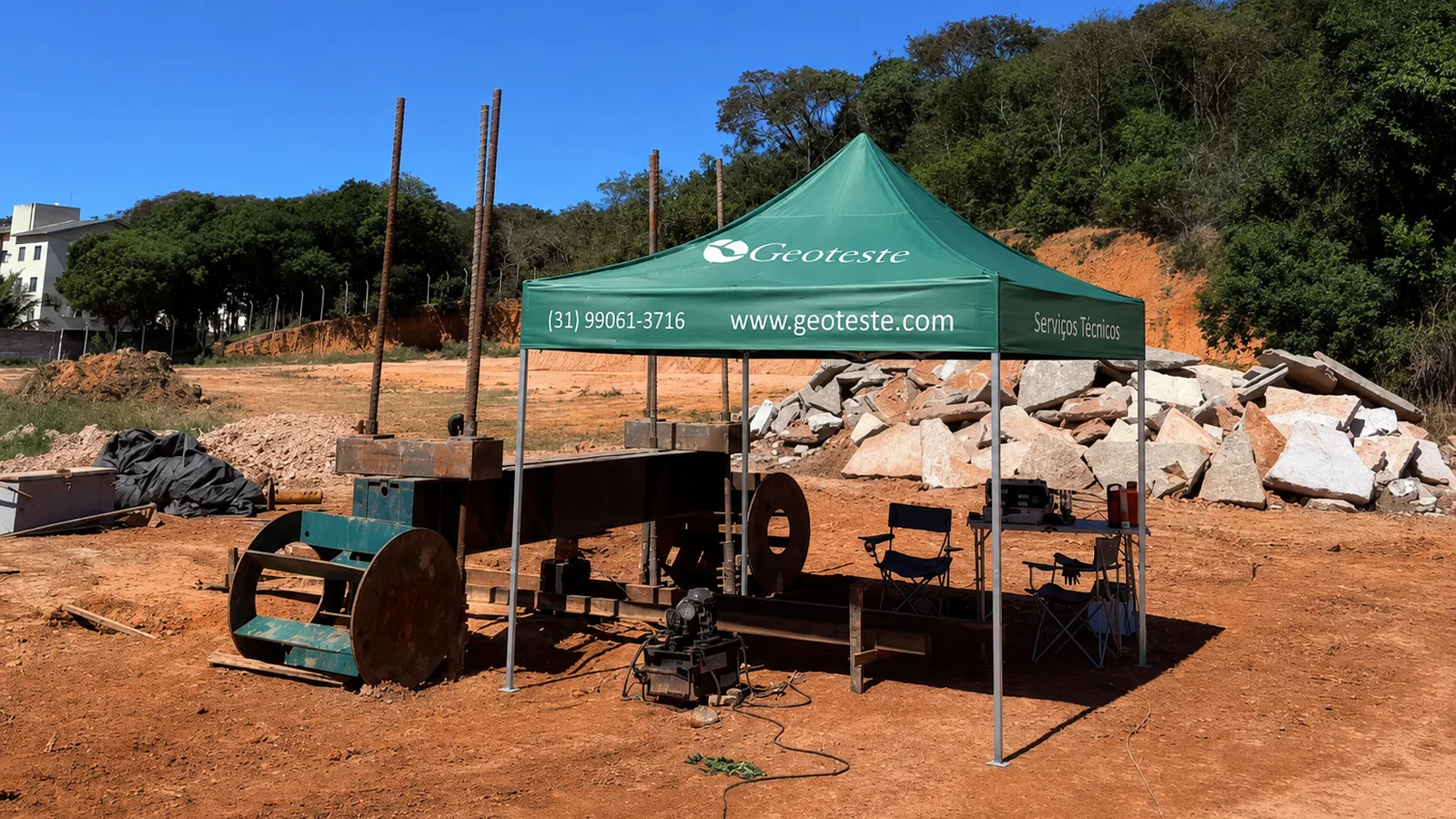
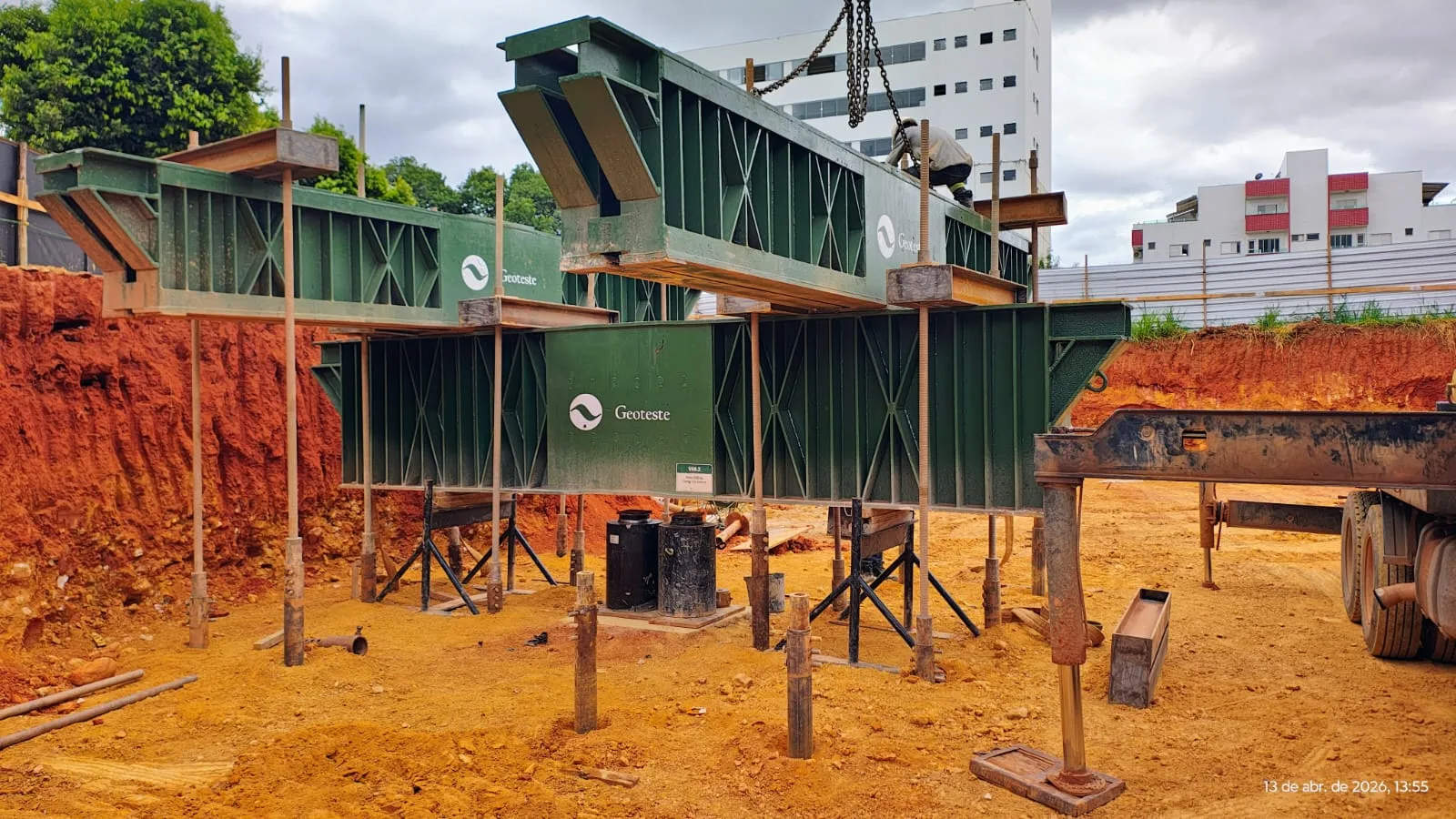
The design of deep foundations for large-scale projects, such as high-rise buildings, bridges, viaducts, and heavy industrial structures, frequently specifies isolated elements subjected to high axial loads. Projects involving large-diameter piles, barrette piles, and caissons require proof of their performance through field tests. The conventional static load test, standardized by ABNT NBR 16903:2020, represents the classic reference for determining behavior under static loading. However, when working loads exceed high levels, assembling a top reaction system becomes a significant logistical, structural, and economic challenge.
In this scenario, the central question arises: when to use a bidirectional load test? The bidirectional test employs one or more sacrificial expansive cells, installed inside the foundation shaft before concreting. This technique alters the test mechanics by transforming the foundation element itself into its reaction structure. The decision to adopt this methodology must be based on rigorous technical criteria, site constraints, and geotechnical feasibility.
The Operating Principle of the Expansive Cell
The bidirectional load test is based on applying hydraulic pressure to a disposable metallic expansive cell, strategically positioned along the pile shaft or near its toe. When pressurized by hydraulic lines connected to the surface, the cell expands and exerts equal and opposite axial forces.
The upper section of the pile is pushed upwards, mobilizing the positive side friction of the segment above the device. Simultaneously, the lower section is pushed downwards, mobilizing the toe resistance combined with the side friction of the lower segment, if any. Static equilibrium occurs within the deep foundation element. This eliminates the need for heavy steel beams, anchors in the soil mass, or concrete kentledge at ground surface.
From a normative perspective, ABNT NBR 6122:2022 allows alternative load testing methods at the discretion of the structural and geotechnical designer, provided that interpretation specificities are considered. Internationally, the test has detailed guidelines in the ASTM D8169/D8169M-26 standard practice, which establishes requirements for instrumentation, application of load stages, and monitoring of upward and downward displacements.
When It's Worth Choosing the Bidirectional Test
The choice between the conventional top-down static load test and the bidirectional method results from the analysis of operational and geotechnical factors. Below, the main scenarios where the bidirectional test offers significant advantages are highlighted.
1. Extremely High Test Loads
For piles with working loads exceeding 1000 ton-force, performing a conventional static test requires the reaction system to support up to twice this magnitude, depending on the required design factors. Constructing a reaction mass with concrete blocks or drilling and reinforcing multiple large-depth tension piles demands exorbitant costs and extended deadlines. The expansive cell solves this physical barrier, as a cell with a capacity of 1500 ton-force can mobilize up to 3000 ton-force of total soil resistance, combining the upper and lower effects.
2. Reduced Physical Space at the Construction Site
Dense urban construction sites, with neighboring buildings adjacent to property lines, often lack free space for assembling transfer beams 15 to 25 meters long, high-capacity cranes, and hundreds of tons of counterweights. The bidirectional test takes place entirely below ground level, requiring only a hydraulic pump station and displacement reading instrumentation on the surface, freeing up the site for other construction activities.
3. Projects Over Water, Bridges, and Steep Slopes
For foundations constructed in rivers, bays, maritime channels, or bridges with piers far from the banks, installing a kentledge or surface reaction anchoring system is technically unfeasible or prohibitively expensive. Caissons and drilled shafts in water bodies greatly benefit from the bidirectional technique, as the test is operated from the top of the element or a small support barge for instrumentation.
4. Operational Safety and Risk Reduction
Large reaction systems with kentledge suspended over steel profiles accumulate high potential energy. Structural stability failures of beams or settlements at the base of the kentledge during the loading cycle represent severe risks to operators. By transferring the reaction to the soil-pile interaction at depth, the bidirectional test eliminates the inherent dangers of mega-reaction structures on the surface.
Technical Comparison between Conventional and Bidirectional Testing
The table below summarizes the main operational and executive differences between the two methods for high-capacity elements:
Criterion | Conventional Load Test (NBR 16903:2020) | Bidirectional Load Test (ASTM D8169/D8169M-26) |
|---|---|---|
Reaction Structure | External: steel beams, anchors, or kentledge | Internal: upper shaft versus lower shaft and toe |
Required Surface Area | Large clear area for assembly and maneuvering | Restricted to pile head and pump station |
Practical Load Limit | Conditioned by beam and anchor resistance | High, reaching tens of thousands of kilonewtons |
Schedule Interference | Slow assembly and disassembly of external system | Prior installation in rebar cage, rapid reading |
Internal Instrumentation | Optional, focused on segment deformations | Mandatory to separate upper and lower displacements |
Curve Interpretation | Load versus settlement curve obtained directly | Reconstruction of equivalent top-down curve |
Geotechnical Criteria: Positioning the Expansive Cell
The success of the bidirectional load test intrinsically depends on the correct elevation positioning of the expansive cell along the pile length. The design objective is to achieve geotechnical equilibrium, where the pullout resistance capacity of the upper segment equals the combined resistance of downward side friction and toe resistance of the lower segment.
If the cell is positioned too close to the top, the upper shaft will fail in soil tension with significant displacements before the lower segment reaches significant levels of load mobilization. The inverse is also true: a cell placed excessively deep in soil with dominant side friction and low toe resistance can limit the mobilization of the upper shaft.
To define this elevation, the designer needs detailed geotechnical investigations, such as rock core drilling, continuous electric cone and piezocone penetration tests, and laboratory tests to determine the shear strength parameters of the soil mass. In situations with very distinct soil horizons or piles embedded in sound rock, it is feasible to use cells at multiple levels to isolate and test specific geotechnical layers independently.
Interpretation and Construction of the Equivalent Top-Down Curve
A fundamental technical aspect that differentiates the bidirectional load test from the classic top-down test is the nature of the measured data. In the conventional test, the jack pushes the pile head downwards, generating continuous compression throughout its length and measuring the total top settlement.
In the bidirectional method, two distinct curves are obtained: the load versus upward displacement curve of the upper shaft and the load versus downward displacement curve of the lower assembly. From these field-measured records, the mathematical derivation of the equivalent top-down curve is performed, a procedure that calculates how the pile would behave if the total load were applied at the head.
This reconstruction requires important analytical corrections:
Differentiated elastic shortening: in the bidirectional test, the upper shaft is tensioned during the test, while in actual top-down loading it is in compression, which alters the elastic deformation of the concrete shaft.
Residual friction and shear direction: the upward movement of the shaft reverses the direction of side friction mobilization relative to the usual downward service loading, requiring evaluation of possible effects on peak resistance.
Settlement compatibility: the displacements required to fully mobilize side friction are historically smaller than the displacements required for full mobilization of toe resistance.
Technical Limitations and Execution Precautions
Despite its notable advantages for large-diameter elements, the bidirectional test should not be viewed as a generic solution for any foundation. The tested element undergoes an internal opening at the elevation of the expansive cell. If the pile is an integral part of the final building structure, the design must provide for embedded pipes for subsequent high-pressure grout injection, filling the gap created by the jack and ensuring the structural continuity of the concrete element.
Furthermore, control of verticality and rebar alignment must be rigorous. Angular deviations in cell installation can introduce undesired eccentricities and bending moments during the test. Finally, the installation of internal reference rods, high-precision displacement transducers, and base level sensors is indispensable to separately record the relative and absolute movements of each component.
How Geoteste Supports Your Foundation Project
Performing performance tests on large capacity piles requires prior planning, highly reliable instrumentation, and compliance with the guidelines of ABNT NBR 6122:2022 and related international normative references, such as ASTM D8169/D8169M-26. Geoteste works side-by-side with designers, geotechnical consultants, and construction companies from the conception of the testing plan, providing support in determining the best load test method for each geotechnical and structural context of the project.
Our technical team has advanced technology in shaft instrumentation, static and dynamic load tests, continuous settlement monitoring, and in-depth technical processing of field data, ensuring that load capacity and deformability results are interpreted with accuracy and safety. Contact our specialists to evaluate the most efficient and safest solution for your project's foundations.